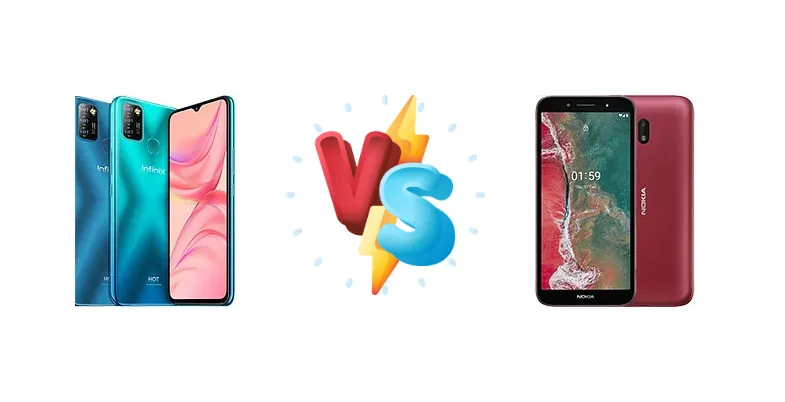
The Infinix Hot 10 Lite and Nokia C1 Plus represent the absolute bottom end of the smartphone market, targeting first-time buyers or those needing a very basic secondary device. Both aim to deliver smartphone functionality at an incredibly low price point, but they achieve this with significantly different hardware choices. This comparison will dissect those choices to determine which offers the best experience for the money.
🏆 Quick Verdict
For the average user, the Infinix Hot 10 Lite emerges as the better choice. Its Mediatek Helio A20 chipset, clocked at 1.8 GHz, provides a noticeable performance advantage over the Nokia C1 Plus’s 1.4 GHz CPU, making it more responsive for everyday tasks. While neither phone excels, the Hot 10 Lite offers a slightly smoother experience.
| Network |
|---|
| 2G bands | GSM 850 / 900 / 1800 / 1900 | GSM 850 / 900 / 1800 / 1900 |
| 3G bands | HSDPA 850 / 900 / 2100 | HSDPA 850 / 900 / 2100 - International, APAC |
| 4G bands | 1, 2, 3, 4, 5, 7, 8, 20, 28 | 1, 3, 7, 8, 20, 28 - International |
| Speed | HSPA 42.2/5.76 Mbps, LTE Cat4 150/50 Mbps | HSPA 21.1/5.76 Mbps, LTE Cat4 150/50 Mbps |
| Technology | GSM / HSPA / LTE | GSM / HSPA / LTE |
| | 3, 7, 20 | 1, 3, 8, 20, 28, 38, 40, 41 - Saudi Arabia |
| Launch |
|---|
| Announced | 2020, September 29. Released 2020, October 26 | 2020, December 15. Released 2021, January 29 |
| Status | Discontinued | Discontinued |
| Body |
|---|
| Build | - | Glass front, plastic back, plastic frame |
| Dimensions | 165.5 x 76.4 x 8.8 mm (6.52 x 3.01 x 0.35 in) | 149.1 x 71.2 x 8.8 mm (5.87 x 2.80 x 0.35 in) |
| SIM | Nano-SIM + Nano-SIM | · Nano-SIM· Nano-SIM + Nano-SIM |
| Weight | - | 146 g (5.15 oz) |
| Display |
|---|
| Resolution | 720 x 1600 pixels, 20:9 ratio (~266 ppi density) | 720 x 1440 pixels, 18:9 ratio (~295 ppi density) |
| Size | 6.6 inches, 105.2 cm2 (~83.2% screen-to-body ratio) | 5.45 inches, 76.7 cm2 (~72.2% screen-to-body ratio) |
| Type | IPS LCD | IPS LCD |
| Platform |
|---|
| CPU | Quad-core 1.8 GHz Cortex-A53 | Quad-core 1.4 GHz |
| Chipset | Mediatek MT6761D Helio A20 (12 nm) | - |
| GPU | PowerVR GE8320 | - |
| OS | Android 10 (Go edition) | Android 10 (Go edition) |
| Memory |
|---|
| Card slot | microSDXC (dedicated slot) | microSDXC (dedicated slot) |
| Internal | 32GB 2GB RAM, 64GB 3GB RAM | 16GB 1GB RAM |
| | eMMC 5.1 | eMMC 5.1 |
| Main Camera |
|---|
| Features | Triple-LED flash | LED flash, HDR |
| Single | 3.2 MP | 5 MP |
| Triple | 13 MP, (wide), AF
Auxiliary lenses | - |
| Video | 1080p@30fps | 720p@30fps |
| Selfie camera |
|---|
| Features | Dual-LED flash | LED flash, HDR |
| Single | 8 MP, (wide) | 5 MP |
| Video | 1080p@30fps | 720p@30fps |
| Sound |
|---|
| 3.5mm jack | Yes | Yes |
| 35mm jack | Yes | Yes |
| Loudspeaker | Yes | Yes |
| Comms |
|---|
| Bluetooth | 5.0, A2DP, LE | 4.2, A2DP, LE |
| NFC | No | No |
| Positioning | GPS | GPS |
| Radio | FM radio | FM radio |
| USB | microUSB 2.0, OTG | microUSB 2.0 |
| WLAN | Wi-Fi 802.11 a/b/g/n/ac, dual-band, Wi-Fi Direct | Wi-Fi 802.11 b/g/n |
| Features |
|---|
| Sensors | Fingerprint (rear-mounted), accelerometer, proximity | Accelerometer, proximity |
| Battery |
|---|
| Charging | 10W wired | - |
| Stand-by | Up to 713 h (2G) / Up to 428 h (3G) | - |
| Talk time | Up to 15 h (2G) / Up to 6 h 30 min (3G) | - |
| Type | 5000 mAh | Li-Ion 2500 mAh, removable |
| Misc |
|---|
| Colors | Black, Red, Blue, Green | Blue, Red |
| Models | X657B | TA-1312 |
| Price | About 100 EUR | About 70 EUR |
Infinix Hot 10 Lite
- Faster processor (Helio A20)
- More responsive user experience
- 10W charging (though slow, it's still a feature)
- Likely limited display quality
- Slow charging speed
Nokia C1 Plus
- Potentially cleaner software experience (Nokia's reputation)
- Brand recognition and trust
- Simple and straightforward operation
- Slower processor
- Less responsive user interface
- Potentially outdated hardware
Display Comparison
Neither device provides display specifications, but given their price point, both likely feature low-resolution LCD panels. The absence of detailed specs suggests neither prioritizes display quality. Expect basic viewing angles and limited brightness. The Nokia C1 Plus, being slightly older, may have even more limited panel technology.
Camera Comparison
Both devices are likely to feature very basic camera setups. Without specific sensor details, it’s safe to assume image quality will be limited, especially in low light. The focus here isn't on photography; it's on providing a functional camera for basic snapshots. Any claims of 'AI' enhancements should be viewed skeptically given the limited processing power.
Performance
The core difference lies in the chipset. The Infinix Hot 10 Lite’s Mediatek MT6761D Helio A20, built on a 12nm process, boasts a 1.8 GHz quad-core Cortex-A53 CPU. This is a significant step up from the Nokia C1 Plus’s unspecified quad-core CPU clocked at 1.4 GHz. The 12nm fabrication process of the Helio A20 also suggests slightly better power efficiency compared to a potentially older, larger-node CPU in the Nokia. This translates to a more fluid experience when switching between apps, though both will struggle with demanding tasks. The higher clock speed of the Helio A20 will be noticeable in app launch times and general responsiveness.
Battery Life
Battery capacity is unspecified for both devices. However, the Infinix Hot 10 Lite’s 10W wired charging suggests a relatively small battery, likely around 4000-5000mAh. The Nokia C1 Plus likely has a similar capacity. Given the low-power chipsets, both should achieve all-day battery life with moderate use, but heavy usage will require frequent charging. The 10W charging on the Infinix will result in a slow charge time, likely taking several hours to reach 100%.
Buying Guide
Buy the Infinix Hot 10 Lite if you prioritize a marginally faster and more responsive user experience, even for basic tasks like browsing and social media. It's the better option for those who occasionally use apps or want a phone that feels less sluggish. Buy the Nokia C1 Plus if brand reputation and a potentially cleaner software experience (though likely still heavily customized) are paramount, and you only need a phone for the most essential functions like calls and messaging.
Frequently Asked Questions
❓ Will the Infinix Hot 10 Lite handle popular social media apps like Facebook and WhatsApp smoothly?
The Infinix Hot 10 Lite's Helio A20 chipset should be capable of running Facebook and WhatsApp without significant issues, though multitasking with other apps open simultaneously may cause some slowdown. These apps are relatively lightweight and optimized for lower-end hardware.
❓ Is the Nokia C1 Plus a good option for someone who primarily needs a phone for making calls and sending texts?
Yes, the Nokia C1 Plus is a perfectly adequate option for basic communication. Its simpler processor and software are sufficient for making calls and sending texts, and its battery life should be sufficient for all-day use with minimal app usage.
❓ Can either of these phones play modern mobile games?
Neither the Infinix Hot 10 Lite nor the Nokia C1 Plus are suitable for playing modern, graphically demanding mobile games. While simple 2D games may be playable at low settings, expect significant lag and poor performance with titles like PUBG or Call of Duty Mobile.
❓ What version of Android do these phones run?
The Nokia C1 Plus launched with Android 9 Pie (Go Edition), while the Infinix Hot 10 Lite launched with Android 10 (Go Edition). Both utilize the 'Go Edition' of Android, a lightweight version designed for devices with limited RAM and processing power.