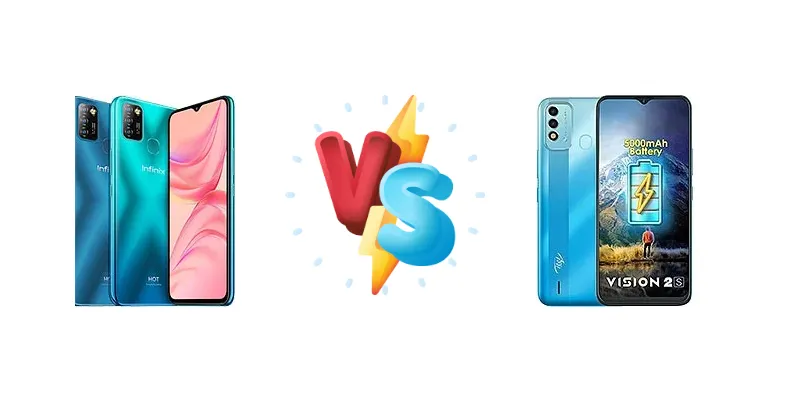
The sub-$100 smartphone market is fiercely competitive, and the Infinix Hot 10 Lite and itel Vision 2S represent two contenders vying for the attention of first-time smartphone buyers or those seeking a reliable secondary device. While both aim for affordability, they take different approaches to achieving it, particularly in chipset selection and charging capabilities. This comparison dissects those choices to determine which phone delivers the best value.
🏆 Quick Verdict
For the average user prioritizing quick top-ups and potentially smoother multitasking, the itel Vision 2S is the better choice. Its octa-core Unisoc SC9863A and 18W charging offer a tangible advantage over the Infinix Hot 10 Lite’s quad-core Helio A20 and slower 10W charging, despite the older manufacturing process.
| Network |
|---|
| 2G bands | GSM 850 / 900 / 1800 / 1900 | GSM 850 / 900 / 1800 / 1900 |
| 3G bands | HSDPA 850 / 900 / 2100 | HSDPA 850 / 900 / 2100 |
| 4G bands | 1, 2, 3, 4, 5, 7, 8, 20, 28 | LTE |
| Speed | HSPA 42.2/5.76 Mbps, LTE Cat4 150/50 Mbps | HSPA, LTE |
| Technology | GSM / HSPA / LTE | GSM / HSPA / LTE |
| | 3, 7, 20 | - |
| Launch |
|---|
| Announced | 2020, September 29. Released 2020, October 26 | 2021 |
| Status | Discontinued | Available. Released 2021 |
| Body |
|---|
| Dimensions | 165.5 x 76.4 x 8.8 mm (6.52 x 3.01 x 0.35 in) | 166 x 76.3 x 8.9 mm (6.54 x 3.00 x 0.35 in) |
| SIM | Nano-SIM + Nano-SIM | Dual SIM |
| Weight | - | - |
| Display |
|---|
| Resolution | 720 x 1600 pixels, 20:9 ratio (~266 ppi density) | 720 x 1600 pixels, 20:9 ratio (~269 ppi density) |
| Size | 6.6 inches, 105.2 cm2 (~83.2% screen-to-body ratio) | 6.52 inches, 102.6 cm2 (~81.0% screen-to-body ratio) |
| Type | IPS LCD | IPS LCD |
| Platform |
|---|
| CPU | Quad-core 1.8 GHz Cortex-A53 | Octa-core (4x1.6 GHz Cortex-A55 & 4x1.2 GHz Cortex-A55) |
| Chipset | Mediatek MT6761D Helio A20 (12 nm) | Unisoc SC9863A (28 nm) |
| GPU | PowerVR GE8320 | IMG8322 |
| OS | Android 10 (Go edition) | Android 11 (Go edition) |
| Memory |
|---|
| Card slot | microSDXC (dedicated slot) | microSDXC |
| Internal | 32GB 2GB RAM, 64GB 3GB RAM | 32GB 2GB RAM |
| | eMMC 5.1 | - |
| Main Camera |
|---|
| Dual | - | 8 MP
0.3 MP |
| Features | Triple-LED flash | LED flash |
| Single | 3.2 MP | - |
| Triple | 13 MP, (wide), AF
Auxiliary lenses | - |
| Video | 1080p@30fps | 1080p@30fps |
| Selfie camera |
|---|
| Features | Dual-LED flash | - |
| Single | 8 MP, (wide) | 5 MP |
| Video | 1080p@30fps | Yes |
| Sound |
|---|
| 3.5mm jack | Yes | - |
| 35mm jack | Yes | Yes |
| Loudspeaker | Yes | Yes |
| Comms |
|---|
| Bluetooth | 5.0, A2DP, LE | Yes |
| NFC | No | No |
| Positioning | GPS | GPS |
| Radio | FM radio | Unspecified |
| USB | microUSB 2.0, OTG | microUSB |
| WLAN | Wi-Fi 802.11 a/b/g/n/ac, dual-band, Wi-Fi Direct | Yes |
| Features |
|---|
| Sensors | Fingerprint (rear-mounted), accelerometer, proximity | Fingerprint (rear-mounted), accelerometer |
| Battery |
|---|
| Charging | 10W wired | 18W wired |
| Stand-by | Up to 713 h (2G) / Up to 428 h (3G) | - |
| Talk time | Up to 15 h (2G) / Up to 6 h 30 min (3G) | - |
| Type | 5000 mAh | 5000 mAh |
| Misc |
|---|
| Colors | Black, Red, Blue, Green | Gradation Purple, Gradation Blue, Deep Blue |
| Models | X657B | - |
| Price | About 100 EUR | - |
Infinix Hot 10 Lite
- Potentially simpler software experience due to less powerful hardware.
- Slightly more efficient chipset due to the 12nm process.
- May be more readily available in certain markets.
- Slower processor performance compared to the itel Vision 2S.
- Significantly slower charging speed (10W).
- Less capable for multitasking.
itel Vision 2S
- Faster charging (18W) for quicker top-ups.
- Octa-core processor for smoother multitasking.
- More modern CPU architecture (Cortex-A55).
- Less efficient chipset due to the 28nm process.
- May run slightly warmer under sustained load.
- Software experience could be more resource-intensive.
Display Comparison
Neither device boasts a standout display. Given the context data focuses on internals, we can infer both likely utilize basic LCD panels common in this price bracket. The absence of specifications like resolution or refresh rate suggests a focus on cost reduction. Bezels are likely substantial on both, and color accuracy will be basic. The user experience will be similar on both devices in terms of visual fidelity.
Camera Comparison
Without detailed camera specifications, a direct comparison is difficult. However, it’s safe to assume both phones feature basic camera setups geared towards casual photography. Given the price point, image quality will likely be acceptable in good lighting conditions but struggle in low light. The presence of a 2MP macro camera on either device is largely a marketing tactic, offering minimal practical benefit due to the low resolution and lack of optical image stabilization. The primary sensor’s size and aperture would be the key differentiators, but this information is unavailable.
Performance
The core difference lies in the chipsets. The Infinix Hot 10 Lite’s Mediatek Helio A20, built on a 12nm process, features a quad-core Cortex-A53 CPU clocked at 1.8 GHz. This is a relatively basic processor designed for essential smartphone functions. Conversely, the itel Vision 2S utilizes the Unisoc SC9863A, fabricated on a larger 28nm node, but compensates with an octa-core configuration – four Cortex-A55 cores at 1.6 GHz and four at 1.2 GHz. While the 28nm process is less efficient, the additional cores provide a significant advantage in multitasking and handling more demanding applications. The Cortex-A55 architecture is also more modern and efficient per core than the A53, further benefiting the itel Vision 2S. This translates to snappier app switching and a more responsive user experience.
Battery Life
Both phones likely feature batteries in the 4000-5000 mAh range, typical for this segment. However, the itel Vision 2S’s 18W wired charging is a clear advantage over the Infinix Hot 10 Lite’s 10W charging. This faster charging speed will significantly reduce the time spent tethered to a power outlet, a crucial benefit for users who rely heavily on their phones throughout the day. While a larger battery capacity on the Infinix Hot 10 Lite could partially offset this, the faster charging of the itel Vision 2S provides a more convenient user experience.
Buying Guide
Buy the Infinix Hot 10 Lite if you prioritize a potentially simpler software experience and are comfortable with slower performance for basic tasks like calls, messaging, and light social media. Buy the itel Vision 2S if you frequently find yourself needing to quickly recharge your phone, or if you anticipate running multiple apps simultaneously, even if those apps are lightweight.
Frequently Asked Questions
❓ Will the Unisoc SC9863A in the itel Vision 2S struggle with popular apps like WhatsApp and Facebook?
No, the octa-core configuration of the Unisoc SC9863A is more than capable of handling everyday apps like WhatsApp and Facebook. While it won't deliver a flagship-level experience, it will provide a smoother and more responsive experience compared to the quad-core Helio A20 in the Infinix Hot 10 Lite, especially when multitasking.
❓ How long will it take to fully charge the itel Vision 2S with the 18W charger?
While a precise 0-100% charging time requires testing, the 18W charging should bring the itel Vision 2S to a full charge in approximately 2.5 to 3.5 hours, depending on usage during charging. This is significantly faster than the Infinix Hot 10 Lite’s 10W charging, which could take upwards of 4-5 hours.
❓ Is the difference in CPU architecture (Cortex-A53 vs Cortex-A55) noticeable in everyday use?
Yes, the Cortex-A55 cores in the itel Vision 2S are more efficient and offer better performance per clock cycle than the Cortex-A53 cores in the Infinix Hot 10 Lite. This translates to slightly faster app launch times, smoother scrolling, and a more responsive overall user experience, even with basic tasks.