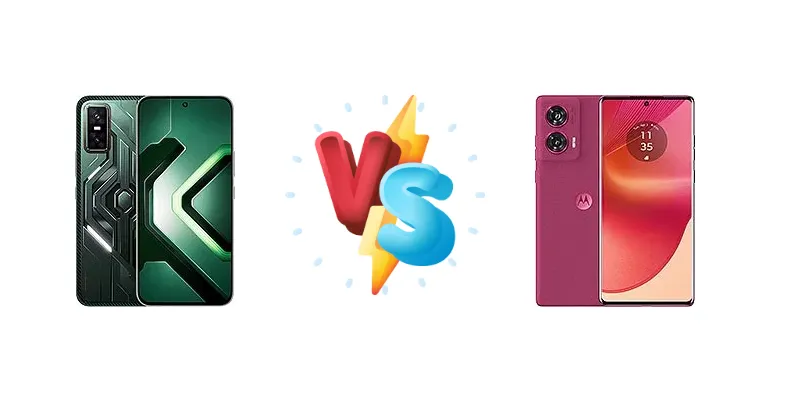
The Infinix GT 30 and Motorola Edge 50 Fusion represent compelling options in the increasingly competitive mid-range smartphone market. The GT 30 aggressively targets gamers with its Dimensity 7400 chipset, while the Edge 50 Fusion prioritizes a balanced experience with the Snapdragon 7s Gen 2 and a focus on all-day battery life. This comparison dissects their key differences to determine which device delivers the best value.
🏆 Quick Verdict
For the average user prioritizing battery life and consistent performance, the Motorola Edge 50 Fusion is the stronger choice. Its 68W charging and measured 12:40h active use battery score outweigh the GT 30’s slightly more powerful, but potentially less efficient, Dimensity 7400. However, gamers on a budget will find the GT 30’s raw processing power appealing.
| Network |
|---|
| 2G bands | GSM 850 / 900 / 1800 / 1900 | GSM 850 / 900 / 1800 / 1900 |
| 3G bands | HSDPA 850 / 900 / 2100 | HSDPA 850 / 900 / 1900 / 2100 |
| 4G bands | 1, 3, 5, 8, 28, 38, 40, 41 | 1, 2, 3, 5, 7, 8, 18, 19, 20, 26, 28, 32, 38, 40, 41, 42, 71 - International |
| 5G bands | 1, 3, 5, 8, 28, 38, 40, 41, 77, 78 SA/NSA/Sub6 | 1, 3, 5, 7, 8, 20, 26, 28, 38, 40, 41, 77, 78 SA/NSA |
| Speed | HSPA, LTE, 5G | HSPA, LTE, 5G |
| Technology | GSM / HSPA / LTE / 5G | GSM / HSPA / LTE / 5G |
| Launch |
|---|
| Announced | 2025, August 08 | 2024, April 16 |
| Status | Available. Released 2025, August 11 | Available. Released 2024, May 15 |
| Body |
|---|
| Build | Glass front (Gorilla Glass 7i), plastic frame, plastic back | Glass front, silicone polymer back (eco leather), plastic frame |
| Dimensions | 163.7 x 75.8 x 8 mm (6.44 x 2.98 x 0.31 in) | 161.9 x 73.1 x 7.9 mm (6.37 x 2.88 x 0.31 in) |
| SIM | Nano-SIM + Nano-SIM | · Nano-SIM + eSIM· Nano-SIM + Nano-SIM |
| Weight | 187 g (6.60 oz) | 174.9 g (6.17 oz) |
| Display |
|---|
| Protection | Corning Gorilla Glass 7i | Corning Gorilla Glass 5 |
| Resolution | 1224 x 2720 pixels, 20:9 ratio (~440 ppi density) | 1080 x 2400 pixels, 20:9 ratio (~393 ppi density) |
| Size | 6.78 inches, 111.0 cm2 (~89.4% screen-to-body ratio) | 6.7 inches, 108.4 cm2 (~91.6% screen-to-body ratio) |
| Type | AMOLED, 1B colors, 144Hz, 2304Hz PWM, 700 nits (typ), 1600 nits (peak), 4500 nits (peak) | P-OLED, 1B colors, 120Hz (LATAM), 144Hz (INT), 1600 nits (peak) |
| Platform |
|---|
| CPU | Octa-core (4x2.6 GHz Cortex-A78 & 4x2.0 GHz Cortex-A55) | Octa-core (4x2.40 GHz Cortex-A78 & 4x1.95 GHz Cortex-A55) - InternationalOcta-core (4x2.2 GHz Cortex-A78 & 4x1.8 GHz Cortex-A55) - LATAM |
| Chipset | Mediatek Dimensity 7400 (4 nm) | Qualcomm SM7435-AB Snapdragon 7s Gen 2 (4 nm) - InternationalQualcomm SM6450 Snapdragon 6 Gen 1 (4 nm) - LATAM |
| GPU | Mali-G615 MC2 | Adreno 710 |
| OS | Android 15, up to 2 major Android upgrades, XOS 15 | Android 14, upgradable to Android 15, up to 3 major Android upgrades |
| Memory |
|---|
| Card slot | No | No |
| Internal | 128GB 8GB RAM, 256GB 8GB RAM | 128GB 8GB RAM, 256GB 8GB RAM, 256GB 12GB RAM, 512GB 8GB RAM, 512GB 12GB RAM |
| Main Camera |
|---|
| Dual | 64 MP, f/1.8, 23mm (wide), 1/1.73", 0.8μm, PDAF
8 MP, f/2.2, 111˚, (ultrawide), AF | 50 MP, f/1.9, (wide), 1/1.56", 1.0µm, multi-directional PDAF, OIS
13 MP, f/2.2, 120˚ (ultrawide), 1/3.0", 1.12µm, AF |
| Features | Dual-LED flash, HDR, panorama | LED flash, HDR, panorama |
| Video | 4K@30fps, 1080p@30/120fps | 4K@30fps, 1080p@30/60/120fps, gyro-EIS |
| Selfie camera |
|---|
| Features | - | HDR |
| Single | 13 MP, f/2.2, 25mm (wide) | 32 MP, f/2.5, (wide), 1/3.14", 0.7µm |
| Video | 4K@30fps, 1080p@30fps | 4K@30fps, 1080p@30fps |
| Sound |
|---|
| 35mm jack | No | No |
| Loudspeaker | Yes, with stereo speakers | Yes, with stereo speakers |
| Comms |
|---|
| Bluetooth | 5.4, A2DP, LE | 5.2, A2DP, LE |
| Infrared port | Yes | - |
| NFC | Yes | Yes |
| Positioning | GPS, GLONASS, GALILEO | GPS, GLONASS, GALILEO |
| Radio | FM radio | No |
| USB | USB Type-C 2.0, OTG | USB Type-C 2.0, OTG |
| WLAN | Wi-Fi 802.11 a/b/g/n/ac/6, dual-band | Wi-Fi 802.11 a/b/g/n/ac, dual-band |
| Features |
|---|
| Sensors | Fingerprint (under display, optical), accelerometer, proximity, compass, gyro | Fingerprint (under display, optical), accelerometer, gyro, proximity, compass |
| Battery |
|---|
| Charging | 45W wired
10W reverse wired
Bypass Charging | 68W wired, 50% in 15 min |
| Type | 5500 mAh | 5000 mAh |
| Misc |
|---|
| Colors | Pulse Green, Cyber Blue, Blade White | Forest Blue, Marshmallow Blue, Hot Pink |
| Models | X6876 | XT2429-1 |
| Price | About 190 EUR | € 208.99 / $ 245.00 / ₹ 18,667 |
Infinix GT 30
- Potentially higher peak CPU performance with Dimensity 7400
- Faster charging speeds than many competitors
- Reverse wired charging for accessories
- Battery life likely shorter than Edge 50 Fusion
- Gaming performance may be limited by thermal throttling
Motorola Edge 50 Fusion
- Exceptional battery life (12:40h active use)
- Faster 68W charging with 15-minute 50% boost
- Brighter display for outdoor visibility
- Snapdragon 6 Gen 1 version (LATAM) significantly underperforms
- Lacks reverse wireless charging
Display Comparison
The Motorola Edge 50 Fusion boasts a significantly brighter display, reaching a measured 1322 nits, making it far more usable outdoors under direct sunlight. While the Infinix GT 30’s display specifications aren’t provided, the Edge 50 Fusion’s brightness advantage is substantial. The Edge 50 Fusion’s panel likely benefits from its higher peak brightness, offering better contrast and color vibrancy. We lack information on panel technology (LTPO, refresh rate) for the GT 30, but the Edge 50 Fusion’s brightness is a clear win.
Camera Comparison
Detailed camera specifications are absent for both devices, making a direct comparison difficult. However, given the market positioning, it’s reasonable to assume both phones feature a primary camera around the 50MP mark. The Edge 50 Fusion’s image processing is likely tuned for natural colors and balanced exposure, typical of Motorola’s approach. The GT 30, marketed towards a younger audience, might prioritize more vibrant, social media-ready images. Without sensor size or aperture information, it’s impossible to definitively declare a winner, but the Edge 50 Fusion’s consistent image processing is a likely advantage.
Performance
The core of the performance difference lies in the chipsets. The Infinix GT 30 utilizes the Mediatek Dimensity 7400 (4nm), featuring a Cortex-A78 prime core clocked at 2.6 GHz. The Motorola Edge 50 Fusion, in international markets, employs the Qualcomm Snapdragon 7s Gen 2 (4nm) with Cortex-A78 cores at 2.4 GHz. While the GT 30’s cores are clocked slightly higher, the Snapdragon 7s Gen 2 generally offers superior sustained performance and efficiency due to Qualcomm’s optimizations. However, the LATAM version of the Edge 50 Fusion uses the Snapdragon 6 Gen 1, a significant downgrade that would heavily favor the GT 30. Both phones utilize an octa-core configuration with similar Cortex-A55 efficiency cores, but the Snapdragon’s Adreno GPU is generally considered more capable than the Mali-G610 MC4 in the Dimensity 7400, providing a gaming advantage to the Fusion (International version).
Battery Life
The Motorola Edge 50 Fusion clearly excels in battery performance, achieving a measured 12 hours and 40 minutes of active use. The Infinix GT 30’s battery capacity is not specified, but its 45W charging is slower than the Edge 50 Fusion’s 68W charging, which can reach 50% charge in just 15 minutes. The GT 30 does offer 10W reverse wired charging, a feature absent on the Fusion, and bypass charging, allowing for charging while the phone is on. However, the Fusion’s significantly longer battery life and faster charging speeds make it the more practical choice for most users.
Buying Guide
Buy the Infinix GT 30 if you need a phone primarily for mobile gaming and appreciate faster charging speeds, even if it means slightly shorter battery life. The Dimensity 7400 offers a performance edge in demanding titles. Buy the Motorola Edge 50 Fusion if you prefer a more balanced smartphone experience with exceptional battery life, faster charging, and a brighter display for everyday use. It’s the better all-rounder for most users.
Frequently Asked Questions
❓ Does the Dimensity 7400 in the Infinix GT 30 overheat during prolonged gaming sessions?
While the Dimensity 7400 is a capable chipset, its thermal performance can be a concern under sustained load. Without specific thermal testing data, it's likely the GT 30 will experience some throttling during extended gaming, potentially impacting frame rates. The Snapdragon 7s Gen 2 in the Edge 50 Fusion (International) generally manages heat more efficiently.
❓ What is 'bypass charging' on the Infinix GT 30 and is it useful?
Bypass charging allows you to use the phone while it's charging, without significantly impacting battery health. Traditionally, using a phone while charging generates heat, which degrades the battery over time. Bypass charging directs power directly to the phone, minimizing heat buildup. This is a useful feature for gamers who want to play while charging.
❓ Is the Snapdragon 6 Gen 1 version of the Motorola Edge 50 Fusion (LATAM) a worthwhile purchase?
No. The Snapdragon 6 Gen 1 is a significantly less powerful chipset than the Snapdragon 7s Gen 2 found in the international version. The performance difference is substantial, and the LATAM version will struggle with demanding tasks and gaming. If possible, prioritize acquiring the international version of the Edge 50 Fusion.
❓ How does the 68W charging on the Motorola Edge 50 Fusion compare to typical 45W charging?
The 68W charging on the Edge 50 Fusion is considerably faster. While 45W charging is respectable, 68W can deliver a 50% charge in just 15 minutes, significantly reducing downtime. This makes the Edge 50 Fusion more convenient for users who need a quick power boost.