
Infinix GT 30 Pro vs Nothing Phone (2a) Plus: A Detailed Comparison
| Phones Images | |||||
|---|---|---|---|---|---|
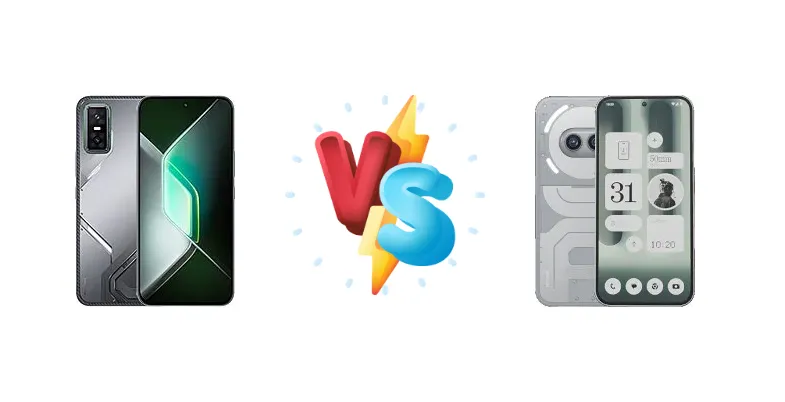
|
🏆 Quick Verdict
For users prioritizing raw gaming performance and peak display brightness, the Infinix GT 30 Pro is the clear winner. However, the Nothing Phone (2a) Plus delivers superior battery life and a more streamlined software experience, making it the better choice for everyday users who value longevity and simplicity.
| PHONES | ||
|---|---|---|
| Phone Names | Infinix GT 30 Pro | Nothing Phone (2a) Plus |
| Network | ||
|---|---|---|
| 2G bands | GSM 850 / 900 / 1800 / 1900 | GSM 850 / 900 / 1800 / 1900 |
| 3G bands | HSDPA 850 / 900 / 1700(AWS) / 1900 / 2100 | HSDPA 800 / 850 / 900 / 1700(AWS) / 1900 / 2100 |
| 4G bands | 1, 2, 3, 4, 5, 7, 8, 12, 17, 20, 28, 38, 40, 41, 42, 66 | 1, 3, 4, 5, 7, 8, 18, 19, 20, 26, 28, 38, 39, 40, 41, 42, 66 |
| 5G bands | 1, 3, 5, 7, 8, 12, 20, 28, 38, 40, 41, 66, 71, 77, 78 SA/NSA/Sub6 | 1, 3, 5, 7, 8, 20, 28, 38, 40, 41, 66, 77, 78 SA/NSA |
| Speed | HSPA, LTE, 5G | HSPA, LTE, 5G |
| Technology | GSM / HSPA / LTE / 5G | GSM / HSPA / LTE / 5G |
| Launch | ||
|---|---|---|
| Announced | 2025, May 21 | 2024, July 31 |
| Status | Available. Released 2025, June 01 | Available. Released 2024, August 03 |
| Body | ||
|---|---|---|
| Build | Glass front (Gorilla Glass 7i), plastic frame, plastic back | Glass front (Gorilla Glass 5), plastic frame, plastic back |
| Dimensions | 163.7 x 75.8 x 8 mm (6.44 x 2.98 x 0.31 in) | 161.7 x 76.3 x 8.5 mm (6.37 x 3.00 x 0.33 in) |
| SIM | Nano-SIM + Nano-SIM | Nano-SIM + Nano-SIM |
| Weight | 189 g (6.67 oz) | 190 g (6.70 oz) |
| Display | ||
|---|---|---|
| Protection | Corning Gorilla Glass 7i | Corning Gorilla Glass 5 |
| Resolution | 1224 x 2720 pixels, 20:9 ratio (~440 ppi density) | 1080 x 2412 pixels, 20:9 ratio (~395 ppi density) |
| Size | 6.78 inches, 111.0 cm2 (~89.4% screen-to-body ratio) | 6.7 inches, 107.5 cm2 (~87.1% screen-to-body ratio) |
| Type | AMOLED, 1B colors, 144Hz, 2304Hz PWM, 700 nits (typ), 1600 nits (peak), 4500 nits (peak) | AMOLED, 1B colors, 120Hz, 2160Hz PWM, HDR10+, 700 nits (typ), 1100 nits (HBM), 1300 nits (peak) |
| Platform | ||
|---|---|---|
| CPU | Octa-core (1x3.35 GHz Cortex-A715 & 3x3.20 GHz Cortex-A715 & 4x2.20 GHz Cortex-A510) | Octa-core (2x3.0 GHz Cortex-A715 & 6x 2.0 GHz Cortex-A510) |
| Chipset | Mediatek Dimensity 8350 Ultimate (4 nm) | Mediatek Dimensity 7350 Pro (4 nm) |
| GPU | Mali G615-MC6 | Mali-G610 MC4 |
| OS | Android 15, up to 2 major Android upgrades, XOS 15 | Android 14, up to 3 major Android upgrades, Nothing OS 3.0 |
| Memory | ||
|---|---|---|
| Card slot | No | No |
| Internal | 256GB 8GB RAM, 256GB 12GB RAM, 512GB 12GB RAM | 256GB 8GB RAM, 256GB 12GB RAM |
| Main Camera | ||
|---|---|---|
| Dual | 108 MP, f/1.9, (wide), 1/1.33", 0.8µm, PDAF 8 MP, f/2.2, 111˚ (ultrawide), 1/4.0", 1.0µm, AF | 50 MP, f/1.9, 24mm (wide), 1/1.57", 1.0µm, PDAF, OIS 50 MP, f/2.2, 114˚ (ultrawide), 1/2.76", 0.64µm |
| Features | Dual-LED flash, HDR, panorama | LED flash, panorama, HDR |
| Video | 4K@30/60fps, 1080p@30/60/120/240fps | 4K@30fps, 1080p@60/120fps, gyro-EIS |
| Selfie camera | ||
|---|---|---|
| Features | - | HDR |
| Single | 13 MP, f/2.2, (wide), 1/3.1", 1.12µm | 50 MP, f/2.2, (wide), 1/2.76" |
| Video | 4K@30fps, 1080p@30fps | 4K@30fps |
| Sound | ||
|---|---|---|
| 35mm jack | No | No |
| Loudspeaker | Yes, with stereo speakers | Yes, with stereo speakers |
| Comms | ||
|---|---|---|
| Bluetooth | 5.4, A2DP, LE | 5.3, A2DP, LE |
| Infrared port | Yes | - |
| NFC | Yes | Yes, 360˚ |
| Positioning | GPS, GLONASS, GALILEO | GPS, GALILEO, GLONASS, BDS, QZSS |
| Radio | FM radio | No |
| USB | USB Type-C 2.0, OTG | USB Type-C 2.0, OTG |
| WLAN | Wi-Fi 802.11 a/b/g/n/ac/6, dual-band, Wi-Fi Direct | Wi-Fi 802.11 a/b/g/n/ac/6, dual-band, Wi-Fi Direct |
| Features | ||
|---|---|---|
| Sensors | Fingerprint (under display, optical), accelerometer, proximity, compass, gyro | Fingerprint (under display, optical), accelerometer, gyro, proximity, compass |
| Battery | ||
|---|---|---|
| Charging | 45W wired 30W wireless 10W reverse wired 5W reverse wireless Bypass Charging 2 | 50W wired, 50% in 21 min, 100% in 56 min |
| Type | 5200 mAh or 5500 mAh | 5000 mAh |
| Misc | ||
|---|---|---|
| Colors | Dark Flare, Blade White, Shadow Ash | Black, Grey |
| Models | X6873 | A142P |
| Price | ₹ 24,994 | € 269.90 / ₹ 22,599 |
Infinix GT 30 Pro
- Superior gaming performance with Dimensity 8350 Ultimate
- Significantly brighter display for outdoor use
- Faster wired and wireless charging options
- Shorter battery life compared to the Nothing Phone (2a) Plus
- Potentially more aggressive thermal throttling under sustained load
Nothing Phone (2a) Plus
- Excellent battery life for all-day use
- Faster wired charging speed (50W)
- Clean and intuitive software experience
- Lower peak display brightness
- Less powerful chipset for demanding games
Display Comparison
The Infinix GT 30 Pro boasts a significantly brighter display, reaching a measured 1897 nits, compared to the Nothing Phone (2a) Plus’s 1097 nits. This difference translates to superior visibility under direct sunlight. While both utilize 4nm chipsets, the GT 30 Pro’s display demands more power. Neither specification details refresh rate or panel type, but the GT 30 Pro’s brightness advantage is a clear win for outdoor users and HDR content consumption. The Nothing Phone (2a) Plus’s lower brightness isn’t necessarily a drawback for indoor use, but it lacks the headroom of the GT 30 Pro.
Camera Comparison
Without detailed camera specifications, a direct comparison is limited. However, the market positioning suggests the Infinix GT 30 Pro may prioritize camera features to appeal to a wider audience. The Nothing Phone (2a) Plus, with its focus on simplicity, likely offers a more streamlined camera experience. The absence of information regarding sensor size and OIS makes it difficult to assess image quality, but the GT 30 Pro’s branding suggests a more feature-rich camera system. We can assume both phones will include standard features like portrait mode and night mode, but the GT 30 Pro may offer more advanced options.
Performance
The Infinix GT 30 Pro’s Mediatek Dimensity 8350 Ultimate chipset, with its 1x3.35 GHz Cortex-A715 core and 3x3.20 GHz Cortex-A715 cores, offers a substantial performance advantage over the Nothing Phone (2a) Plus’s Dimensity 7350 Pro (2x3.0 GHz Cortex-A715 & 6x 2.0 GHz Cortex-A510). The GT 30 Pro’s core configuration suggests better multi-core performance, crucial for demanding tasks and gaming. While both are built on a 4nm process, the 8350 Ultimate is a higher-tier chip. The Nothing Phone (2a) Plus prioritizes efficiency with its core configuration, likely contributing to its longer battery life, but at the cost of peak performance.
Battery Life
The Nothing Phone (2a) Plus demonstrably outperforms the Infinix GT 30 Pro in battery life, achieving an active use score of 16:34h versus the GT 30 Pro’s 13:24h. This difference is likely attributable to the Dimensity 7350 Pro’s efficiency and potentially a larger battery capacity (not specified). While the GT 30 Pro offers both 45W wired and 30W wireless charging, along with reverse charging capabilities, the Nothing Phone (2a) Plus’s 50W wired charging (0-100% in 56 minutes) provides a faster overall charging experience. The GT 30 Pro’s bypass charging feature, allowing charging while gaming, is a niche benefit for hardcore gamers.
Buying Guide
Buy the Infinix GT 30 Pro if you need a phone capable of handling demanding games at high settings, appreciate a brighter display for outdoor visibility, and value faster wired and wireless charging. Buy the Nothing Phone (2a) Plus if you prefer a phone that lasts all day on a single charge, offers a clean and intuitive software experience, and prioritizes a balanced feature set over outright performance.