
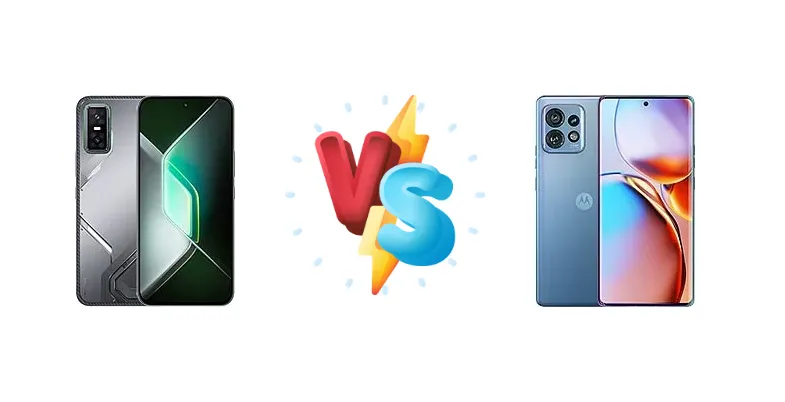
Infinix GT 30 Pro vs Motorola Edge 40 Pro: A Deep Dive into Performance and Value
| Phones Images | |||||
|---|---|---|---|---|---|
|
🏆 Quick Verdict
For the average user prioritizing a balanced experience, the Motorola Edge 40 Pro emerges as the winner. Its Snapdragon 8 Gen 2 offers superior thermal management and all-around efficiency, coupled with faster charging. However, gamers on a budget will find the Infinix GT 30 Pro’s Dimensity 8350 Ultimate a compelling alternative.
| PHONES | ||
|---|---|---|
| Phone Names | Infinix GT 30 Pro | Motorola Edge 40 Pro |
| Network | ||
|---|---|---|
| 2G bands | GSM 850 / 900 / 1800 / 1900 | GSM 850 / 900 / 1800 / 1900 |
| 3G bands | HSDPA 850 / 900 / 1700(AWS) / 1900 / 2100 | HSDPA 850 / 900 / 1700(AWS) / 1900 / 2100 |
| 4G bands | 1, 2, 3, 4, 5, 7, 8, 12, 17, 20, 28, 38, 40, 41, 42, 66 | 1, 2, 3, 4, 5, 7, 8, 12, 13, 17, 18, 19, 20, 25, 26, 28, 32, 38, 39, 40, 41, 42, 43, 48, 66 |
| 5G bands | 1, 3, 5, 7, 8, 12, 20, 28, 38, 40, 41, 66, 71, 77, 78 SA/NSA/Sub6 | 1, 2, 3, 5, 7, 8, 20, 28, 38, 40, 41, 66, 77, 78 SA/NSA/Sub6 |
| Speed | HSPA, LTE, 5G | HSPA, LTE, 5G |
| Technology | GSM / HSPA / LTE / 5G | GSM / HSPA / LTE / 5G |
| Launch | ||
|---|---|---|
| Announced | 2025, May 21 | 2023, April 04 |
| Status | Available. Released 2025, June 01 | Available. Released 2023, April 04 |
| Body | ||
|---|---|---|
| Build | Glass front (Gorilla Glass 7i), plastic frame, plastic back | Glass front (Gorilla Glass Victus), glass back (Gorilla Glass Victus), aluminum frame |
| Dimensions | 163.7 x 75.8 x 8 mm (6.44 x 2.98 x 0.31 in) | 161.2 x 74 x 8.6 mm (6.35 x 2.91 x 0.34 in) |
| SIM | Nano-SIM + Nano-SIM | Nano-SIM + eSIM |
| Weight | 189 g (6.67 oz) | 199 g (7.02 oz) |
| - | IP68 dust/water resistant (up to 1.5m for 30 min) | |
| Display | ||
|---|---|---|
| Protection | Corning Gorilla Glass 7i | Corning Gorilla Glass Victus |
| Resolution | 1224 x 2720 pixels, 20:9 ratio (~440 ppi density) | 1080 x 2400 pixels, 20:9 ratio (~394 ppi density) |
| Size | 6.78 inches, 111.0 cm2 (~89.4% screen-to-body ratio) | 6.67 inches, 108.0 cm2 (~90.5% screen-to-body ratio) |
| Type | AMOLED, 1B colors, 144Hz, 2304Hz PWM, 700 nits (typ), 1600 nits (peak), 4500 nits (peak) | OLED, 1B colors, 165Hz, HDR10+, Dolby Vision, 1300 nits (peak) |
| Platform | ||
|---|---|---|
| CPU | Octa-core (1x3.35 GHz Cortex-A715 & 3x3.20 GHz Cortex-A715 & 4x2.20 GHz Cortex-A510) | Octa-core (1x3.2 GHz Cortex-X3 & 2x2.8 GHz Cortex-A715 & 2x2.8 GHz Cortex-A710 & 3x2.0 GHz Cortex-A510) |
| Chipset | Mediatek Dimensity 8350 Ultimate (4 nm) | Qualcomm SM8550-AB Snapdragon 8 Gen 2 (4 nm) |
| GPU | Mali G615-MC6 | Adreno 740 |
| OS | Android 15, up to 2 major Android upgrades, XOS 15 | Android 13, up to 3 major Android upgrades |
| Memory | ||
|---|---|---|
| Card slot | No | No |
| Internal | 256GB 8GB RAM, 256GB 12GB RAM, 512GB 12GB RAM | 256GB 12GB RAM, 512GB 12GB RAM |
| - | UFS 4.0 | |
| Main Camera | ||
|---|---|---|
| Dual | 108 MP, f/1.9, (wide), 1/1.33", 0.8µm, PDAF 8 MP, f/2.2, 111˚ (ultrawide), 1/4.0", 1.0µm, AF | - |
| Features | Dual-LED flash, HDR, panorama | Dual-LED flash, panorama, HDR |
| Triple | - | 50 MP, f/1.8, (wide), 1/1.55", 1.0µm, multi-directional PDAF, OIS 12 MP, f/1.6, (telephoto), 1/2.93", 1.22µm, PDAF, 2x optical zoom 50 MP, f/2.2, 114˚ (ultrawide), 1/2.76", 0.64µm, AF |
| Video | 4K@30/60fps, 1080p@30/60/120/240fps | 8K@30fps, 4K@30/60fps, 1080p@30/60/120/240/960fps, 10-bit HDR10+, gyro-EIS |
| Selfie camera | ||
|---|---|---|
| Features | - | HDR |
| Single | 13 MP, f/2.2, (wide), 1/3.1", 1.12µm | 60 MP, f/2.2, (wide), 1/2.8", 0.61µm |
| Video | 4K@30fps, 1080p@30fps | 4K@30/60fps, 1080p@30/60fps |
| Sound | ||
|---|---|---|
| 3.5mm jack | - | No |
| 35mm jack | No | No |
| Loudspeaker | Yes, with stereo speakers | Yes, with stereo speakers |
| Comms | ||
|---|---|---|
| Bluetooth | 5.4, A2DP, LE | 5.3, A2DP, LE |
| Infrared port | Yes | - |
| NFC | Yes | Yes |
| Positioning | GPS, GLONASS, GALILEO | GPS, GLONASS, GALILEO, BDS |
| Radio | FM radio | No |
| USB | USB Type-C 2.0, OTG | USB Type-C 3.2, OTG, DisplayPort 1.4 |
| WLAN | Wi-Fi 802.11 a/b/g/n/ac/6, dual-band, Wi-Fi Direct | Wi-Fi 802.11 a/b/g/n/ac/6e/7, tri-band, Wi-Fi Direct |
| Features | ||
|---|---|---|
| Sensors | Fingerprint (under display, optical), accelerometer, proximity, compass, gyro | Fingerprint (under display, optical), accelerometer, gyro, proximity, compass |
| - | Ready For 3.5 support | |
| Battery | ||
|---|---|---|
| Charging | 45W wired 30W wireless 10W reverse wired 5W reverse wireless Bypass Charging 2 | 125W wired, PD3.0, QC5, 50% in 6 min, 100% in 23 min 15W wireless 5W reverse wired 5W reverse wireless |
| Type | 5200 mAh or 5500 mAh | Li-Po 4600 mAh |
| Misc | ||
|---|---|---|
| Colors | Dark Flare, Blade White, Shadow Ash | Interstellar Black, Lunar Blue |
| Models | X6873 | - |
| Price | ₹ 24,994 | € 313.87 |
| Tests | ||
|---|---|---|
| Battery life | - | Endurance rating 117h |
| Camera | - | Photo / Video |
| Display | - | Contrast ratio: Infinite (nominal) |
| Loudspeaker | - | -22.6 LUFS (Excellent) |
| Performance | - | AnTuTu: 1273764 (v9) GeekBench: 4896 (v5.1), 5352 (v6) GFXBench: 112fps (ES 3.1 onscreen) |
Infinix GT 30 Pro
- Significantly brighter display for outdoor visibility
- Faster wireless charging (30W)
- Potentially more affordable price point
- Less efficient chipset (Dimensity 8350 Ultimate)
- Slower wired charging (45W)
Motorola Edge 40 Pro
- More powerful and efficient chipset (Snapdragon 8 Gen 2)
- Much faster wired charging (125W)
- Potentially better camera performance
- Lower peak display brightness
- Higher price point
Display Comparison
The Infinix GT 30 Pro boasts a significantly brighter display, reaching a measured 1897 nits, compared to the Motorola Edge 40 Pro’s 1050 nits. This translates to superior visibility in direct sunlight. While both displays feature an infinite (nominal) contrast ratio, the GT 30 Pro’s higher peak brightness is a clear advantage for outdoor use. Details regarding panel technology (LTPO vs standard OLED) are missing, but the GT 30 Pro’s brightness suggests a more advanced panel. Bezels appear comparable based on available imagery, and color accuracy is not specified for either device, requiring further testing.
Camera Comparison
Both devices are listed as having Photo/Video capabilities, but detailed camera specifications are absent. Without sensor size, aperture, or OIS information, a direct comparison is difficult. The presence of a 2MP macro camera on either device is unlikely to significantly impact image quality. The Motorola Edge 40 Pro, given its flagship positioning, likely features a more sophisticated image processing pipeline and potentially larger sensors for improved low-light performance. The GT 30 Pro may prioritize computational photography to compensate for potentially smaller sensors.
Performance
The Motorola Edge 40 Pro’s Snapdragon 8 Gen 2 (4nm) is architecturally superior to the Infinix GT 30 Pro’s Mediatek Dimensity 8350 Ultimate (4nm). The Snapdragon 8 Gen 2 utilizes a Cortex-X3 prime core for peak performance, alongside Cortex-A715 and A710 cores, while the Dimensity 8350 Ultimate relies on a combination of Cortex-A715 and A510 cores. While both are 4nm chips, the Snapdragon 8 Gen 2 generally exhibits better sustained performance due to its more efficient design and superior thermal management. The Edge 40 Pro’s CPU configuration (1x3.2 GHz Cortex-X3, 2x2.8 GHz Cortex-A715, 2x2.8 GHz Cortex-A710, 3x2.0 GHz Cortex-A510) is optimized for both single-core and multi-core tasks, while the GT 30 Pro’s (1x3.35 GHz Cortex-A715, 3x3.20 GHz Cortex-A715, 4x2.20 GHz Cortex-A510) leans more heavily on the A715 cores. RAM speed is not specified, but both likely utilize LPDDR5x for fast memory access.
Battery Life
The Motorola Edge 40 Pro boasts a significantly faster charging speed at 125W wired, achieving 50% charge in 6 minutes and 100% in 23 minutes, compared to the Infinix GT 30 Pro’s 45W wired charging. The Edge 40 Pro also supports PD3.0 and QC5, offering broader compatibility. While the Edge 40 Pro’s battery capacity isn’t specified, its endurance rating of 117h suggests efficient power management. The GT 30 Pro offers 30W wireless and 10W reverse wired/5W reverse wireless charging, while the Edge 40 Pro provides 15W wireless and 5W reverse wireless. The GT 30 Pro’s active use battery score of 13:24h indicates good, but not exceptional, battery life. The Edge 40 Pro’s faster charging mitigates concerns about potential battery capacity differences.
Buying Guide
Buy the Infinix GT 30 Pro if you need maximum gaming performance for your dollar and prioritize fast wireless charging. Its Dimensity 8350 Ultimate delivers impressive power, and the 30W wireless charging is a standout feature. Buy the Motorola Edge 40 Pro if you prefer a more polished, refined experience with a focus on efficiency, faster wired charging, and a potentially more stable software experience.