
Infinix GT 30 Pro vs Google Pixel 7a: A Detailed Comparison
| Phones Images | |||||
|---|---|---|---|---|---|
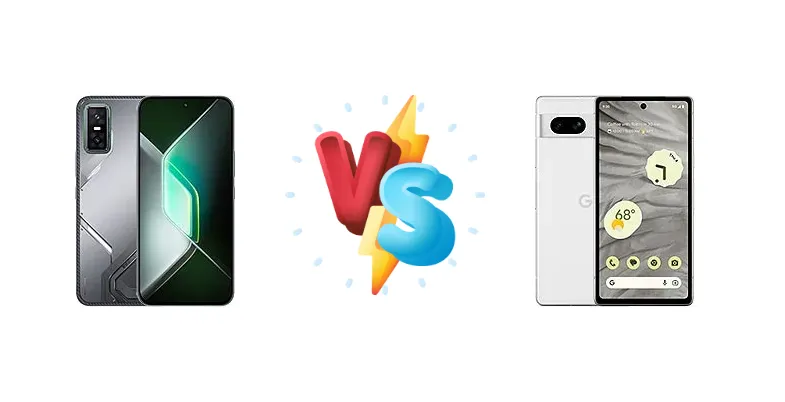
|
🏆 Quick Verdict
For the average user prioritizing camera quality and a polished software experience, the Google Pixel 7a is the better choice. However, gamers and power users who demand raw performance and rapid charging will find the Infinix GT 30 Pro a more compelling option.
| PHONES | ||
|---|---|---|
| Phone Names | Infinix GT 30 Pro | Google Pixel 7a |
| Network | ||
|---|---|---|
| 2G bands | GSM 850 / 900 / 1800 / 1900 | GSM 850 / 900 / 1800 / 1900 |
| 3G bands | HSDPA 850 / 900 / 1700(AWS) / 1900 / 2100 | HSDPA 800 / 850 / 900 / 1700(AWS) / 1900 / 2100 |
| 4G bands | 1, 2, 3, 4, 5, 7, 8, 12, 17, 20, 28, 38, 40, 41, 42, 66 | 1, 2, 3, 4, 5, 7, 8, 12, 13, 14, 17, 20, 25, 26, 28, 29, 30, 38, 40, 41, 48, 66, 71 - GWKK3, G0DZQ |
| 5G bands | 1, 3, 5, 7, 8, 12, 20, 28, 38, 40, 41, 66, 71, 77, 78 SA/NSA/Sub6 | 1, 2, 3, 5, 7, 8, 12, 14, 20, 25, 28, 30, 38, 41, 48, 66, 71, 77, 78 SA/NSA/Sub6 - GWKK3 |
| Speed | HSPA, LTE, 5G | HSPA, LTE, 5G |
| Technology | GSM / HSPA / LTE / 5G | GSM / HSPA / LTE / 5G |
| - | 1, 2, 3, 5, 7, 8, 12, 20, 25, 28, 38, 40, 41, 66, 75, 76, 77, 78, 79 SA/NSA/Sub6 - GHL1X, G82U8 | |
| Launch | ||
|---|---|---|
| Announced | 2025, May 21 | 2023, May 10 |
| Status | Available. Released 2025, June 01 | Available. Released 2023, May 10 |
| Body | ||
|---|---|---|
| Build | Glass front (Gorilla Glass 7i), plastic frame, plastic back | Glass front (Gorilla Glass 3), aluminum frame, plastic back |
| Dimensions | 163.7 x 75.8 x 8 mm (6.44 x 2.98 x 0.31 in) | 152 x 72.9 x 9 mm (5.98 x 2.87 x 0.35 in) |
| SIM | Nano-SIM + Nano-SIM | Nano-SIM + eSIM |
| Weight | 189 g (6.67 oz) | 193.5 g (6.84 oz) |
| - | IP67 dust/water resistant (up to 1m for 30 min) | |
| Display | ||
|---|---|---|
| Protection | Corning Gorilla Glass 7i | Corning Gorilla Glass 3 |
| Resolution | 1224 x 2720 pixels, 20:9 ratio (~440 ppi density) | 1080 x 2400 pixels, 20:9 ratio (~429 ppi density) |
| Size | 6.78 inches, 111.0 cm2 (~89.4% screen-to-body ratio) | 6.1 inches, 90.7 cm2 (~81.8% screen-to-body ratio) |
| Type | AMOLED, 1B colors, 144Hz, 2304Hz PWM, 700 nits (typ), 1600 nits (peak), 4500 nits (peak) | OLED, HDR, 90Hz |
| - | Always-on display | |
| Platform | ||
|---|---|---|
| CPU | Octa-core (1x3.35 GHz Cortex-A715 & 3x3.20 GHz Cortex-A715 & 4x2.20 GHz Cortex-A510) | Octa-core (2x2.85 GHz Cortex-X1 & 2x2.35 GHz Cortex-A78 & 4x1.80 GHz Cortex-A55) |
| Chipset | Mediatek Dimensity 8350 Ultimate (4 nm) | Google Tensor G2 (5 nm) |
| GPU | Mali G615-MC6 | Mali-G710 MP7 |
| OS | Android 15, up to 2 major Android upgrades, XOS 15 | Android 13, upgradable to Android 15, up to 5 major Android upgrades |
| Memory | ||
|---|---|---|
| Card slot | No | No |
| Internal | 256GB 8GB RAM, 256GB 12GB RAM, 512GB 12GB RAM | 128GB 8GB RAM |
| - | UFS 3.1 | |
| Main Camera | ||
|---|---|---|
| Dual | 108 MP, f/1.9, (wide), 1/1.33", 0.8µm, PDAF 8 MP, f/2.2, 111˚ (ultrawide), 1/4.0", 1.0µm, AF | 64 MP, f/1.9, 26mm (wide), 1/1.73", 0.8µm, dual pixel PDAF, OIS 13 MP, f/2.2, 120˚ (ultrawide), 1.12µm |
| Features | Dual-LED flash, HDR, panorama | Dual-LED flash, Pixel Shift, Auto-HDR, panorama |
| Video | 4K@30/60fps, 1080p@30/60/120/240fps | 4K@30/60fps, 1080p@30/60/120/240fps, OIS |
| Selfie camera | ||
|---|---|---|
| Features | - | HDR, panorama |
| Single | 13 MP, f/2.2, (wide), 1/3.1", 1.12µm | 13 MP, f/2.2, 20mm (ultrawide), 1.12µm |
| Video | 4K@30fps, 1080p@30fps | 4K@30fps, 1080p@30fps |
| Sound | ||
|---|---|---|
| 3.5mm jack | - | No |
| 35mm jack | No | No |
| Loudspeaker | Yes, with stereo speakers | Yes, with stereo speakers |
| Comms | ||
|---|---|---|
| Bluetooth | 5.4, A2DP, LE | 5.3, A2DP, LE |
| Infrared port | Yes | - |
| NFC | Yes | Yes |
| Positioning | GPS, GLONASS, GALILEO | GPS, GLONASS, GALILEO, BDS, QZSS, NavIC |
| Radio | FM radio | No |
| USB | USB Type-C 2.0, OTG | USB Type-C 3.2 |
| WLAN | Wi-Fi 802.11 a/b/g/n/ac/6, dual-band, Wi-Fi Direct | Wi-Fi 802.11 a/b/g/n/ac/6e, tri-band |
| Features | ||
|---|---|---|
| Sensors | Fingerprint (under display, optical), accelerometer, proximity, compass, gyro | Fingerprint (under display, optical), accelerometer, gyro, proximity, compass, barometer |
| Battery | ||
|---|---|---|
| Charging | 45W wired 30W wireless 10W reverse wired 5W reverse wireless Bypass Charging 2 | 18W wired, PD3.0 7.5W wireless |
| Type | 5200 mAh or 5500 mAh | Li-Po 4385 mAh |
| Misc | ||
|---|---|---|
| Colors | Dark Flare, Blade White, Shadow Ash | Charcoal, Snow, Sea, Coral |
| Models | X6873 | GWKK3, GHL1X, G0DZQ, G82U8 |
| Price | ₹ 24,994 | € 179.90 / $ 150.00 / £ 170.00 / ₹ 25,980 |
Infinix GT 30 Pro
- Significantly faster charging speeds (45W wired, 30W wireless)
- More powerful chipset (Dimensity 8350 Ultimate) for gaming
- Brighter display for outdoor visibility
- Camera performance likely inferior to Pixel 7a
- Software experience may not be as refined as Pixel 7a
Google Pixel 7a
- Exceptional camera quality and image processing
- Clean and optimized Android software experience
- Compact and comfortable form factor
- Slower charging speeds (18W wired, 7.5W wireless)
- Less powerful chipset for demanding tasks
Display Comparison
The Infinix GT 30 Pro boasts a significantly brighter display, reaching a measured 1897 nits, compared to the Pixel 7a’s 1070 nits. This translates to superior visibility in direct sunlight. While both likely utilize AMOLED panels, the GT 30 Pro’s higher peak brightness is a clear advantage for outdoor use. The Pixel 7a’s display, while dimmer, benefits from Google’s color calibration expertise, likely offering more accurate colors out of the box. Details regarding refresh rate and PWM dimming are missing for the GT 30 Pro, but these are crucial for minimizing eye strain, especially for extended gaming sessions.
Camera Comparison
The Pixel 7a’s strength lies in its computational photography prowess, leveraging Google’s Tensor G2 chip for advanced image processing. While specific sensor details are missing for both, the Pixel 7a’s reputation suggests a focus on dynamic range and detail in challenging lighting conditions. The GT 30 Pro’s camera system is less well-defined in the provided data, making a direct sensor comparison impossible. However, the Pixel 7a’s consistent image quality and video stabilization are likely to outperform the GT 30 Pro in most scenarios. The absence of details regarding OIS on the GT 30 Pro is a concern for video recording.
Performance
The chipset is where these phones diverge significantly. The Infinix GT 30 Pro’s Mediatek Dimensity 8350 Ultimate (4nm) is built for performance, featuring a tri-cluster configuration with a high-clocked Cortex-A715 core at 3.35 GHz. This contrasts with the Google Pixel 7a’s Google Tensor G2 (5nm), which prioritizes AI and machine learning tasks. While the Tensor G2’s Cortex-X1 cores reach 2.85 GHz, the Dimensity 8350 Ultimate’s architecture suggests superior sustained performance in demanding applications like games. The 4nm process of the Dimensity 8350 Ultimate also implies better thermal efficiency, potentially reducing throttling during prolonged gaming. The Pixel 7a’s Tensor G2 excels in tasks like voice recognition and image processing.
Battery Life
The Infinix GT 30 Pro delivers a measured active use battery life of 13:24h, a respectable figure. However, the Pixel 7a’s older endurance rating of 76h (likely based on a different testing methodology) suggests comparable or potentially longer battery life under similar usage. The GT 30 Pro compensates with significantly faster charging: 45W wired, 30W wireless, and even 10W reverse wireless. The Pixel 7a is limited to 18W wired charging and 7.5W wireless, meaning the GT 30 Pro can replenish its battery much faster. The GT 30 Pro’s ‘Bypass Charging 2’ feature, allowing direct power from the charger to the device while bypassing the battery, is beneficial for gaming.
Buying Guide
Buy the Infinix GT 30 Pro if you need a phone primarily for gaming, demanding multitasking, and appreciate incredibly fast charging speeds. Its Dimensity 8350 Ultimate chipset delivers substantial performance. Buy the Google Pixel 7a if you prefer a streamlined Android experience, exceptional camera capabilities, and a more compact form factor, even if it means sacrificing some raw processing power.