
Xiaomi Redmi K70 Ultra vs. Infinix GT 20 Pro: Which Mid-Range Flagship Reigns Supreme?
| Phones Images | |||||
|---|---|---|---|---|---|
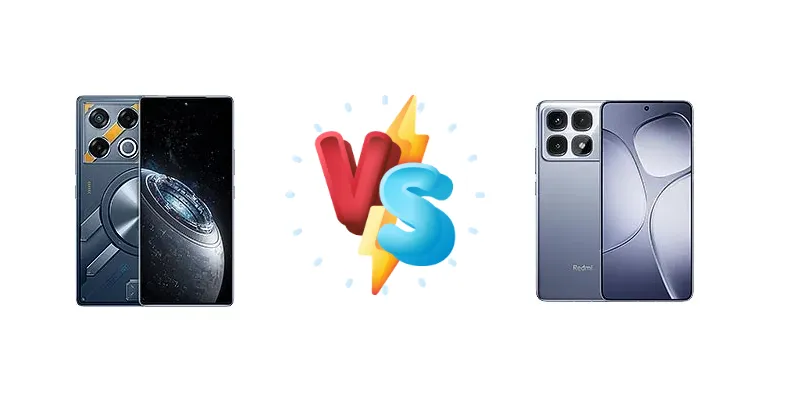
|
🏆 Quick Verdict
For users demanding the fastest possible performance and charging speeds, the Xiaomi Redmi K70 Ultra is the clear winner. However, the Infinix GT 20 Pro provides a strong alternative for budget-conscious buyers who still desire a capable and responsive experience.
| PHONES | ||
|---|---|---|
| Phone Names | Infinix GT 20 Pro | Xiaomi Redmi K70 Ultra |
| Network | ||
|---|---|---|
| 2G bands | GSM 850 / 900 / 1800 / 1900 | GSM 850 / 900 / 1800 / 1900 |
| 3G bands | HSDPA 850 / 900 / 1700(AWS) / 1900 / 2100 | HSDPA 800 / 850 / 900 / 1700(AWS) / 2100 |
| 4G bands | 1, 2, 3, 4, 5, 7, 8, 12, 17, 20, 28, 38, 40, 41, 42, 66 | 1, 3, 4, 5, 7, 8, 18, 19, 26, 28, 34, 38, 39, 40, 41, 42, 48, 66 |
| 5G bands | 1, 3, 5, 7, 8, 12, 20, 28, 38, 40, 41, 66, 77, 78 SA/NSA | 1, 3, 5, 7, 8, 28, 66, 38, 40, 41, 48, 77, 78 SA/NSA |
| Speed | HSPA, LTE, 5G | HSPA, LTE, 5G |
| Technology | GSM / HSPA / LTE / 5G | GSM / CDMA / HSPA / CDMA2000 / LTE / 5G |
| Launch | ||
|---|---|---|
| Announced | 2024, April 26 | 2024, July 19 |
| Status | Available. Released 2024, April 26 | Available. Released 2024, July 19 |
| Body | ||
|---|---|---|
| Build | - | Glass front, aluminum frame |
| Dimensions | 164.3 x 75.4 x 8.2 mm (6.47 x 2.97 x 0.32 in) | 160.4 x 75.1 x 8.4 mm (6.31 x 2.96 x 0.33 in) |
| SIM | Nano-SIM + Nano-SIM | Nano-SIM + Nano-SIM |
| Weight | 194 g (6.84 oz) | 211 g (7.44 oz) |
| Display | ||
|---|---|---|
| Protection | - | Scratch/drop-resistant glass |
| Resolution | 1080 x 2436 pixels (~388 ppi density) | 1220 x 2712 pixels, 20:9 ratio (~446 ppi density) |
| Size | 6.78 inches, 112.7 cm2 (~91.0% screen-to-body ratio) | 6.67 inches, 107.4 cm2 (~89.1% screen-to-body ratio) |
| Type | AMOLED, 1B colors, 144Hz, 2304Hz PWM, 1300 nits (peak) | OLED, 68B colors, 144Hz, Dolby Vision, HDR10+, 1600 nits (HBM), 4000 nits (peak) |
| Platform | ||
|---|---|---|
| CPU | Octa-core (1x3.1 GHz Cortex-A78 & 3x3.0 GHz Cortex-A78 & 4x2.0 GHz Cortex-A55) | Octa-core (1x3.25 GHz Cortex-X4 & 3x2.85 GHz Cortex-X4 & 4x2.0 GHz Cortex-A720) |
| Chipset | Mediatek Dimensity 8200 Ultimate (4 nm) | Mediatek Dimensity 9300+ (4 nm) |
| GPU | Mali-G610 MC6 | Immortalis-G720 MC12 |
| OS | Android 14, XOS 14 | Android 14, HyperOS |
| Memory | ||
|---|---|---|
| Card slot | Unspecified | No |
| Internal | 256GB 8GB RAM, 256GB 12GB RAM | 256GB 12GB RAM, 512GB 12GB RAM, 512GB 16GB RAM, 1TB 16GB RAM, 1TB 24GB RAM |
| Main Camera | ||
|---|---|---|
| Features | Quad-LED flash, HDR, panorama | Color spectrum sensor, Dual-LED dual-tone flash, HDR, panorama |
| Triple | 108 MP, f/1.8, 24mm (wide), 1/1.67", 0.64µm, AF, OIS 2 MP (macro) Auxiliary lens | 50 MP, f/1.7, 23mm (wide), 1/1.56", 1.0µm, PDAF, OIS 8 MP, 119˚ (ultrawide), 1/4.0", 1.12µm 2 MP (macro) |
| Video | 4K@30/60fps, 1080p@30/60/120/240fps | 8K@24/30fps, 4K@24/30/60fps, 1080p@30/60/120/240/960fps, gyro-EIS |
| Selfie camera | ||
|---|---|---|
| Features | Dual-LED flash | HDR |
| Single | 32 MP, f/2.2, 22mm (wide) | 20 MP, (wide), 1/2.0", 0.8µm |
| Video | 1440p@30fps, 1080p@30/60fps | 1080p@30fps |
| Sound | ||
|---|---|---|
| 35mm jack | No | No |
| Loudspeaker | Yes, with stereo speakers | Yes, with stereo speakers |
| Comms | ||
|---|---|---|
| Bluetooth | Yes | 5.4, A2DP, LE, LHDC 5 |
| Infrared port | Yes | Yes |
| NFC | Yes | Yes |
| Positioning | GPS, GLONASS, GALILEO | GPS (L1+L5), BDS (B1I+B1C+B2a+B2b), GALILEO (E1+E5a+E5b), QZSS (L1+L5), NavIC (L5), GLONASS |
| Radio | FM radio | Unspecified |
| USB | USB Type-C 2.0, OTG | USB Type-C |
| WLAN | Wi-Fi 802.11 a/b/g/n/ac/6, dual-band, Wi-Fi Direct | Wi-Fi 802.11 a/b/g/n/ac/6/7, dual-band, Wi-Fi Direct |
| Features | ||
|---|---|---|
| Sensors | Fingerprint (under display, optical), accelerometer, proximity, compass, gyro | Fingerprint (under display, optical), accelerometer, gyro, proximity, compass |
| Battery | ||
|---|---|---|
| Charging | 45W wired, PD3 | 120W wired, PD3.0, 100% in 24 min |
| Type | 5000 mAh | Li-Po 5500 mAh |
| Misc | ||
|---|---|---|
| Colors | Mecha Blue, Mecha Orange, Mecha Silver | Black, White, Violet, Green Championship Edition, Orange Championship Edition |
| Models | X6871 | 2407FRK8EC |
| Price | About 250 EUR | About 330 EUR |
Infinix GT 20 Pro
- More affordable price point
- Respectable performance for everyday tasks
- Efficient Dimensity 8200 Ultimate chipset
- Slower charging speed (45W)
- Less powerful processor compared to K70 Ultra
- Potentially less advanced camera system
Xiaomi Redmi K70 Ultra
- Blazing-fast 120W charging
- Significantly more powerful Dimensity 9300+ processor
- Enhanced gaming performance
- Higher price tag
- Potentially higher power consumption
- May run slightly warmer under heavy load
Display Comparison
While both devices likely employ AMOLED panels (based on brand trends), specific details like peak brightness and refresh rates are missing. However, the focus should be on the chipset's ability to drive the display smoothly. The K70 Ultra's more powerful Dimensity 9300+ will likely handle high refresh rates and graphically intensive content with greater ease. Bezels are expected to be minimal on both, typical of modern smartphones. Color accuracy is also likely to be similar, with both brands aiming for vibrant and accurate displays.
Camera Comparison
Without specific sensor details, a direct comparison is difficult. However, Xiaomi typically prioritizes camera performance in its K-series, suggesting the K70 Ultra likely features a more advanced camera system. The Dimensity 9300+'s enhanced ISP (Image Signal Processor) will also contribute to better image processing capabilities. The Infinix GT 20 Pro will likely offer a competent camera experience, but may fall short in low-light performance and dynamic range compared to the K70 Ultra. We can assume both will have a standard main, ultrawide, and potentially a macro lens, but the quality of these sensors will be the deciding factor.
Performance
The core difference lies in the chipsets. The Xiaomi Redmi K70 Ultra’s Dimensity 9300+ features a 1x3.25 GHz Cortex-X4 prime core, alongside 3x2.85 GHz Cortex-X4 cores, representing a significant leap in CPU performance over the Infinix GT 20 Pro’s Dimensity 8200 Ultimate. The 8200 Ultimate utilizes a 1x3.1 GHz Cortex-A78 core and 3x3.0 GHz Cortex-A78 cores. This architectural difference translates to faster application loading, smoother multitasking, and superior gaming performance on the K70 Ultra. Both utilize a 4nm process, but the newer generation cores in the 9300+ offer improved efficiency. The K70 Ultra's LPDDR5x RAM will also contribute to faster data transfer speeds, further enhancing performance.
Battery Life
The Xiaomi Redmi K70 Ultra’s 120W wired charging is a game-changer, promising a full charge in just 24 minutes. This is a substantial advantage over the Infinix GT 20 Pro’s 45W charging. While battery capacity isn't specified, the faster charging speed of the K70 Ultra mitigates the impact of a potentially smaller battery. The PD3.0 support on both devices ensures compatibility with a wide range of chargers. The K70 Ultra’s faster charging is particularly beneficial for users who frequently find themselves needing to quickly top up their battery.
Buying Guide
Buy the Infinix GT 20 Pro if you need a solid all-rounder with respectable performance for everyday tasks and moderate gaming, and if maximizing value for your money is paramount. Buy the Xiaomi Redmi K70 Ultra if you prioritize raw processing power for demanding applications, enjoy fast-paced gaming, and value the convenience of incredibly rapid 120W charging, even at a slightly higher price point.