
Infinix GT 20 Pro vs Samsung Galaxy A55: A Deep Dive into Mid-Range Champions
| Phones Images | |||||
|---|---|---|---|---|---|
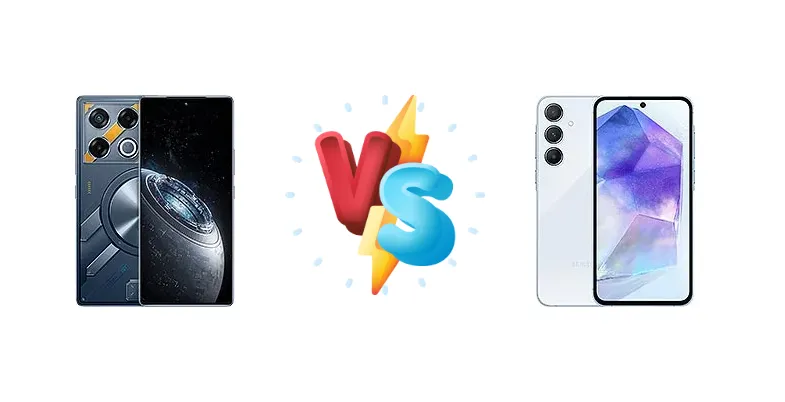
|
🏆 Quick Verdict
For users prioritizing raw performance and gaming capabilities, the Infinix GT 20 Pro emerges as the winner. Its Dimensity 8200 Ultimate chipset delivers a noticeable performance edge. However, the Samsung Galaxy A55 excels in battery endurance and offers a more refined software experience, making it ideal for everyday users.
| PHONES | ||
|---|---|---|
| Phone Names | Infinix GT 20 Pro | Samsung Galaxy A55 |
| Network | ||
|---|---|---|
| 2G bands | GSM 850 / 900 / 1800 / 1900 | GSM 850 / 900 / 1800 / 1900 |
| 3G bands | HSDPA 850 / 900 / 1700(AWS) / 1900 / 2100 | HSDPA 850 / 900 / 1700(AWS) / 1900 / 2100 |
| 4G bands | 1, 2, 3, 4, 5, 7, 8, 12, 17, 20, 28, 38, 40, 41, 42, 66 | 1, 2, 3, 4, 5, 7, 8, 12, 17, 20, 25, 26, 28, 32, 38, 40, 41, 66 |
| 5G bands | 1, 3, 5, 7, 8, 12, 20, 28, 38, 40, 41, 66, 77, 78 SA/NSA | 1, 3, 5, 7, 8, 20, 28, 38, 40, 41, 66, 77, 78 SA/NSA/Sub6 |
| Speed | HSPA, LTE, 5G | HSPA, LTE, 5G |
| Technology | GSM / HSPA / LTE / 5G | GSM / HSPA / LTE / 5G |
| Launch | ||
|---|---|---|
| Announced | 2024, April 26 | 2024, March 11 |
| Status | Available. Released 2024, April 26 | Available. Released 2024, March 15 |
| Body | ||
|---|---|---|
| Build | - | Glass front (Gorilla Glass Victus+), glass back (Gorilla Glass), aluminum frame |
| Dimensions | 164.3 x 75.4 x 8.2 mm (6.47 x 2.97 x 0.32 in) | 161.1 x 77.4 x 8.2 mm (6.34 x 3.05 x 0.32 in) |
| SIM | Nano-SIM + Nano-SIM | · Nano-SIM· Nano-SIM + eSIM· Nano-SIM + Nano-SIM· Nano-SIM + Nano-SIM + eSIM (max 2 at a time) |
| Weight | 194 g (6.84 oz) | 213 g (7.51 oz) |
| Display | ||
|---|---|---|
| Protection | - | Corning Gorilla Glass Victus+ |
| Resolution | 1080 x 2436 pixels (~388 ppi density) | 1080 x 2340 pixels, 19.5:9 ratio (~390 ppi density) |
| Size | 6.78 inches, 112.7 cm2 (~91.0% screen-to-body ratio) | 6.6 inches, 106.9 cm2 (~85.8% screen-to-body ratio) |
| Type | AMOLED, 1B colors, 144Hz, 2304Hz PWM, 1300 nits (peak) | Super AMOLED, 120Hz, HDR10+, 1000 nits (HBM) |
| Platform | ||
|---|---|---|
| CPU | Octa-core (1x3.1 GHz Cortex-A78 & 3x3.0 GHz Cortex-A78 & 4x2.0 GHz Cortex-A55) | Octa-core (4x2.75 GHz Cortex-A78 & 4x2.0 GHz Cortex-A55) |
| Chipset | Mediatek Dimensity 8200 Ultimate (4 nm) | Exynos 1480 (4 nm) |
| GPU | Mali-G610 MC6 | Xclipse 530 |
| OS | Android 14, XOS 14 | Android 14, up to 4 major Android upgrades, One UI 6.1 |
| Memory | ||
|---|---|---|
| Card slot | Unspecified | microSDXC (uses shared SIM slot) |
| Internal | 256GB 8GB RAM, 256GB 12GB RAM | 128GB 6GB RAM, 128GB 8GB RAM, 256GB 6GB RAM, 256GB 8GB RAM, 256GB 12GB RAM |
| Main Camera | ||
|---|---|---|
| Features | Quad-LED flash, HDR, panorama | LED flash, panorama, HDR |
| Triple | 108 MP, f/1.8, 24mm (wide), 1/1.67", 0.64µm, AF, OIS 2 MP (macro) Auxiliary lens | 50 MP, f/1.8, (wide), 1/1.56", 1.0µm, PDAF, OIS 12 MP, f/2.2, 123˚ (ultrawide), 1/3.06", 1.12µm 5 MP (macro) |
| Video | 4K@30/60fps, 1080p@30/60/120/240fps | 4K@30fps, 1080p@30/60fps, gyro-EIS |
| Selfie camera | ||
|---|---|---|
| Features | Dual-LED flash | - |
| Single | 32 MP, f/2.2, 22mm (wide) | 32 MP, f/2.2, 26mm (wide), 1/2.74", 0.8µm |
| Video | 1440p@30fps, 1080p@30/60fps | 4K@30fps, 1080p@30/60fps |
| Sound | ||
|---|---|---|
| 35mm jack | No | No |
| Loudspeaker | Yes, with stereo speakers | Yes, with stereo speakers |
| Comms | ||
|---|---|---|
| Bluetooth | Yes | 5.3, A2DP, LE |
| Infrared port | Yes | - |
| NFC | Yes | Yes (market/region dependent) |
| Positioning | GPS, GLONASS, GALILEO | GPS, GALILEO, GLONASS, BDS, QZSS |
| Radio | FM radio | No |
| USB | USB Type-C 2.0, OTG | USB Type-C 2.0, OTG |
| WLAN | Wi-Fi 802.11 a/b/g/n/ac/6, dual-band, Wi-Fi Direct | Wi-Fi 802.11 a/b/g/n/ac/6, dual-band, Wi-Fi Direct |
| Features | ||
|---|---|---|
| Sensors | Fingerprint (under display, optical), accelerometer, proximity, compass, gyro | Fingerprint (under display, optical), accelerometer, gyro, compass |
| Battery | ||
|---|---|---|
| Charging | 45W wired, PD3 | 25W wired |
| Type | 5000 mAh | Li-Ion 5000 mAh |
| Misc | ||
|---|---|---|
| Colors | Mecha Blue, Mecha Orange, Mecha Silver | Iceblue, Lilac, Navy, Lemon |
| Models | X6871 | SM-A556V, SM-A556B, SM-A556B/DS, SM-A556E, SM-A556E/DS, SM-A5560 |
| Price | About 250 EUR | $ 324.99 / £ 251.50 / € 319.99 / ₹ 23,998 |
| SAR EU | - | 0.68 W/kg (head) 1.04 W/kg (body) |
Infinix GT 20 Pro
- Superior processing power with Dimensity 8200 Ultimate
- Faster 45W charging with PD3 support
- Potentially better gaming performance
- Battery life likely shorter than Galaxy A55
- Software experience may not be as refined as Samsung’s One UI
Samsung Galaxy A55
- Excellent battery life (13:27h active use)
- Brighter display (1010 nits)
- Samsung’s One UI software and ecosystem
- Less powerful chipset (Exynos 1480)
- Slower 25W charging
Display Comparison
The Samsung Galaxy A55 boasts a brighter display, reaching a measured peak of 1010 nits, ensuring excellent visibility even in direct sunlight. While the GT 20 Pro’s display specs aren’t provided, Samsung’s panel technology typically offers superior color accuracy and viewing angles. The A55’s brightness advantage is particularly beneficial for outdoor use and HDR content consumption. The lack of LTPO on either device suggests both will rely on adaptive refresh rate switching rather than variable refresh rate for power saving.
Camera Comparison
Without detailed camera specifications for the GT 20 Pro, a direct comparison is limited. However, Samsung’s Galaxy A55 is known for its consistent image processing and reliable performance in various lighting conditions. The A55 likely benefits from Samsung’s advanced image signal processing (ISP). The presence of Optical Image Stabilization (OIS) on the A55 is a significant advantage, reducing blur in photos and videos, especially in low light. It’s reasonable to assume the GT 20 Pro will include a multi-camera setup, but without sensor size or aperture information, it’s difficult to assess its image quality relative to the A55.
Performance
The core difference lies in the chipsets: the Infinix GT 20 Pro utilizes the Mediatek Dimensity 8200 Ultimate (4nm), while the Galaxy A55 features the Exynos 1480 (4nm). The Dimensity 8200 Ultimate’s CPU configuration – 1x3.1 GHz Cortex-A78, 3x3.0 GHz Cortex-A78, and 4x2.0 GHz Cortex-A55 – is architecturally more potent than the A55’s 4x2.75 GHz Cortex-A78 and 4x2.0 GHz Cortex-A55. This translates to faster application loading, smoother multitasking, and a more responsive gaming experience on the GT 20 Pro. While both are 4nm chips, the Dimensity 8200 Ultimate’s superior core configuration provides a clear performance advantage. The A55’s Exynos 1480 is optimized for efficiency, but sacrifices some raw power.
Battery Life
The Samsung Galaxy A55 demonstrates a clear advantage in battery life, achieving 13 hours and 27 minutes of active use. The Infinix GT 20 Pro’s battery capacity is unknown, but its 45W wired charging (with PD3 support) is significantly faster than the A55’s 25W charging. This means the GT 20 Pro can replenish its battery much quicker, mitigating any potential capacity disadvantage. While faster charging doesn’t equate to longer overall battery life, it reduces downtime and provides greater convenience.
Buying Guide
Buy the Infinix GT 20 Pro if you need a phone primarily for gaming, demanding multitasking, or appreciate faster charging speeds. Its chipset provides a significant performance boost for the price. Buy the Samsung Galaxy A55 if you prefer a phone with exceptional battery life, a vibrant display, and Samsung’s One UI software, prioritizing a smooth and reliable daily experience over peak performance.