
OnePlus Nord 4 vs. Infinix GT 20 Pro: A Deep Dive into Mid-Range Power
| Phones Images | |||||
|---|---|---|---|---|---|
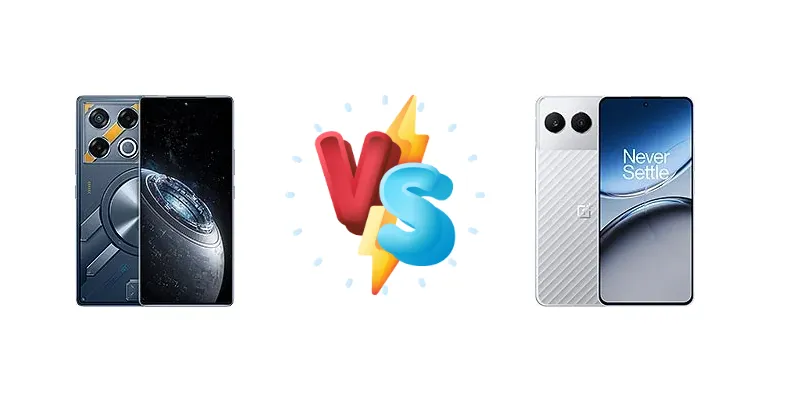
|
🏆 Quick Verdict
For the average user prioritizing all-around performance and convenience, the OnePlus Nord 4 emerges as the winner. Its significantly faster 100W charging and brighter display, coupled with a strong Snapdragon 7+ Gen 3 chipset, offer a more polished and user-friendly experience. However, gamers on a tight budget may find the GT 20 Pro’s Dimensity 8200 Ultimate a viable alternative.
| PHONES | ||
|---|---|---|
| Phone Names | Infinix GT 20 Pro | OnePlus Nord 4 |
| Network | ||
|---|---|---|
| 2G bands | GSM 850 / 900 / 1800 / 1900 | GSM 850 / 900 / 1800 / 1900 |
| 3G bands | HSDPA 850 / 900 / 1700(AWS) / 1900 / 2100 | HSDPA 800 / 850 / 900 / 1700(AWS) / 1800 / 1900 / 2100 - International |
| 4G bands | 1, 2, 3, 4, 5, 7, 8, 12, 17, 20, 28, 38, 40, 41, 42, 66 | 1, 2, 3, 4, 5, 7, 8, 12, 17, 18, 19, 20, 26, 28, 38, 39, 40, 41, 66 - International |
| 5G bands | 1, 3, 5, 7, 8, 12, 20, 28, 38, 40, 41, 66, 77, 78 SA/NSA | 1, 2, 3, 5, 7, 8, 12, 20, 28, 38, 40, 41, 66, 77, 78 SA/NSA - International |
| Speed | HSPA, LTE, 5G | HSPA, LTE, 5G |
| Technology | GSM / HSPA / LTE / 5G | GSM / HSPA / LTE / 5G |
| Launch | ||
|---|---|---|
| Announced | 2024, April 26 | 2024, July 16 |
| Status | Available. Released 2024, April 26 | Available. Released 2024, August 08 |
| Body | ||
|---|---|---|
| Build | - | Glass front, aluminum back, aluminum frame |
| Dimensions | 164.3 x 75.4 x 8.2 mm (6.47 x 2.97 x 0.32 in) | 162.6 x 75 x 8 mm (6.40 x 2.95 x 0.31 in) |
| SIM | Nano-SIM + Nano-SIM | Nano-SIM + Nano-SIM |
| Weight | 194 g (6.84 oz) | 199.5 g (7.05 oz) |
| Display | ||
|---|---|---|
| Resolution | 1080 x 2436 pixels (~388 ppi density) | 1240 x 2772 pixels, 20:9 ratio (~450 ppi density) |
| Size | 6.78 inches, 112.7 cm2 (~91.0% screen-to-body ratio) | 6.74 inches, 109.7 cm2 (~90.0% screen-to-body ratio) |
| Type | AMOLED, 1B colors, 144Hz, 2304Hz PWM, 1300 nits (peak) | Fluid AMOLED, 1B colors, 120Hz, HDR10+, 2150 nits (peak) |
| Platform | ||
|---|---|---|
| CPU | Octa-core (1x3.1 GHz Cortex-A78 & 3x3.0 GHz Cortex-A78 & 4x2.0 GHz Cortex-A55) | Octa-core (1x2.8 GHz Cortex-X4 & 4x2.6 GHz Cortex-A720 & 3x1.9 GHz Cortex-A520) |
| Chipset | Mediatek Dimensity 8200 Ultimate (4 nm) | Qualcomm SM7675 Snapdragon 7+ Gen 3 (4 nm) |
| GPU | Mali-G610 MC6 | Adreno 732 |
| OS | Android 14, XOS 14 | Android 14, up to 4 major Android upgrades, OxygenOS 15 |
| Memory | ||
|---|---|---|
| Card slot | Unspecified | No |
| Internal | 256GB 8GB RAM, 256GB 12GB RAM | 128GB 8GB RAM, 256GB 8GB RAM, 256GB 12GB RAM, 512GB 16GB RAM |
| Main Camera | ||
|---|---|---|
| Dual | - | 50 MP, f/1.8, 25mm (wide), 1/1.95", 0.8µm, PDAF, OIS 8 MP, f/2.2, 112˚ (ultrawide), 1/4.0", 1.12µm |
| Features | Quad-LED flash, HDR, panorama | Dual-LED flash, HDR, panorama |
| Triple | 108 MP, f/1.8, 24mm (wide), 1/1.67", 0.64µm, AF, OIS 2 MP (macro) Auxiliary lens | - |
| Video | 4K@30/60fps, 1080p@30/60/120/240fps | 4K@30/60fps, 1080p@30/60/120fps, gyro-EIS |
| Selfie camera | ||
|---|---|---|
| Features | Dual-LED flash | Panorama |
| Single | 32 MP, f/2.2, 22mm (wide) | 16 MP, f/2.4, 24mm (wide), 1.0µm |
| Video | 1440p@30fps, 1080p@30/60fps | 1080p@30fps |
| Sound | ||
|---|---|---|
| 35mm jack | No | No |
| Loudspeaker | Yes, with stereo speakers | Yes, with stereo speakers |
| Comms | ||
|---|---|---|
| Bluetooth | Yes | 5.4, A2DP, LE, aptX HD, LHDC |
| Infrared port | Yes | Yes |
| NFC | Yes | Yes |
| Positioning | GPS, GLONASS, GALILEO | GPS, GALILEO, GLONASS, BDS, QZSS |
| Radio | FM radio | No |
| USB | USB Type-C 2.0, OTG | USB Type-C 2.0 |
| WLAN | Wi-Fi 802.11 a/b/g/n/ac/6, dual-band, Wi-Fi Direct | Wi-Fi 802.11 a/b/g/n/ac/6, dual-band, Wi-Fi Direct |
| Features | ||
|---|---|---|
| Sensors | Fingerprint (under display, optical), accelerometer, proximity, compass, gyro | Fingerprint (under display, optical), accelerometer, gyro, proximity, compass |
| Battery | ||
|---|---|---|
| Charging | 45W wired, PD3 | 100W wired, PPS, 100% in 28 min |
| Type | 5000 mAh | 5500 mAh |
| Misc | ||
|---|---|---|
| Colors | Mecha Blue, Mecha Orange, Mecha Silver | Obsidian Midnight, Mercurial Silver, Oasis Green |
| Models | X6871 | CPH2663, CPH2661 |
| Price | About 250 EUR | € 410.27 / £ 423.17 |
| SAR | - | 1.18 W/kg (head) 1.06 W/kg (body) |
Infinix GT 20 Pro
- Powerful Dimensity 8200 Ultimate chipset
- Aggressive pricing for gaming performance
- Potentially optimized gaming software features
- Slower 45W charging
- Display brightness likely lower than Nord 4
- Camera performance potentially less refined
OnePlus Nord 4
- Ultra-fast 100W charging (28 min 0-100%)
- Bright 1163 nit display for outdoor visibility
- Efficient Snapdragon 7+ Gen 3 chipset
- Potentially higher price point
- Gaming performance may be slightly lower than GT 20 Pro in raw benchmarks
- Software experience may be less tailored to gaming
Display Comparison
The OnePlus Nord 4 boasts a significant advantage in display technology, achieving a measured peak brightness of 1163 nits. This translates to superior visibility in direct sunlight compared to the Infinix GT 20 Pro, which lacks published brightness data. While both utilize 4nm chipsets, the Nord 4’s brighter panel enhances media consumption and outdoor usability. The absence of LTPO technology in either device suggests both will rely on adaptive refresh rate switching to conserve battery, but the Nord 4’s higher peak brightness is a clear differentiator.
Camera Comparison
Without detailed camera specifications for the Infinix GT 20 Pro, a direct comparison is limited. However, the OnePlus Nord 4 is expected to feature a capable main sensor, likely with Optical Image Stabilization (OIS), which is crucial for sharp, stable images and videos. The GT 20 Pro’s camera performance will heavily rely on its image processing algorithms. The prevalence of low-resolution auxiliary cameras (often 2MP) in this price segment suggests focusing on the main sensor’s capabilities is paramount. The Nord 4’s likely superior image processing and OIS give it an edge in image quality.
Performance
Both devices employ 4nm process nodes, but the chipsets differ significantly. The OnePlus Nord 4’s Qualcomm Snapdragon 7+ Gen 3 features a Cortex-X4 prime core clocked at 2.8 GHz, designed for peak performance, alongside Cortex-A720 performance cores. The Infinix GT 20 Pro utilizes the MediaTek Dimensity 8200 Ultimate, with a Cortex-A78 prime core at 3.1 GHz. While the GT 20 Pro’s prime core has a higher clock speed, the Snapdragon 7+ Gen 3’s newer architecture and more efficient core design generally translate to better sustained performance and improved power efficiency. The Nord 4’s likely use of faster LPDDR5x RAM further contributes to a smoother multitasking experience.
Battery Life
The OnePlus Nord 4 shines in battery charging, supporting 100W wired charging with PPS, achieving a full charge in just 28 minutes. The Infinix GT 20 Pro’s 45W wired charging, while respectable, is significantly slower. The Nord 4’s active use score of 14:41h demonstrates excellent battery life, suggesting efficient power management alongside its 4nm chipset. While the GT 20 Pro’s battery capacity is unknown, the Nord 4’s faster charging and proven endurance provide a more convenient user experience.
Buying Guide
Buy the Infinix GT 20 Pro if you prioritize raw gaming performance within a strict budget and are willing to compromise on charging speed and display brightness. Buy the OnePlus Nord 4 if you value a more balanced experience with faster charging, a brighter and more vibrant display, and a refined software experience, even if it comes at a slightly higher price point.