
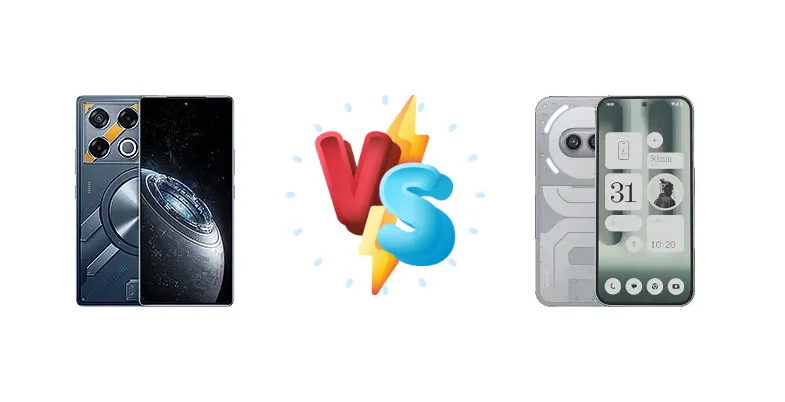
Infinix GT 20 Pro vs Nothing Phone (2a) Plus: A Deep Dive into Performance and Battery Life
| Phones Images | |||||
|---|---|---|---|---|---|
|
🏆 Quick Verdict
For users prioritizing raw performance and gaming, the Infinix GT 20 Pro is the clear winner thanks to its Dimensity 8200 Ultimate. However, the Nothing Phone (2a) Plus delivers exceptional all-day battery life – scoring 16:34h in active use – and a brighter display, making it ideal for everyday users.
| PHONES | ||
|---|---|---|
| Phone Names | Infinix GT 20 Pro | Nothing Phone (2a) Plus |
| Network | ||
|---|---|---|
| 2G bands | GSM 850 / 900 / 1800 / 1900 | GSM 850 / 900 / 1800 / 1900 |
| 3G bands | HSDPA 850 / 900 / 1700(AWS) / 1900 / 2100 | HSDPA 800 / 850 / 900 / 1700(AWS) / 1900 / 2100 |
| 4G bands | 1, 2, 3, 4, 5, 7, 8, 12, 17, 20, 28, 38, 40, 41, 42, 66 | 1, 3, 4, 5, 7, 8, 18, 19, 20, 26, 28, 38, 39, 40, 41, 42, 66 |
| 5G bands | 1, 3, 5, 7, 8, 12, 20, 28, 38, 40, 41, 66, 77, 78 SA/NSA | 1, 3, 5, 7, 8, 20, 28, 38, 40, 41, 66, 77, 78 SA/NSA |
| Speed | HSPA, LTE, 5G | HSPA, LTE, 5G |
| Technology | GSM / HSPA / LTE / 5G | GSM / HSPA / LTE / 5G |
| Launch | ||
|---|---|---|
| Announced | 2024, April 26 | 2024, July 31 |
| Status | Available. Released 2024, April 26 | Available. Released 2024, August 03 |
| Body | ||
|---|---|---|
| Build | - | Glass front (Gorilla Glass 5), plastic frame, plastic back |
| Dimensions | 164.3 x 75.4 x 8.2 mm (6.47 x 2.97 x 0.32 in) | 161.7 x 76.3 x 8.5 mm (6.37 x 3.00 x 0.33 in) |
| SIM | Nano-SIM + Nano-SIM | Nano-SIM + Nano-SIM |
| Weight | 194 g (6.84 oz) | 190 g (6.70 oz) |
| Display | ||
|---|---|---|
| Protection | - | Corning Gorilla Glass 5 |
| Resolution | 1080 x 2436 pixels (~388 ppi density) | 1080 x 2412 pixels, 20:9 ratio (~395 ppi density) |
| Size | 6.78 inches, 112.7 cm2 (~91.0% screen-to-body ratio) | 6.7 inches, 107.5 cm2 (~87.1% screen-to-body ratio) |
| Type | AMOLED, 1B colors, 144Hz, 2304Hz PWM, 1300 nits (peak) | AMOLED, 1B colors, 120Hz, 2160Hz PWM, HDR10+, 700 nits (typ), 1100 nits (HBM), 1300 nits (peak) |
| Platform | ||
|---|---|---|
| CPU | Octa-core (1x3.1 GHz Cortex-A78 & 3x3.0 GHz Cortex-A78 & 4x2.0 GHz Cortex-A55) | Octa-core (2x3.0 GHz Cortex-A715 & 6x 2.0 GHz Cortex-A510) |
| Chipset | Mediatek Dimensity 8200 Ultimate (4 nm) | Mediatek Dimensity 7350 Pro (4 nm) |
| GPU | Mali-G610 MC6 | Mali-G610 MC4 |
| OS | Android 14, XOS 14 | Android 14, up to 3 major Android upgrades, Nothing OS 3.0 |
| Memory | ||
|---|---|---|
| Card slot | Unspecified | No |
| Internal | 256GB 8GB RAM, 256GB 12GB RAM | 256GB 8GB RAM, 256GB 12GB RAM |
| Main Camera | ||
|---|---|---|
| Dual | - | 50 MP, f/1.9, 24mm (wide), 1/1.57", 1.0µm, PDAF, OIS 50 MP, f/2.2, 114˚ (ultrawide), 1/2.76", 0.64µm |
| Features | Quad-LED flash, HDR, panorama | LED flash, panorama, HDR |
| Triple | 108 MP, f/1.8, 24mm (wide), 1/1.67", 0.64µm, AF, OIS 2 MP (macro) Auxiliary lens | - |
| Video | 4K@30/60fps, 1080p@30/60/120/240fps | 4K@30fps, 1080p@60/120fps, gyro-EIS |
| Selfie camera | ||
|---|---|---|
| Features | Dual-LED flash | HDR |
| Single | 32 MP, f/2.2, 22mm (wide) | 50 MP, f/2.2, (wide), 1/2.76" |
| Video | 1440p@30fps, 1080p@30/60fps | 4K@30fps |
| Sound | ||
|---|---|---|
| 35mm jack | No | No |
| Loudspeaker | Yes, with stereo speakers | Yes, with stereo speakers |
| Comms | ||
|---|---|---|
| Bluetooth | Yes | 5.3, A2DP, LE |
| Infrared port | Yes | - |
| NFC | Yes | Yes, 360˚ |
| Positioning | GPS, GLONASS, GALILEO | GPS, GALILEO, GLONASS, BDS, QZSS |
| Radio | FM radio | No |
| USB | USB Type-C 2.0, OTG | USB Type-C 2.0, OTG |
| WLAN | Wi-Fi 802.11 a/b/g/n/ac/6, dual-band, Wi-Fi Direct | Wi-Fi 802.11 a/b/g/n/ac/6, dual-band, Wi-Fi Direct |
| Features | ||
|---|---|---|
| Sensors | Fingerprint (under display, optical), accelerometer, proximity, compass, gyro | Fingerprint (under display, optical), accelerometer, gyro, proximity, compass |
| Battery | ||
|---|---|---|
| Charging | 45W wired, PD3 | 50W wired, 50% in 21 min, 100% in 56 min |
| Type | 5000 mAh | 5000 mAh |
| Misc | ||
|---|---|---|
| Colors | Mecha Blue, Mecha Orange, Mecha Silver | Black, Grey |
| Models | X6871 | A142P |
| Price | About 250 EUR | € 269.90 / ₹ 22,599 |
Infinix GT 20 Pro
- More powerful Dimensity 8200 Ultimate chipset
- Faster CPU clock speeds for demanding tasks
- Potentially faster charging with 45W wired (PD3)
- Likely shorter battery life due to power-hungry chipset
- Display brightness likely lower than Nothing Phone (2a) Plus
- Camera details are currently unknown
Nothing Phone (2a) Plus
- Exceptional 16:34h active use battery life
- Brighter display with 1097 nits peak brightness
- Clean and refined software experience
- Less powerful Dimensity 7350 Pro chipset
- Slower 50W charging (56 minutes to 100%)
- May struggle with extremely demanding games
Display Comparison
The Nothing Phone (2a) Plus boasts a significantly brighter display, reaching a measured peak of 1097 nits. This translates to superior visibility outdoors. While the GT 20 Pro’s display specs are not provided, the (2a) Plus’s brightness advantage is substantial. The (2a) Plus’s panel likely benefits from its newer design and optimization. The GT 20 Pro’s display quality will be a key factor for users who spend significant time outdoors or in brightly lit environments.
Camera Comparison
Without detailed camera specs for the GT 20 Pro, a direct comparison is limited. However, the Nothing Phone (2a) Plus likely benefits from Nothing’s image processing algorithms. The (2a) Plus’s camera system is designed for consistent, natural-looking photos. The GT 20 Pro will likely focus on delivering vibrant, punchy images, appealing to a different aesthetic. The absence of OIS information for the GT 20 Pro is a concern for low-light photography.
Performance
The Infinix GT 20 Pro’s Mediatek Dimensity 8200 Ultimate (4nm) is a more powerful chipset than the Nothing Phone (2a) Plus’s Dimensity 7350 Pro (4nm). The 8200 Ultimate features a faster prime core (3.1 GHz Cortex-A78) compared to the (2a) Plus’s Cortex-A715 (3.0 GHz). This translates to a noticeable performance advantage in demanding tasks like gaming and video editing. The GT 20 Pro’s CPU configuration – 1x3.1 GHz, 3x3.0 GHz, and 4x2.0 GHz – is geared towards sustained performance, while the (2a) Plus’s 2x3.0 GHz and 6x2.0 GHz configuration prioritizes efficiency. The GT 20 Pro is the better choice for power users.
Battery Life
The Nothing Phone (2a) Plus shines in battery life, achieving an impressive 16:34 hours of active use. While the GT 20 Pro’s battery capacity is unknown, its more powerful chipset will likely consume more power. The (2a) Plus’s 50W charging (56 minutes to 100%) is slower than the GT 20 Pro’s 45W charging (PD3), but the longer battery life mitigates this difference. The (2a) Plus’s charging speed is adequate for most users, while the GT 20 Pro’s faster charging is beneficial for those who frequently need a quick top-up.
Buying Guide
Buy the Infinix GT 20 Pro if you need uncompromising gaming performance, fast charging, and don't mind potentially shorter battery life. It's for the enthusiast who values speed above all else. Buy the Nothing Phone (2a) Plus if you prefer a phone that lasts all day, offers a vibrant display, and provides a clean, refined software experience. It’s the better choice for mainstream users.