
Infinix GT 20 Pro vs Google Pixel 8a: A Deep Dive into Performance and Value
| Phones Images | |||||
|---|---|---|---|---|---|
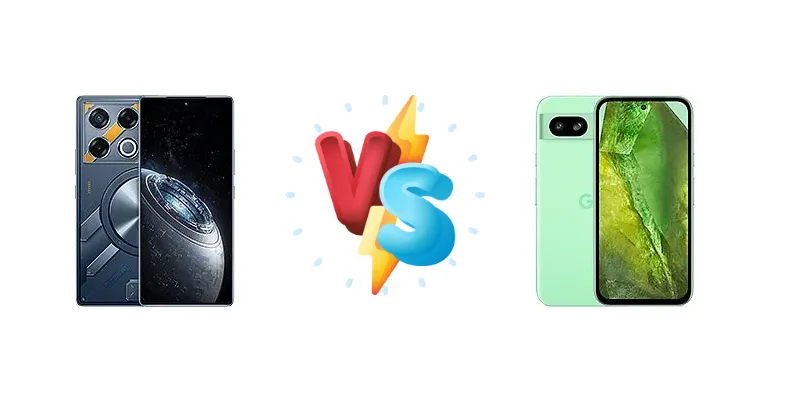
|
🏆 Quick Verdict
For the average user prioritizing a balanced experience with a focus on photography and software support, the Google Pixel 8a is the better choice. However, gamers and power users who demand raw performance and rapid charging will find the Infinix GT 20 Pro a more compelling option.
| PHONES | ||
|---|---|---|
| Phone Names | Infinix GT 20 Pro | Google Pixel 8a |
| Network | ||
|---|---|---|
| 2G bands | GSM 850 / 900 / 1800 / 1900 | GSM 850 / 900 / 1800 / 1900 |
| 3G bands | HSDPA 850 / 900 / 1700(AWS) / 1900 / 2100 | HSDPA 800 / 850 / 900 / 1700(AWS) / 1900 / 2100 |
| 4G bands | 1, 2, 3, 4, 5, 7, 8, 12, 17, 20, 28, 38, 40, 41, 42, 66 | 1, 2, 3, 4, 5, 7, 8, 12, 17, 18, 19, 20, 26, 28, 32, 38, 40, 41, 42, 66 - G6GPR (International) |
| 5G bands | 1, 3, 5, 7, 8, 12, 20, 28, 38, 40, 41, 66, 77, 78 SA/NSA | 1, 2, 3, 5, 7, 8, 12, 20, 26, 28, 38, 40, 41, 66, 75, 76, 77, 78 SA/NSA/Sub6 - G6GPR (International) |
| Speed | HSPA, LTE, 5G | HSPA, LTE, 5G |
| Technology | GSM / HSPA / LTE / 5G | GSM / HSPA / LTE / 5G |
| Launch | ||
|---|---|---|
| Announced | 2024, April 26 | 2024, May 07 |
| Status | Available. Released 2024, April 26 | Available. Released 2024, May 14 |
| Body | ||
|---|---|---|
| Build | - | Glass front (Gorilla Glass 3), aluminum frame, plastic back |
| Dimensions | 164.3 x 75.4 x 8.2 mm (6.47 x 2.97 x 0.32 in) | 152.1 x 72.7 x 8.9 mm (5.99 x 2.86 x 0.35 in) |
| SIM | Nano-SIM + Nano-SIM | Nano-SIM + eSIM |
| Weight | 194 g (6.84 oz) | 188 g (6.63 oz) |
| Display | ||
|---|---|---|
| Protection | - | Corning Gorilla Glass 3, Mohs level 5 |
| Resolution | 1080 x 2436 pixels (~388 ppi density) | 1080 x 2400 pixels, 20:9 ratio (~430 ppi density) |
| Size | 6.78 inches, 112.7 cm2 (~91.0% screen-to-body ratio) | 6.1 inches, 90.3 cm2 (~81.6% screen-to-body ratio) |
| Type | AMOLED, 1B colors, 144Hz, 2304Hz PWM, 1300 nits (peak) | OLED, HDR, 120Hz, 2000 nits (peak) |
| Platform | ||
|---|---|---|
| CPU | Octa-core (1x3.1 GHz Cortex-A78 & 3x3.0 GHz Cortex-A78 & 4x2.0 GHz Cortex-A55) | Nona-core (1x3.0 GHz Cortex-X3 & 4x2.45 GHz Cortex-A715 & 4x2.15 GHz Cortex-A510) |
| Chipset | Mediatek Dimensity 8200 Ultimate (4 nm) | Google Tensor G3 (4 nm) |
| GPU | Mali-G610 MC6 | Immortalis-G715s MC10 |
| OS | Android 14, XOS 14 | Android 14, upgradable to Android 16, up to 7 major Android upgrades |
| Memory | ||
|---|---|---|
| Card slot | Unspecified | No |
| Internal | 256GB 8GB RAM, 256GB 12GB RAM | 128GB 8GB RAM, 256GB 8GB RAM |
| Main Camera | ||
|---|---|---|
| Dual | - | 64 MP (16 MP eff.), f/1.9, 26mm (wide), 1/1.73", 0.8µm, dual pixel PDAF, OIS 13 MP, f/2.2, 120˚ (ultrawide), 1.12µm |
| Features | Quad-LED flash, HDR, panorama | Dual-LED flash, Pixel Shift, Ultra HDR, panorama, Best Take |
| Triple | 108 MP, f/1.8, 24mm (wide), 1/1.67", 0.64µm, AF, OIS 2 MP (macro) Auxiliary lens | - |
| Video | 4K@30/60fps, 1080p@30/60/120/240fps | 4K@30/60fps, 1080p@30/60/120/240fps, OIS |
| Selfie camera | ||
|---|---|---|
| Features | Dual-LED flash | HDR, panorama |
| Single | 32 MP, f/2.2, 22mm (wide) | 13 MP, f/2.2, 20mm (ultrawide), 1.12µm |
| Video | 1440p@30fps, 1080p@30/60fps | 4K@30fps, 1080p@30/60fps |
| Sound | ||
|---|---|---|
| 35mm jack | No | No |
| Loudspeaker | Yes, with stereo speakers | Yes, with stereo speakers |
| Comms | ||
|---|---|---|
| Bluetooth | Yes | 5.3, A2DP, LE |
| Infrared port | Yes | - |
| NFC | Yes | Yes |
| Positioning | GPS, GLONASS, GALILEO | GPS, GLONASS, GALILEO, BDS, QZSS, NavIC |
| Radio | FM radio | No |
| USB | USB Type-C 2.0, OTG | USB Type-C 3.2 |
| WLAN | Wi-Fi 802.11 a/b/g/n/ac/6, dual-band, Wi-Fi Direct | Wi-Fi 802.11 a/b/g/n/ac/6e, dual/tri-band (market/region dependent) |
| Features | ||
|---|---|---|
| Sensors | Fingerprint (under display, optical), accelerometer, proximity, compass, gyro | Fingerprint (under display, optical), accelerometer, gyro, proximity, compass, barometer |
| Battery | ||
|---|---|---|
| Charging | 45W wired, PD3 | 18W wired, PD3.0 7.5W wireless Bypass charging |
| Type | 5000 mAh | Li-Po 4492 mAh |
| Misc | ||
|---|---|---|
| Colors | Mecha Blue, Mecha Orange, Mecha Silver | Obsidian, Porcelain, Bay, Aloe |
| Models | X6871 | GKV4X, G6GPR, G8HHN, G576D |
| Price | About 250 EUR | $ 229.98 / C$ 417.99 / £ 279.00 / € 299.99 / ₹ 33,300 |
| EU LABEL | ||
|---|---|---|
| Battery | - | 40:06h endurance, 1000 cycles |
| Energy | - | Class B |
| Free fall | - | Class A (270 falls) |
| Repairability | - | Class B |
Infinix GT 20 Pro
- Faster charging (45W vs 18W)
- Potentially superior gaming performance
- More aggressive pricing likely
- Software experience may be less refined
- Camera performance likely trails the Pixel 8a
- Battery endurance data unavailable
Google Pixel 8a
- Exceptional camera quality with AI enhancements
- Long-term software support from Google
- Excellent battery life and endurance
- Slower charging speed
- Less raw gaming power compared to GT 20 Pro
- Higher price point
Display Comparison
The Pixel 8a boasts a significantly brighter display, reaching a measured 1508 nits, making it far more usable in direct sunlight compared to the GT 20 Pro (brightness data unavailable). While both utilize 4nm chipsets, the Pixel 8a’s display technology likely contributes to better power efficiency during typical use. The GT 20 Pro’s display specs are currently unknown, but a focus on gaming would suggest a high refresh rate is present, though its impact on battery life remains to be seen. The Pixel 8a’s brightness advantage is crucial for outdoor visibility.
Camera Comparison
The Pixel 8a’s camera prowess is heavily reliant on Google’s computational photography, leveraging the Tensor G3’s AI capabilities. While sensor size and aperture data are missing for both devices, the Pixel 8a’s history suggests a focus on image quality and dynamic range. The GT 20 Pro’s camera specs are unknown, but a gaming-focused phone may prioritize speed over ultimate image fidelity. The Pixel 8a’s image processing will likely deliver more consistent and pleasing results in a wider range of conditions, while the GT 20 Pro may offer more manual control for experienced photographers.
Performance
The Infinix GT 20 Pro’s Mediatek Dimensity 8200 Ultimate, built on a 4nm process, features a tri-cluster Cortex-A78 setup (1x3.1 GHz & 3x3.0 GHz) designed for sustained performance. The Google Pixel 8a, also on a 4nm process, utilizes the Google Tensor G3 with a nona-core configuration (1x3.0 GHz Cortex-X3). While the Tensor G3’s Cortex-X3 core offers peak performance advantages, the Dimensity 8200 Ultimate’s architecture is optimized for gaming. The Pixel 8a’s Tensor G3 excels in AI tasks, impacting features like image processing and voice recognition. The GT 20 Pro will likely demonstrate superior raw GPU power for demanding games, while the Pixel 8a will shine in everyday tasks and AI-driven features.
Battery Life
The Google Pixel 8a demonstrates impressive battery endurance, achieving 40:06 hours of total usage and an active use score of 11:25 hours. Its battery is rated for 1000 cycles, indicating long-term reliability. The Infinix GT 20 Pro offers 45W wired charging with PD3, significantly faster than the Pixel 8a’s 18W charging. While the GT 20 Pro’s battery capacity is unknown, the faster charging mitigates concerns about potential battery drain from its power-hungry chipset. The Pixel 8a prioritizes longevity and consistent performance, while the GT 20 Pro focuses on quickly replenishing its battery.
Buying Guide
Buy the Infinix GT 20 Pro if you need uncompromising gaming performance on a budget, prioritize extremely fast charging, and don't mind a less polished software experience. Buy the Google Pixel 8a if you prefer a seamless Android experience, exceptional camera quality powered by AI, and long-term software support, even if it means sacrificing some raw processing power and charging speed.