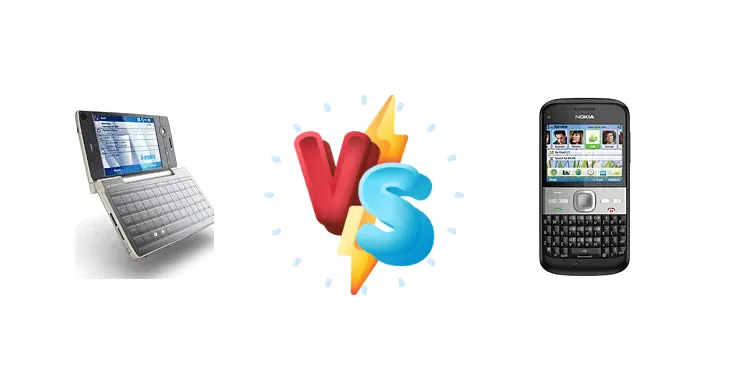
The i-mate Ultimate 7150 and Nokia E5 represent distinct approaches to early smartphone functionality. The i-mate, running Windows Mobile, aimed for a more PC-like experience, while the Nokia E5, built on Symbian, prioritized efficient communication and organization. This comparison revisits these devices, analyzing their strengths and weaknesses in a modern context.
🏆 Quick Verdict
For users prioritizing a more familiar desktop-like interface and potentially broader software compatibility (despite its age), the i-mate Ultimate 7150 offers a unique experience. However, the Nokia E5’s simpler, more refined Symbian OS and likely superior battery life make it the more practical choice for basic smartphone tasks.
| Network |
|---|
| 2G bands | GSM 850 / 900 / 1800 / 1900 | GSM 850 / 900 / 1800 / 1900 |
| 3G bands | HSDPA 850 / 1900 / 2100 | HSDPA 900 / 1900 / 2100 |
| Speed | HSPA | HSPA 10.2/2 Mbps |
| Technology | GSM / HSPA | GSM / HSPA |
| | - | HSDPA 850 / 1900 / 2100 |
| Launch |
|---|
| Announced | 2007, February | 2010, April. Released 2010, August |
| Status | Cancelled | Discontinued |
| Body |
|---|
| Dimensions | 110 x 74 x 18 mm (4.33 x 2.91 x 0.71 in) | 115 x 58.9 x 12.8 mm, 75 cc (4.53 x 2.32 x 0.50 in) |
| Keyboard | QWERTY | QWERTY |
| SIM | Mini-SIM | Mini-SIM |
| Weight | 180 g (6.35 oz) | 126 g (4.44 oz) |
| Display |
|---|
| Resolution | 640 x 480 pixels, 4:3 ratio (~211 ppi density) | 320 x 240 pixels, 4:3 ratio (~169 ppi density) |
| Size | 3.8 inches, 44.7 cm2 (~54.9% screen-to-body ratio) | 2.36 inches, 17.2 cm2 (~25.5% screen-to-body ratio) |
| Type | TFT resistive touchscreen, 256K colors (65K effective) | TFT, 256K colors |
| | Second OLED, 2.2 inches display (128 x 128 pixels)
Handwriting recognition | - |
| Platform |
|---|
| CPU | Intel Bulverde 520 MHz | 600 MHz ARM 11 |
| OS | Microsoft Windows Mobile 6.0 Professional | Symbian 9.3, Series 60 rel. 3.2 |
| Memory |
|---|
| Card slot | microSD | microSDHC (dedicated slot), 2 GB included |
| Internal | 128MB RAM, 256MB ROM | 250MB; 256MB RAM |
| Main Camera |
|---|
| Features | - | LED flash |
| Single | 2 MP | 5 MP |
| Video | Yes | 480p@15fps |
| Selfie camera |
|---|
| Single | VGA videocall camera | - |
| | - | No |
| Sound |
|---|
| 3.5mm jack | No | Yes |
| 35mm jack | No | Yes |
| Alert types | Vibration; Downloadable polyphonic, MP3 ringtones | - |
| Loudspeaker | Yes | Yes |
| Comms |
|---|
| Bluetooth | 2.0, A2DP | 2.0, A2DP |
| Infrared port | Yes | - |
| Positioning | No | GPS, A-GPS; Ovi Maps |
| Radio | Stereo FM radio | Stereo FM radio, RDS |
| USB | miniUSB | microUSB 2.0 |
| WLAN | Wi-Fi 802.11 b/g/e/i | Wi-Fi 802.11 b/g, UPnP & DLNA technology |
| Features |
|---|
| Browser | WAP 2.0/xHTML, HTML (PocketIE) | WAP 2.0/xHTML, HTML, Adobe Flash Lite |
| | Voice memo
MP3/AAC/AAC+/WMA/OGG/AMR player
WMV/MP4 player
Pocket Office
File manager
TV-out | Document editor (Word, Excel, PowerPoint), PDF viewer
MP4/H.264/WMV player
MP3/WAV/WMA/eAAC+ player
Voice command/dial
Organizer
Predictive text input |
| Battery |
|---|
| Music play | - | Up to 38 h |
| Stand-by | - | Up to 635 h (2G) / Up to 670 h (3G) |
| Talk time | - | Up to 13 h 10 min (2G) / Up to 5 h 15 min (3G) |
| Type | Removable Li-Ion 1400 mAh battery | Removable Li-Ion 1200 mAh battery (BL-4D) |
| Misc |
|---|
| Colors | Silver | Carbon Black, Chalk White, Sky Blue, Copper Brown, Silver Grey |
| Price | About 300 EUR | About 90 EUR |
| SAR | - | 1.18 W/kg (head) 1.12 W/kg (body) |
| SAR EU | - | 0.88 W/kg (head) |
| Tests |
|---|
| Audio quality | - |
Noise -90.0dB / Crosstalk -91.5dB |
| Camera | - |
Photo |
| Loudspeaker | - |
Voice 75dB / Noise 66dB / Ring 75dB |
i-mate Ultimate 7150
- Unique x86 architecture for potential software compatibility.
- Windows Mobile offers a desktop-like interface.
- Compact form factor for portability.
- Intel Bulverde processor is power-hungry.
- Windows Mobile can be complex and resource-intensive.
- Limited camera capabilities.
Nokia E5
- Efficient ARM 11 processor for longer battery life.
- Symbian OS is simple and reliable.
- Compact and durable design.
- Symbian OS is less versatile than Windows Mobile.
- Limited app ecosystem compared to modern smartphones.
- Basic camera capabilities.
Display Comparison
Neither device boasts a standout display by modern standards. Details regarding screen resolution and panel type are unavailable, but both likely featured low-resolution color displays typical of the era. The i-mate’s focus was on functionality, not visual fidelity, while the Nokia E5 prioritized readability for text-heavy tasks. Bezels were substantial on both, maximizing screen real estate within a compact footprint.
Camera Comparison
Both devices feature a 'Photo' camera, indicating a basic camera functionality. Specific megapixel counts are not provided, but image quality would have been limited by the technology of the time. The cameras were primarily intended for basic documentation, not high-quality photography. The Nokia E5, benefiting from Nokia’s established camera expertise, likely offered slightly better image processing and usability, but neither device is a contender for modern smartphone photography.
Performance
The i-mate Ultimate 7150’s 520 MHz Intel Bulverde processor represents an attempt to bring x86 architecture to the mobile space. While offering potential compatibility advantages, it was often less power-efficient than the ARM-based processors common at the time. The Nokia E5, with its 600 MHz ARM 11 processor, likely offered a smoother, more responsive experience for everyday tasks due to the ARM architecture’s inherent efficiency. The ARM 11’s lower power consumption would have translated to longer battery life. The Bulverde’s architecture, while theoretically capable, was hampered by software optimization challenges.
Battery Life
Battery capacity details are unavailable for either device. However, the Nokia E5’s ARM 11 processor likely resulted in significantly better battery life compared to the i-mate Ultimate 7150’s power-hungry Intel Bulverde. The i-mate’s x86 architecture and Windows Mobile OS would have placed a greater strain on the battery, requiring more frequent charging. The Nokia E5’s Symbian OS was designed for efficiency, maximizing battery life for extended use.
Buying Guide
Buy the i-mate Ultimate 7150 if you're a collector interested in experiencing Windows Mobile on a dedicated device, or if you require specific legacy software compatibility. Buy the Nokia E5 if you value simplicity, reliability, and a focus on core communication features – a digital notepad and phone in a compact form factor.
Frequently Asked Questions
❓ Is the i-mate Ultimate 7150 compatible with modern Windows software?
No, the i-mate Ultimate 7150 runs Windows Mobile, a legacy operating system. While some compatibility layers exist, running modern Windows software directly is not possible. Its strength lies in running older Windows Mobile applications.
❓ Can the Nokia E5 be used for basic internet browsing?
Yes, the Nokia E5 supports basic internet browsing through its built-in web browser. However, the experience will be significantly slower and less feature-rich compared to modern smartphones due to the limited processing power and slower data speeds of the time.
❓ Which device is easier to repair if something goes wrong?
The Nokia E5 is likely easier to repair due to its simpler construction and wider availability of spare parts. The i-mate Ultimate 7150, with its less common x86 architecture, may be more difficult to find parts for.