
i-mate Ultimate 6150 vs. Samsung Galaxy S23 Ultra: A 20-Year Tech Time Capsule
| Phones Images | |||||
|---|---|---|---|---|---|
|
🏆 Quick Verdict
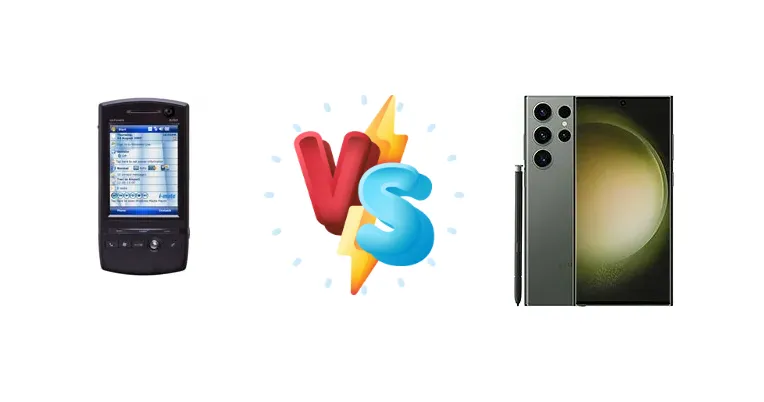
The Samsung Galaxy S23 Ultra unequivocally wins this comparison. Its Snapdragon 8 Gen 2 chipset, stunning display, and advanced camera system are light years ahead of the i-mate Ultimate 6150. However, the i-mate deserves recognition as a pioneer that paved the way for today's smartphones.
| PHONES | ||
|---|---|---|
| Phone Names | i-mate Ultimate 6150 | Samsung Galaxy S23 Ultra |
| Network | ||
|---|---|---|
| 2G bands | GSM 850 / 900 / 1800 / 1900 | GSM 850 / 900 / 1800 / 1900 |
| 3G bands | HSDPA 850 / 1900 / 2100 | HSDPA 850 / 900 / 1700(AWS) / 1900 / 2100 |
| 4G bands | - | 1, 2, 3, 4, 5, 7, 8, 12, 13, 17, 18, 19, 20, 25, 26, 28, 32, 38, 39, 40, 41, 66 - International |
| 5G bands | - | 1, 2, 3, 5, 7, 8, 12, 20, 25, 28, 38, 40, 41, 66, 75, 77, 78 SA/NSA/Sub6 - International |
| Speed | HSPA | HSPA, LTE (up to 7CA), 5G |
| Technology | GSM / HSPA | GSM / CDMA / HSPA / EVDO / LTE / 5G |
| - | 1, 7, 28, 41, 66, 71, 78, 258, 260, 261 SA/NSA/Sub6/mmWave - USA | |
| Launch | ||
|---|---|---|
| Announced | 2007, February. Released 2008, January | 2023, February 01 |
| Status | Discontinued | Available. Released 2023, February 17 |
| Body | ||
|---|---|---|
| Build | - | Glass front (Gorilla Glass Victus 2), glass back (Gorilla Glass Victus 2), aluminum frame |
| Dimensions | 118.5 x 60.5 x 15.5 mm (4.67 x 2.38 x 0.61 in) | 163.4 x 78.1 x 8.9 mm (6.43 x 3.07 x 0.35 in) |
| SIM | Mini-SIM | · Nano-SIM + eSIM· Nano-SIM + Nano-SIM + eSIM (max 2 at a time) |
| Weight | 152 g (5.36 oz) | 234 g (8.25 oz) |
| - | IP68 dust/water resistant (up to 1.5m for 30 min) Armor aluminum frame with tougher drop and scratch resistance (advertised) Stylus (Bluetooth integration, accelerometer, gyro) | |
| Display | ||
|---|---|---|
| Protection | - | Corning Gorilla Glass Victus 2 |
| Resolution | 640 x 480 pixels, 4:3 ratio (~286 ppi density) | 1440 x 3088 pixels, 19.3:9 ratio (~500 ppi density) |
| Size | 2.8 inches, 24.3 cm2 (~33.9% screen-to-body ratio) | 6.8 inches, 114.7 cm2 (~89.9% screen-to-body ratio) |
| Type | TFT resistive touchscreen, 256K colors (65K effective) | Dynamic AMOLED 2X, 120Hz, HDR10+, 1200 nits (HBM), 1750 nits (peak) |
| Handwriting recognition | Always-on display | |
| Platform | ||
|---|---|---|
| CPU | Intel Bulverde 520 MHz | Octa-core (1x3.36 GHz Cortex-X3 & 2x2.8 GHz Cortex-A715 & 2x2.8 GHz Cortex-A710 & 3x2.0 GHz Cortex-A510) |
| Chipset | - | Qualcomm SM8550-AC Snapdragon 8 Gen 2 (4 nm) |
| GPU | - | Adreno 740 |
| OS | Microsoft Windows Mobile 6.0 Professional | Android 13, up to 4 major Android upgrades, One UI 8 |
| Memory | ||
|---|---|---|
| Card slot | microSD (dedicated slot) | No |
| Internal | 128MB RAM, 256MB ROM | 256GB 8GB RAM, 256GB 12GB RAM, 512GB 12GB RAM, 1TB 12GB RAM |
| - | UFS 4.0 | |
| Main Camera | ||
|---|---|---|
| Features | - | Laser AF, LED flash, auto-HDR, panorama |
| Quad | - | 200 MP, f/1.7, 24mm (wide), 1/1.3", 0.6µm, multi-directional PDAF, OIS 10 MP, f/2.4, 70mm (telephoto), 1/3.52", 1.12µm, PDAF, OIS, 3x optical zoom 10 MP, f/4.9, 230mm (periscope telephoto), 1/3.52", 1.12µm, PDAF, OIS, 10x optical zoom 12 MP, f/2.2, 13mm, 120˚ (ultrawide), 1/2.55", 1.4µm, dual pixel PDAF, Super Steady video |
| Single | 2 MP | 12 MP, f/2.2, 26mm (wide), Dual Pixel PDAF |
| Video | Yes | 8K@24/30fps, 4K@30/60fps, 1080p@30/60/120/240fps, HDR10+, stereo sound rec., gyro-EIS |
| Selfie camera | ||
|---|---|---|
| Features | - | HDR, HDR10+ |
| Single | VGA videocall camera | 12 MP, f/2.2, 26mm (wide), 1/3.2", 1.12µm, dual pixel PDAF |
| Video | - | 4K@30/60fps, 1080p@30fps |
| Sound | ||
|---|---|---|
| 3.5mm jack | No | No |
| 35mm jack | No | No |
| Alert types | Vibration; Downloadable polyphonic, MP3 ringtones | - |
| Loudspeaker | Yes | Yes, with stereo speakers |
| - | 32-bit/384kHz audio Tuned by AKG | |
| Comms | ||
|---|---|---|
| Bluetooth | 2.0, A2DP | 5.3, A2DP, LE |
| Infrared port | Yes | - |
| NFC | - | Yes |
| Positioning | No | GPS, GALILEO, GLONASS, BDS, QZSS |
| Radio | Stereo FM radio | No |
| USB | miniUSB | USB Type-C 3.2, OTG |
| WLAN | Wi-Fi 802.11 b/g/e/i | Wi-Fi 802.11 a/b/g/n/ac/6e, tri-band, Wi-Fi Direct |
| Features | ||
|---|---|---|
| Browser | WAP 2.0/xHTML, HTML (PocketIE) | - |
| Sensors | - | Fingerprint (under display, ultrasonic), accelerometer, gyro, proximity, compass, barometer |
| Voice memo MP3/AAC/AAC+/WMA/OGG/AMR player WMV/MP4 player Pocket Office File manager TV-out | Samsung DeX, Samsung Wireless DeX (desktop experience support) Bixby natural language commands and dictation Samsung Pay (Visa, MasterCard certified) Ultra Wideband (UWB) support | |
| Battery | ||
|---|---|---|
| Charging | - | 45W wired, PD3.0, 65% in 30 min 15W wireless (Qi) 4.5W reverse wireless |
| Type | Removable Li-Ion 1530 mAh battery | Li-Ion 5000 mAh |
| Misc | ||
|---|---|---|
| Colors | Silver | Phantom Black, Green, Cream, Lavender, Graphite, Sky Blue, Lime, Red, BMW M Edition |
| Models | - | SM-S918B, SM-S918B/DS, SM-S918U, SM-S918U1, SM-S918W, SM-S918N, SM-S9180, SM-S918E, SM-S918E/DS |
| Price | About 260 EUR | € 549.90 / $ 454.99 / £ 433.00 |
| SAR | - | 1.12 W/kg (head) 0.92 W/kg (body) |
| SAR EU | - | 0.96 W/kg (head) 1.40 W/kg (body) |
| Tests | ||
|---|---|---|
| Battery life | - | Endurance rating 126h |
| Camera | - | Photo / Video |
| Display | - | Contrast ratio: Infinite (nominal) |
| Loudspeaker | - | -25.6 LUFS (Very good) |
| Performance | - | AnTuTu: 1241531 (v9) GeekBench: 4927 (v5.1) GFXBench: 67fps (ES 3.1 onscreen) |
i-mate Ultimate 6150
- Historical significance – a pioneer in smartphone design.
- Compact size – significantly smaller and lighter than modern phones.
- Unique aesthetic – a nostalgic design for collectors.
- Extremely limited processing power.
- Low-resolution display.
- Poor camera quality.
- Limited battery life.
Samsung Galaxy S23 Ultra
- Exceptional performance with Snapdragon 8 Gen 2.
- Stunning display with high brightness and contrast.
- Advanced camera system with excellent image quality.
- Long-lasting battery life with fast charging.
- Modern features and software support.
- High price point.
- Large size and weight.
- Complex software with potential bloatware.
Display Comparison
The i-mate Ultimate 6150’s display specifications are unavailable, but typical of the era, it would have been a small, low-resolution LCD. In contrast, the Samsung Galaxy S23 Ultra boasts a display capable of reaching 1274 nits of peak brightness, offering exceptional visibility even in direct sunlight. The S23 Ultra’s infinite contrast ratio, likely achieved through OLED technology, provides deep blacks and vibrant colors, a stark contrast to the limited color gamut and lower brightness of the i-mate. The S23 Ultra also benefits from adaptive refresh rate technology (LTPO) for smoother scrolling and improved power efficiency, a feature unimaginable in 2004.
Camera Comparison
Camera details for the i-mate Ultimate 6150 are limited, but it likely featured a low-resolution CMOS sensor. The Samsung Galaxy S23 Ultra, on the other hand, features a sophisticated camera system with a high-resolution primary sensor (details unspecified in provided data, but likely 200MP) and advanced image processing algorithms. The S23 Ultra’s optical image stabilization (OIS) and larger lens apertures allow for superior low-light performance and sharper images. The i-mate’s camera would be limited to basic photography, while the S23 Ultra offers professional-grade photo and video capabilities.
Performance
The i-mate Ultimate 6150’s Intel Bulverde 520 MHz CPU represents a significant technological leap *for its time*, but is dwarfed by the Samsung Galaxy S23 Ultra’s Qualcomm Snapdragon 8 Gen 2 (4nm). The Snapdragon 8 Gen 2’s octa-core architecture (1x3.36 GHz Cortex-X3, 2x2.8 GHz Cortex-A715, 2x2.8 GHz Cortex-A710, 3x2.0 GHz Cortex-A510) delivers exponentially faster processing speeds and significantly improved multi-tasking capabilities. The 4nm fabrication process of the Snapdragon 8 Gen 2 also contributes to superior thermal efficiency, preventing throttling during demanding tasks. The i-mate would struggle with even basic modern apps, while the S23 Ultra handles graphically intensive games and complex applications with ease.
Battery Life
Battery capacity for the i-mate Ultimate 6150 is unknown, but typical of devices from that era, it would have offered limited talk time and standby duration. The Samsung Galaxy S23 Ultra’s endurance rating of 126 hours and active use score of 13:24h demonstrate a massive improvement in battery life. The S23 Ultra also supports 45W wired charging with PD3.0, achieving a 65% charge in just 30 minutes, and 15W wireless charging (Qi), features unavailable on the i-mate. The addition of 4.5W reverse wireless charging further enhances the S23 Ultra’s versatility.
Buying Guide
Buy the i-mate Ultimate 6150 if you're a collector of mobile history, fascinated by the early days of smartphone development, or seeking a nostalgic piece of tech. Buy the Samsung Galaxy S23 Ultra if you demand cutting-edge performance, a versatile camera, all-day battery life, and the latest features in a modern smartphone experience.