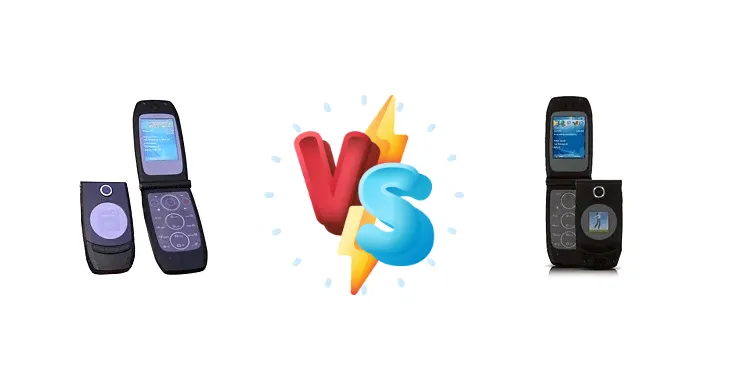
The i-mate Smartflip and Qtek 8500 represent a pivotal moment in smartphone history, offering early adopters a glimpse into the potential of mobile Windows. Both devices, released around the same time, aimed to bridge the gap between PDAs and mobile phones. However, despite sharing the same core hardware – the TI OMAP 850 chipset – subtle differences in design and software implementation create distinct user experiences. This comparison dissects those nuances.
🏆 Quick Verdict
For the average user seeking a functional early Windows Mobile device, the Qtek 8500 emerges as the slightly more practical choice. While both share identical processing power, Qtek’s brand recognition and potentially wider software support at the time of release give it a marginal edge. However, the Smartflip’s design may appeal to those prioritizing a more compact form factor.
| Network |
|---|
| 2G bands | GSM 850 / 900 / 1800 / 1900 | GSM 850 / 900 / 1800 / 1900 |
| EDGE | Class 10 | Class 10 |
| GPRS | Class 10 | Class 10 |
| Technology | GSM | GSM |
| Launch |
|---|
| Announced | 2006, February | 2006, February |
| Status | Discontinued | Discontinued |
| Body |
|---|
| Dimensions | 98.5 x 51.4 x 15.8 mm (3.88 x 2.02 x 0.62 in) | 98.5 x 51.4 x 15.8 mm (3.88 x 2.02 x 0.62 in) |
| SIM | Mini-SIM | Mini-SIM |
| Weight | 99 g (3.49 oz) | 99 g (3.49 oz) |
| Display |
|---|
| Resolution | 240 x 320 pixels, 2.2 inches, 4:3 ratio (~182 ppi density) | 240 x 320 pixels, 4:3 ratio (~182 ppi density) |
| Size | 2.2 inches, 34 x 45 mm, 15.0 cm2 (~29.6% screen-to-body ratio) | 2.2 inches, 34 x 45 mm, 15.0 cm2 (~29.6% screen-to-body ratio) |
| Type | TFT, 65K colors | TFT, 65K colors |
| | Second external 1.2-inch TFT display, 65K colors (128 x 128 pixels) | Second external 1.2-inch TFT display, 65K colors (128 x 128 pixels) |
| Platform |
|---|
| CPU | 200 MHz ARM926EJ-S | 200 MHz ARM926EJ-S |
| Chipset | TI OMAP 850 | TI OMAP 850 |
| OS | Microsoft Windows Mobile 5.0 Smartphone | Microsoft Windows Mobile 5.0 Smartphone |
| Memory |
|---|
| Card slot | microSD (dedicated slot) | microSD (dedicated slot) |
| Internal | 64MB RAM, 64MB ROM | 64MB RAM, 64MB ROM |
| Main Camera |
|---|
| Single | 1.3 MP | 1.3 MP |
| Video | Yes | Yes |
| Sound |
|---|
| 3.5mm jack | No | No |
| 35mm jack | No | No |
| Alert types | Vibration; Downloadable polyphonic, MP3 ringtones | Vibration; Downloadable polyphonic, MP3 ringtones |
| Loudspeaker | Yes | Yes |
| Comms |
|---|
| Bluetooth | 1.2 | 1.2 |
| Positioning | No | No |
| Radio | No | No |
| USB | 1.1 | 1.1 |
| WLAN | No | No |
| Features |
|---|
| Browser | WAP 2.0/xHTML, HTML (PocketIE) | WAP 2.0/xHTML, HTML (PocketIE) |
| | Pocket Office
Voice memo/dial
MP3/AAC player
Predictive text input | Pocket Office
Voice memo
MP3/AAC player
Predictive text input |
| Battery |
|---|
| Type | Removable Li-Ion 750 mAh battery | Removable Li-Ion 750 mAh battery |
| Misc |
|---|
| Colors | Stylish black | Stylish black |
| Price | About 110 EUR | About 190 EUR |
i-mate Smartflip
- More compact and pocketable design.
- Potentially more unique aesthetic.
- May appeal to users prioritizing minimalism.
- Potentially limited software support due to i-mate's smaller market share.
- Smaller screen may hinder usability for some tasks.
Qtek 8500
- Stronger brand recognition and potential for wider software compatibility.
- Likely a larger user community for support and troubleshooting.
- More conventional smartphone form factor.
- May be slightly larger and less portable than the Smartflip.
- Design may be less distinctive.
Display Comparison
Both the i-mate Smartflip and Qtek 8500 likely feature similar small-scale LCD displays, typical of the era. Given the shared chipset and target market, display resolution is likely comparable, around 176x220 pixels. The key difference will be in screen size and viewing angles, with the Smartflip potentially sacrificing screen real estate for a more compact form factor. Neither device will offer the vibrant colors or high resolutions of modern smartphones, but usability will depend on backlight brightness and contrast ratios, specs not provided.
Camera Comparison
Both devices likely include a basic camera, typical of early smartphones – likely a VGA (0.3MP) sensor. Image quality will be poor by modern standards, with limited detail and significant noise. The camera’s primary function will be capturing quick snapshots for notes or contact photos, rather than serious photography. Lens aperture and the presence of any image stabilization are unlikely to be significant factors given the technology of the time.
Performance
The core of both devices is the TI OMAP 850 chipset, featuring a 200 MHz ARM926EJ-S CPU. This means raw processing power is identical. Performance differences will stem from RAM allocation and software optimization. While the amount of RAM isn’t specified, the Qtek 8500, being a more mainstream brand, may have benefited from slightly more aggressive memory management. The OMAP 850’s limitations will be apparent with multitasking and demanding applications, highlighting the era’s constraints.
Battery Life
Battery life will be heavily dependent on usage patterns. The 200 MHz ARM9 processor is relatively power-efficient, but the Windows Mobile operating system and constant radio activity will drain the battery quickly. Battery capacity is not specified, but both devices likely utilize similar-sized batteries given their comparable form factors. Expect a maximum of 24-48 hours of standby time and several hours of talk time, depending on network conditions.
Buying Guide
Buy the i-mate Smartflip if you prioritize extreme portability and a minimalist design, and are comfortable with potentially limited software support. Its smaller size makes it ideal for users who primarily need basic PDA functionality on the go. Buy the Qtek 8500 if you value brand reliability, a potentially larger user community for troubleshooting, and a more conventional smartphone experience. It’s the better option for users intending to heavily utilize Windows Mobile’s features.
Frequently Asked Questions
❓ Will either of these phones work reliably on modern cellular networks?
No. These devices are designed for 2G and potentially early 3G networks. Modern cellular infrastructure has evolved significantly, and they will likely not be compatible or will experience extremely limited functionality.
❓ Can I install modern apps on the i-mate Smartflip or Qtek 8500?
No. These devices run Windows Mobile, a legacy operating system. Modern Android or iOS apps are not compatible. While some enthusiasts have attempted to port alternative operating systems, it's a complex process with limited success.
❓ What kind of storage does the OMAP 850 chipset support, and is it expandable?
The OMAP 850 typically supports CompactFlash (CF) or Secure Digital (SD) card expansion for storage. Internal storage is likely limited, making external storage essential for storing applications, contacts, and media. The specific card type and maximum capacity will vary by model.
❓ Is it possible to use these phones as a Bluetooth modem for a laptop?
Yes, both the i-mate Smartflip and Qtek 8500 support Bluetooth connectivity and can be used as a Bluetooth modem for a laptop, providing limited internet access through the cellular network. However, data transfer speeds will be slow compared to modern standards.