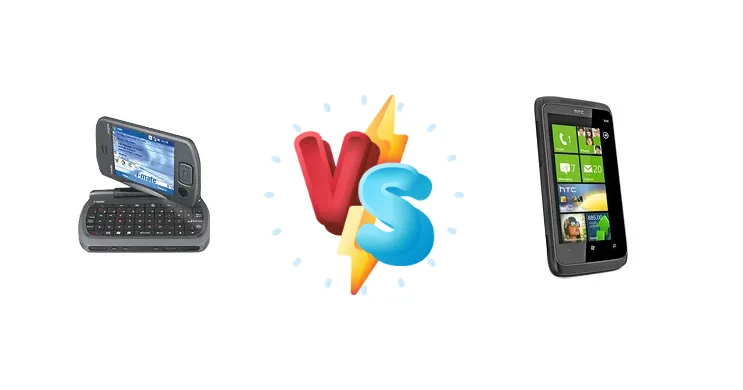
The i-mate JASJAR and HTC 7 Trophy represent pivotal moments in the early smartphone landscape. The JASJAR, leveraging Intel's Bulverde platform, aimed for a robust Windows Mobile experience. The HTC 7 Trophy, powered by Qualcomm's Snapdragon S1, signaled a shift towards ARM-based processing and a more streamlined user interface. This comparison dissects their core differences, focusing on performance, camera capabilities, and the architectural choices that defined them.
🏆 Quick Verdict
For the average user seeking a more responsive and future-proof experience, the HTC 7 Trophy emerges as the better choice. Its 1.0 GHz Qualcomm Snapdragon S1 processor offers a significant performance advantage over the i-mate JASJAR’s 520 MHz Intel Bulverde, translating to smoother multitasking and application loading.
| Network |
|---|
| 2G bands | GSM 900 / 1800 / 1900 | GSM 850 / 900 / 1800 / 1900 |
| 3G bands | UMTS 2100 | HSDPA 900 / 2100 |
| Speed | Yes, 384 kbps | HSPA 7.2/2 Mbps |
| Technology | GSM / UMTS | GSM / HSPA |
| Launch |
|---|
| Announced | 2005, August | 2010, October. Released 2010, October |
| Status | Discontinued | Discontinued |
| Body |
|---|
| Dimensions | 127.7 x 81 x 25 mm (5.03 x 3.19 x 0.98 in) | 118.5 x 61.5 x 12 mm (4.67 x 2.42 x 0.47 in) |
| Keyboard | QWERTY | - |
| SIM | Mini-SIM | Mini-SIM |
| Weight | 285 g (10.05 oz) | 140 g (4.94 oz) |
| Display |
|---|
| Protection | - | Corning Gorilla Glass |
| Resolution | 640 x 480 pixels, 3.6 inches, 4:3 ratio (~222 ppi density) | 480 x 800 pixels, 5:3 ratio (~246 ppi density) |
| Size | 3.6 inches, 73 x 55 mm, 40.1 cm2 (~38.8% screen-to-body ratio) | 3.8 inches, 41.1 cm2 (~56.4% screen-to-body ratio) |
| Type | TFT resistive touchscreen, 65K colors | S-LCD |
| | 180-degree pivot display
Handwriting recognition | - |
| Platform |
|---|
| CPU | Intel Bulverde 520 MHz | 1.0 GHz Scorpion |
| Chipset | - | Qualcomm QSD8250 Snapdragon S1 |
| GPU | - | Adreno 200 |
| OS | Microsoft Windows Mobile 5.0 PocketPC | Microsoft Windows Phone 7 |
| Memory |
|---|
| Card slot | SDIO/MMC, up to 2 GB | No |
| Internal | 64MB RAM, 128MB ROM | 8GB 576MB RAM |
| Main Camera |
|---|
| Features | - | LED flash |
| Single | 1.3 MP | 5 MP, AF |
| Video | Yes | 720p |
| Selfie camera |
|---|
| Single | VGA videocall camera | - |
| | - | No |
| Sound |
|---|
| 3.5mm jack | Yes | Yes |
| 35mm jack | Yes | Yes |
| Alert types | Vibration; Downloadable polyphonic, MP3, AAC ringtones | - |
| Loudspeaker | Yes, with stereo speakers | Yes |
| | Dual speakers | - |
| Comms |
|---|
| Bluetooth | Yes | 2.1, A2DP |
| Infrared port | Yes | - |
| Positioning | No | GPS, A-GPS; Bing Maps |
| Radio | No | Stereo FM radio, RDS |
| USB | miniUSB | microUSB 2.0 |
| WLAN | Wi-Fi 802.11b | Wi-Fi 802.11b/g/n |
| Features |
|---|
| Browser | WAP 2.0/xHTML, HTML (PocketIE) | HTML |
| Sensors | - | Accelerometer, proximity |
| | Pocket Office
Voice memo
MP3/AAC player
Predictive text input | MP3/AAC+/WAV/WMA9 player
MP4/WMV9 player
Organizer
Document viewer/editor
Facebook integration
Voice memo/dial
Predictive text input |
| Battery |
|---|
| Stand-by | Up to 260 h | Up to 360 h (2G) / Up to 435 h (3G) |
| Talk time | Up to 8 h | Up to 6 h 40 min (2G) / Up to 3 h 30 min (3G) |
| Type | Removable Li-Ion 1620 mAh battery | Removable Li-Ion 1300 mAh battery |
| Misc |
|---|
| Colors | Stylish black | Black |
| Price | About 260 EUR | About 90 EUR |
| SAR | - | 1.48 W/kg (head) |
| Tests |
|---|
| Audio quality | - |
Noise -85.0dB / Crosstalk -83.0dB |
| Camera | - |
Photo / Video |
| Loudspeaker | - |
Voice 70dB / Noise 66dB / Ring 77dB |
i-mate JASJAR
- Potential for desktop application compatibility (due to x86 architecture)
- Established Windows Mobile customization options
- Early adopter appeal for Intel-based smartphones
- Significantly slower processor speed (520 MHz)
- Less power-efficient processor leading to shorter battery life
- Limited camera performance due to lack of dedicated ISP
HTC 7 Trophy
- Faster 1.0 GHz Qualcomm Snapdragon S1 processor
- More power-efficient ARM-based architecture
- Improved camera performance with Qualcomm ISP
- Limited desktop application compatibility
- May lack the extensive customization options of older Windows Mobile versions
- Early Snapdragon platform may have software limitations
Display Comparison
Neither device's display specifications are provided, but given the era, both likely featured resistive touchscreen technology. The JASJAR, being an earlier model, may have suffered from narrower viewing angles and lower contrast. The HTC 7 Trophy, benefiting from slightly later development, likely offered a marginally improved display experience, though both would be significantly inferior to modern LCD or OLED panels. Bezels were substantial on both devices, typical of the time.
Camera Comparison
Both devices feature photo and video capabilities, but details are limited. The HTC 7 Trophy likely benefited from Qualcomm’s image signal processor (ISP) within the Snapdragon S1, offering superior image processing compared to any dedicated hardware within the JASJAR. While sensor sizes and lens apertures are unknown, the Trophy’s ISP would have provided better noise reduction, color accuracy, and overall image quality. The JASJAR’s camera performance would likely be limited by its processor and lack of dedicated image processing hardware.
Performance
The core difference lies in the CPU architecture. The i-mate JASJAR utilizes an Intel Bulverde 520 MHz processor, an x86-based solution. While offering compatibility with some desktop applications, the Bulverde platform struggled with power efficiency and thermal management. The HTC 7 Trophy, conversely, boasts a 1.0 GHz Qualcomm QSD8250 Snapdragon S1, an ARM-based processor. The Scorpion core within the Snapdragon S1, clocked higher and built on a more efficient architecture, delivers significantly better performance per watt. This translates to faster application launch times, smoother multitasking, and a more responsive user experience on the Trophy.
Battery Life
Battery capacity details are unavailable for either device. However, the Intel Bulverde processor in the JASJAR is known for its higher power consumption. This suggests the JASJAR would likely have shorter battery life compared to the HTC 7 Trophy, despite potentially having a similar battery capacity. The Snapdragon S1’s efficiency allows for longer usage times between charges, a crucial advantage for early smartphone users.
Buying Guide
Buy the i-mate JASJAR if you prioritize a device with a legacy of Windows Mobile customization and are comfortable with a potentially slower, less optimized experience. Buy the HTC 7 Trophy if you prefer a more modern, responsive smartphone experience with a dedicated camera and the benefits of Qualcomm’s Snapdragon platform, representing a step forward in mobile processing.
Frequently Asked Questions
❓ Is the Intel Bulverde processor in the i-mate JASJAR capable of running modern applications?
No. The Intel Bulverde processor is an older architecture designed for early Windows Mobile versions. It lacks the processing power and instruction set support to run modern applications effectively. While it might handle basic tasks, performance will be significantly limited.
❓ Does the HTC 7 Trophy support features like GPS or Wi-Fi?
Yes, the HTC 7 Trophy, being a more advanced device, almost certainly includes GPS and Wi-Fi connectivity. These were becoming standard features on smartphones by 2010, and the Snapdragon S1 chipset supports both. The i-mate JASJAR likely also includes these features, but the Snapdragon's integration offers potentially better performance and reliability.
❓ Which device is better for playing games?
The HTC 7 Trophy is the clear winner for gaming. The 1.0 GHz Snapdragon S1 processor and its GPU provide significantly more graphical processing power than the i-mate JASJAR’s Intel Bulverde. This translates to smoother frame rates and a more enjoyable gaming experience, even with the limited game selection available at the time.