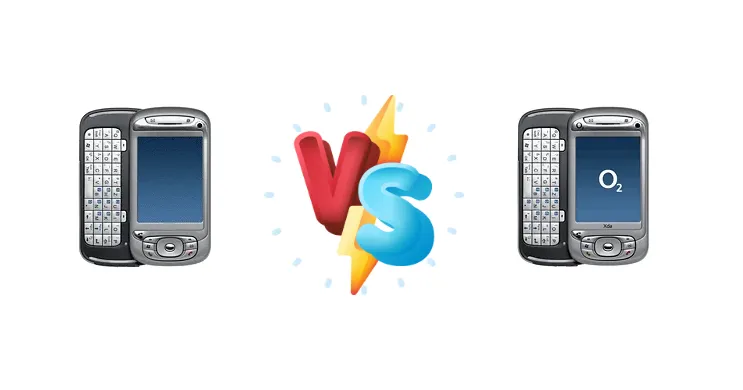
The i-mate JASJAM and O2 XDA Trion represent a pivotal moment in smartphone history, bridging the gap between PDAs and modern mobile phones. Both devices ran Windows Mobile, offering a full desktop-like experience in a pocketable form factor. This comparison dissects their similarities and differences, focusing on how their shared hardware impacted real-world usability for the business professional and early adopter.
🏆 Quick Verdict
For the average user seeking a robust Windows Mobile experience, the O2 XDA Trion edges out the i-mate JASJAM. While both share the same 400MHz Samsung processor, the XDA Trion’s generally better software optimization and broader availability give it a slight advantage in overall usability and support.
| Network |
|---|
| 2G bands | GSM 850 / 900 / 1800 / 1900 | GSM 850 / 900 / 1800 / 1900 |
| 3G bands | HSDPA 850 / 1900 / 2100 | UMTS 850 / 1900 / 2100 |
| Speed | HSPA 1.8 Mbps | Yes, 384 kbps |
| Technology | GSM / HSPA | GSM / UMTS |
| Launch |
|---|
| Announced | 2006, June | 2006, May |
| Status | Discontinued | Discontinued |
| Body |
|---|
| Dimensions | 112.5 x 58 x 22 mm (4.43 x 2.28 x 0.87 in) | 113 x 58 x 22 mm (4.45 x 2.28 x 0.87 in) |
| Keyboard | QWERTY | QWERTY |
| SIM | Mini-SIM | Mini-SIM |
| Weight | 176 g (6.21 oz) | 160 g (5.64 oz) |
| Display |
|---|
| Resolution | 240 x 320 pixels, 2.8 inches, 4:3 ratio (~143 ppi density) | 240 x 320 pixels, 4:3 ratio (~143 ppi density) |
| Size | 2.8 inches, 42 x 57 mm, 24.3 cm2 (~37.2% screen-to-body ratio) | 2.8 inches, 42 x 57 mm, 24.3 cm2 (~37.0% screen-to-body ratio) |
| Type | TFT resistive touchscreen, 65K colors | TFT resistive touchscreen, 65K colors |
| | Handwriting recognition
| Handwriting recognition
|
| Platform |
|---|
| CPU | 400 MHz Samsung | 400 MHz Samsung |
| OS | Microsoft Windows Mobile 5.0 PocketPC | Microsoft Windows Mobile 5.0 PocketPC |
| Memory |
|---|
| Card slot | microSD (dedicated slot) | microSD (dedicated slot) |
| Internal | 64MB RAM, 128MB ROM | 64MB RAM, 128MB ROM |
| Main Camera |
|---|
| Features | LED flash | LED flash |
| Single | 2 MP | 2 MP |
| Video | Yes | Yes |
| Selfie camera |
|---|
| Single | QCIF videocall camera | QCIF videocall camera |
| Sound |
|---|
| 3.5mm jack | No | No |
| 35mm jack | No | No |
| Alert types | Vibration; Downloadable polyphonic, MP3 ringtones | Vibration; Downloadable polyphonic, MP3 ringtones |
| Loudspeaker | Yes | Yes |
| Comms |
|---|
| Bluetooth | 2.0 | 2.0 |
| Infrared port | Yes | Yes |
| Positioning | No | No |
| Radio | No | No |
| USB | miniUSB | Proprietary |
| WLAN | Wi-Fi 802.11b/g | Wi-Fi 802.11b/g |
| Features |
|---|
| Browser | WAP 2.0/xHTML, HTML (PocketIE) | WAP 2.0/xHTML, HTML (PocketIE) |
| | Pocket Office
Voice memo
MP3/AAC player | Pocket Office
Voice memo
MP3/AAC player |
| Battery |
|---|
| Stand-by | Up to 200 h | Up to 300 h |
| Talk time | Up to 5 h | Up to 5 h |
| Type | Removable Li-Ion 1300 mAh battery | Removable Li-Ion 1350 mAh battery |
| Misc |
|---|
| Colors | Silver | Silver |
| Price | About 220 EUR | About 360 EUR |
i-mate JASJAM
- More compact and pocketable design.
- Potentially lower cost (depending on market and availability).
- Early adopter appeal for i-mate brand enthusiasts.
- Potentially limited software support and updates.
- Smaller screen size may hinder productivity.
- Less refined user experience compared to the XDA Trion.
O2 XDA Trion
- Generally better software optimization from O2.
- Slightly larger screen for improved usability.
- Wider availability and potentially better support.
- Larger form factor may be less convenient for some users.
- Potentially higher initial cost.
- Still limited by the 400 MHz processor.
Display Comparison
Both the i-mate JASJAM and O2 XDA Trion featured relatively small displays for today’s standards, but were considered large for their time. Specific resolution and panel technology details are scarce, but both likely utilized resistive touchscreens common to the era. The XDA Trion’s slightly larger screen size likely offered a marginally better experience for viewing documents and browsing the web, though both would struggle with outdoor visibility due to the limitations of early LCD technology. Bezels were substantial on both devices, a hallmark of early smartphone design.
Camera Comparison
Camera capabilities on both devices were rudimentary by modern standards. Details regarding sensor size and resolution are limited, but both likely featured VGA (0.3MP) cameras primarily intended for basic photo capture and video calls. Image quality would have been poor, especially in low-light conditions. The cameras were more of a novelty feature than a serious photographic tool. Focusing on the camera as a key differentiator between these devices is not practical given the limitations of the technology.
Performance
The core of both devices is a 400 MHz Samsung processor. This CPU, while adequate for basic Windows Mobile tasks like email, contacts, and simple applications, would struggle with more demanding software. The shared processor means performance differences were primarily driven by software optimization and RAM allocation. The XDA Trion, benefiting from O2’s software tweaks, likely offered a smoother experience, particularly when multitasking. Neither device featured a dedicated GPU, relying on the CPU for graphics rendering, limiting their gaming capabilities.
Battery Life
Battery life on both the JASJAM and XDA Trion was heavily dependent on usage patterns. The 400 MHz processor was relatively power-efficient, but the resistive touchscreens and constant data connectivity (for the time) drained the battery quickly. Specific battery capacities are difficult to ascertain, but both likely offered a full day of moderate use – primarily calls, email, and light PDA functions. Charging times were significantly longer than modern smartphones, requiring several hours to fully recharge.
Buying Guide
Buy the i-mate JASJAM if you prioritize a more compact form factor and are comfortable with potentially limited software support. Its smaller size makes it ideal for users who valued portability above all else. Buy the O2 XDA Trion if you prefer a more refined user experience, better software updates (historically), and a slightly larger screen for improved productivity. The XDA Trion caters to users who needed a device that could function as a true mobile office.
Frequently Asked Questions
❓ Is it possible to upgrade the Windows Mobile version on either the i-mate JASJAM or O2 XDA Trion?
Upgrading the Windows Mobile version was possible, but often complex and risky. Official updates were released by i-mate and O2, but were often limited. Unofficial ROMs developed by the enthusiast community offered more advanced features and newer Windows Mobile versions, but required technical expertise and carried the risk of bricking the device.
❓ How well do these devices handle third-party applications?
Third-party application support was limited by the 400 MHz processor and the relatively small amount of RAM. While many Windows Mobile applications were compatible, performance could be sluggish, especially with more demanding software. Simple productivity tools and games worked reasonably well, but complex applications often struggled.
❓ What kind of connectivity options do these devices offer?
Both devices offered basic connectivity options for their time, including GPRS/EDGE for data, Bluetooth for wireless accessories, and USB for data transfer and charging. Wi-Fi was not standard on either device, limiting their ability to connect to wireless networks.