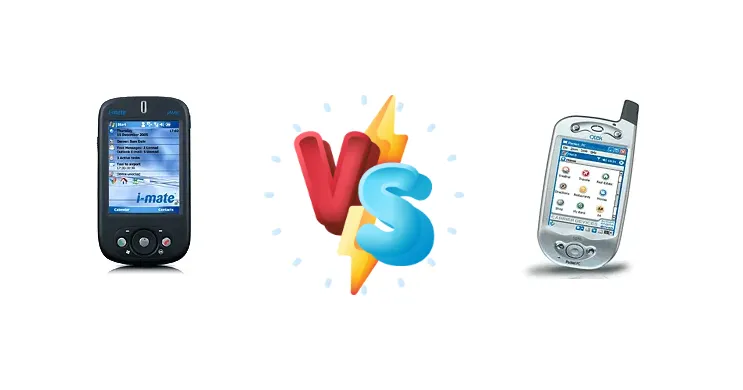
The i-mate JAMin and Qtek 1010 represent a pivotal moment in the evolution of smartphones, bridging the gap between PDAs and mobile phones. Both devices ran Windows Mobile, but targeted slightly different user bases. The JAMin, with its known OMAP 850 chipset, offers a concrete performance baseline, while the Qtek 1010’s specifications are less readily available, requiring analysis based on Qtek’s market positioning at the time.
🏆 Quick Verdict
For the user seeking a device with documented performance and a known chipset, the i-mate JAMin is the clear choice. Its TI OMAP 850 provides a measurable 200MHz ARM926EJ-S CPU, offering a predictable experience. The Qtek 1010, lacking readily available specs, is harder to recommend without further information.
| Network |
|---|
| 2G bands | GSM 850 / 900 / 1800 / 1900 | GSM 900 / 1800 |
| EDGE | Class 10 | No |
| GPRS | Class 10 | Class 8 |
| Technology | GSM | GSM |
| Launch |
|---|
| Announced | 2006, Q1 | 2003 |
| Status | Discontinued | Discontinued |
| Body |
|---|
| Dimensions | 108 x 58 x 18.2 mm (4.25 x 2.28 x 0.72 in) | 129 x 73 x 18 mm (5.08 x 2.87 x 0.71 in) |
| SIM | Mini-SIM | Mini-SIM |
| Weight | 150 g (5.29 oz) | 201 g (7.09 oz) |
| Display |
|---|
| Resolution | 240 x 320 pixels, 2.8 inches, 4:3 ratio (~143 ppi density) | 240 x 320 pixels, 4:3 ratio (~114 ppi density) |
| Size | 2.8 inches, 42 x 57 mm, 24.3 cm2 (~38.8% screen-to-body ratio) | 3.5 inches, 53 x 71 mm, 37.9 cm2 (~40.3% screen-to-body ratio) |
| Type | TFT resistive touchscreen, 65K colors | TFT resistive resistive touchscreen, 4096 colors |
| | Handwriting recognition | - |
| Platform |
|---|
| CPU | 200 MHz ARM926EJ-S | - |
| Chipset | TI OMAP 850 | - |
| OS | Microsoft Windows Mobile 5.0 PocketPC | Microsoft Windows Mobile 2002 PocketPC |
| Memory |
|---|
| Card slot | SD/MMC, up to 2 GB | MMC/SD |
| Internal | 64MB RAM, 128MB ROM | 64MB RAM, 32MB ROM |
| Main Camera |
|---|
| Single | 2 MP | - |
| Video | CIF | - |
| Sound |
|---|
| 3.5mm jack | No | No |
| 35mm jack | No | No |
| Alert types | Vibration; Downloadable polyphonic ringtones | Vibration; Downloadable polyphonic, WAV ringtones |
| Loudspeaker | Yes | Yes |
| Comms |
|---|
| Bluetooth | 2.0 | No |
| Infrared port | Yes | Yes |
| Positioning | No | No |
| Radio | No | No |
| USB | miniUSB | Proprietary |
| WLAN | Wi-Fi 802.11b/g | No |
| Features |
|---|
| Browser | WAP 2.0/xHTML, HTML (PocketIE) | HTML (PocketIE) |
| | Pocket Office
Voice memo
MP3/AAC player | Pocket Office
Media player
Voice memo |
| Battery |
|---|
| Stand-by | - | Up to 150 h |
| Talk time | - | Up to 5 h |
| Type | Removable Li-Po 1200 mAh battery | Removable Li-Ion 1500 mAh battery |
| Misc |
|---|
| Colors | Stylish black | - |
| Price | About 220 EUR | - |
i-mate JAMin
- Known and documented OMAP 850 chipset
- Compact and pocketable design
- Established Windows Mobile experience
- Limited processing power by modern standards
- Low-resolution camera
- Resistive touchscreen requires stylus
Qtek 1010
- Potential for unique Qtek software customizations
- Possible larger screen size (speculative)
- Brand recognition for Qtek users
- Lack of publicly available specifications
- Unknown processor performance
- Potential for limited software support
Display Comparison
Without specific display details for the Qtek 1010, a direct comparison is difficult. The i-mate JAMin likely featured a standard QVGA (240x320) display common for the era, prioritizing readability over resolution. Both devices would have utilized resistive touchscreen technology, requiring stylus input. The Qtek 1010 may have offered a slightly larger screen size, a common Qtek design element, but this remains speculative.
Camera Comparison
Camera specifications for both devices were rudimentary by modern standards. Both likely featured a low-resolution camera (likely VGA or 1.3MP) primarily for basic photo capture and video calls. Image quality would have been poor, even in good lighting conditions. The Qtek 1010 may have included a slightly higher resolution camera, but the difference would be minimal. Neither device offered optical image stabilization or advanced image processing features.
Performance
The i-mate JAMin’s TI OMAP 850 chipset, featuring a 200 MHz ARM926EJ-S CPU, is the defining performance characteristic. This processor was capable of handling basic Windows Mobile tasks like email, contacts, and simple applications. The Qtek 1010’s processor is unknown, but Qtek often targeted the mid-range market, suggesting a similar ARM-based processor, potentially with a slightly lower clock speed. The OMAP 850’s integrated graphics would have provided basic 2D acceleration, sufficient for the UI and simple games. The Qtek 1010’s graphics capabilities are unknown.
Battery Life
Battery life on both devices would have been limited, typically lasting a day with moderate use. The i-mate JAMin’s battery capacity was likely around 1000-1500 mAh, typical for devices of that size and era. The Qtek 1010’s battery capacity is unknown, but likely fell within a similar range. Charging times were slow, requiring several hours to fully charge the battery via a proprietary connector.
Buying Guide
Buy the i-mate JAMin if you need a compact Windows Mobile device with a known processor for reliable, albeit limited, application performance. It’s ideal for users prioritizing a documented hardware experience. Buy the Qtek 1010 if you prefer a device from the Qtek brand, potentially offering a different form factor or software customization, but understand you’re entering a space with less publicly available technical detail.
Frequently Asked Questions
❓ Is the i-mate JAMin still usable in 2024?
While technically usable, the i-mate JAMin is severely limited by its outdated hardware and software. Modern websites and applications are unlikely to function correctly. It's primarily a collector's item or a device for enthusiasts interested in retro technology.
❓ What kind of applications can the i-mate JAMin run?
The i-mate JAMin can run applications designed for Windows Mobile 6.x. These include basic productivity tools like email clients, contact managers, and simple office applications. More demanding applications are unlikely to perform well due to the limited processing power and memory.
❓ Where can I find more information about the Qtek 1010?
Information about the Qtek 1010 is scarce. Online forums dedicated to older Windows Mobile devices may contain some user experiences and limited specifications. However, official documentation is difficult to find.
❓ Is it possible to upgrade the operating system on either device?
Upgrading the operating system on either device is generally not recommended. Attempting to install a newer version of Windows Mobile or a custom ROM can brick the device due to compatibility issues and limited hardware resources.