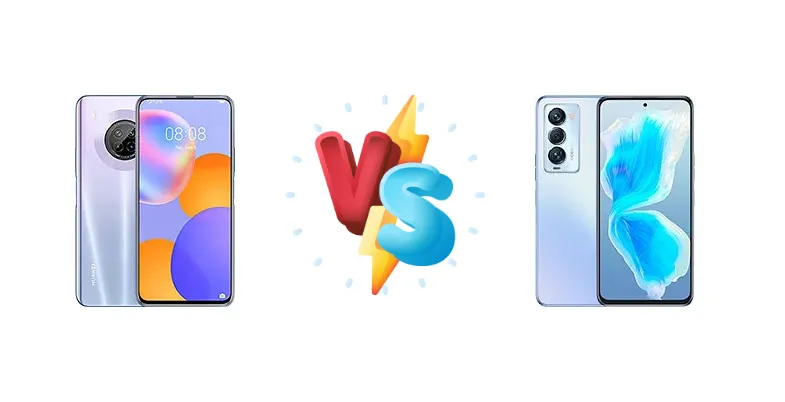
The Huawei Y9a and Tecno Camon 18 Premier represent compelling options in the competitive mid-range smartphone market. While both aim to deliver a balanced experience, they diverge in key areas like processing power and charging speed. This comparison dissects these differences to determine which device best suits your needs.
🏆 Quick Verdict
For the average user prioritizing performance and faster charging, the Tecno Camon 18 Premier is the better choice. Its Helio G96 chipset offers a noticeable upgrade over the Y9a’s Helio G80, and the 33W charging significantly reduces downtime. However, the Y9a remains a viable option for those on a tighter budget.
| Network |
|---|
| 2G bands | GSM 900 / 1800 / 1900 | GSM 850 / 900 / 1800 / 1900 |
| 3G bands | HSDPA 850 / 900 / 1700(AWS) / 1900 / 2100 | HSDPA 850 / 900 / 2100 |
| 4G bands | 1, 2, 3, 4, 5, 7, 8, 20, 28, 38, 40, 41 - FRL-L22 | LTE |
| Speed | HSPA, LTE | HSPA, LTE |
| Technology | GSM / HSPA / LTE | GSM / HSPA / LTE |
| | 1, 2, 3, 4, 5, 7, 8, 20, 28, 38, 40, 41, 66 - FRL-L23 | - |
| Launch |
|---|
| Announced | 2020, September 07. Released 2020, September 12 | 2021, October 04 |
| Status | Discontinued | Available. Released 2021, October 11 |
| Body |
|---|
| Build | - | Glass front, plastic frame, glass back |
| Dimensions | 163.5 x 76.5 x 9 mm (6.44 x 3.01 x 0.35 in) | 163.8 x 75.9 x 8.2 mm (6.45 x 2.99 x 0.32 in) |
| SIM | Nano-SIM + Nano-SIM | Nano-SIM + Nano-SIM |
| Weight | 197 g (6.95 oz) | 200.6 g (7.09 oz) |
| Display |
|---|
| Resolution | 1080 x 2400 pixels, 20:9 ratio (~397 ppi density) | 1080 x 2400 pixels, 20:9 ratio (~393 ppi density) |
| Size | 6.63 inches, 106.1 cm2 (~84.8% screen-to-body ratio) | 6.7 inches, 108.4 cm2 (~87.2% screen-to-body ratio) |
| Type | IPS LCD | AMOLED, 120Hz, 550 nits (typ) |
| Platform |
|---|
| CPU | Octa-core (2x2.0 GHz Cortex-A75 & 6x1.8 GHz Cortex-A55) | Octa-core (2x2.05 GHz Cortex-A76 & 6x2.0 GHz Cortex-A55) |
| Chipset | Mediatek MT6769V/CU Helio G80 (12 nm) | Mediatek MT6781 Helio G96 (12 nm) |
| GPU | Mali-G52 MC2 | Mali-G57 MC2 |
| OS | Android 10, EMUI 10.1, no Google Play Services | Android 11, HIOS 8.0 |
| Memory |
|---|
| Card slot | Nano Memory (uses shared SIM slot) | microSDXC (dedicated slot) |
| Internal | 128GB 6GB RAM, 128GB 8GB RAM | 256GB 8GB RAM |
| | UFS 2.1 | UFS |
| Main Camera |
|---|
| Features | Quad-LED flash, HDR, panorama | Quad-LED flash, panorama, HDR |
| Quad | 64 MP, f/1.8, 26mm (wide), 1/1.73", 0.8µm, PDAF
8 MP, f/2.4, 120˚ (ultrawide)
2 MP (macro)
Auxiliary lens | - |
| Single | - | 32 MP, (wide) |
| Triple | - | 64 MP, f/1.6, 26mm (wide), PDAF
8 MP, f/3.5, 135mm (periscope telephoto), PDAF, 5x optical zoom
12 MP, (ultrawide), gimbal OIS |
| Video | 4K@30fps, 1080p@30fps, gyro-EIS | 4K@30fps, 1080p@30fps, gyro-EIS |
| Selfie camera |
|---|
| Features | HDR | Dual-LED flash, HDR |
| Single | Motorized pop-up 16 MP, f/2.2, (wide), 1/3.1", 1.0µm | 32 MP, (wide) |
| Video | 1080p@30fps | 1080p@30fps |
| Sound |
|---|
| 3.5mm jack | Yes | Yes |
| 35mm jack | Yes | Yes |
| Loudspeaker | Yes | Yes |
| Comms |
|---|
| Bluetooth | 5.1, A2DP, LE | Yes |
| NFC | No | Yes |
| Positioning | GPS, GLONASS, BDS | GPS |
| Radio | No | FM radio |
| USB | USB Type-C 2.0, OTG | USB Type-C 2.0, OTG |
| WLAN | Wi-Fi 802.11 a/b/g/n/ac, dual-band, Wi-Fi Direct | Yes |
| Features |
|---|
| Sensors | Fingerprint (side-mounted), accelerometer, gyro, proximity, compass | Fingerprint (side-mounted), accelerometer, gyro, proximity |
| Battery |
|---|
| Charging | 22.5W / 40W wired (region dependent) | 33W wired, 64% in 30 min |
| Type | Li-Po 4200 mAh or 4300 mAh (region dependent) | 4750 mAh |
| Misc |
|---|
| Colors | Space Silver, Sakura Pink, Midnight Black | Polar night, Vast sky |
| Models | FRL-22, FRL-23, FRL-L22, FRL-L23 | CH9, CH9n |
| Price | About 200 EUR | About 390 EUR |
| Tests |
|---|
| Battery life | - |
Endurance rating 112h
|
| Camera | - |
Photo / Video |
| Display | - |
Contrast ratio: Infinite (nominal) |
| Loudspeaker | - |
-26.2 LUFS (Good)
|
| Performance | - |
AnTuTu: 293517 (v8), 346389 (v9)
GeekBench: 1758 (v5.1)
GFXBench: 12fps (ES 3.1 onscreen) |
Huawei Y9a
- Potentially lower price point
- Reliable Mediatek Helio G80 performance for basic tasks
- Decent battery endurance
- Slower charging speeds (22.5W/40W)
- Older chipset architecture (Helio G80)
- Likely lower peak display brightness
Tecno Camon 18 Premier
- Faster 33W charging
- More powerful and efficient Helio G96 chipset
- Higher peak display brightness (422 nits)
- Slightly higher price
- Battery endurance rating is the same as Y9a despite faster charging
- Camera details are limited
Display Comparison
The Tecno Camon 18 Premier boasts a measured peak brightness of 422 nits, which, while not exceptional, provides adequate visibility in most conditions. The Huawei Y9a’s display specifications are less defined, but given its market positioning, it likely falls short of the Camon 18 Premier in brightness. Both devices feature an 'infinite' contrast ratio, a marketing term that doesn't provide meaningful differentiation. The absence of refresh rate data for the Y9a suggests a standard 60Hz panel, while the Camon 18 Premier’s display is likely similar, focusing on color accuracy and viewing angles rather than fluidity.
Camera Comparison
Both devices are marketed with a focus on photography and video, but detailed sensor information is limited. The Tecno Camon 18 Premier likely prioritizes image processing algorithms and potentially larger sensor sizes to enhance low-light performance. The Y9a’s camera system, while capable, is likely to be less sophisticated. Without specific details on sensor sizes and apertures, it’s difficult to make a definitive judgment, but the Camon 18 Premier’s positioning suggests a more advanced camera experience. The inclusion of OIS (Optical Image Stabilization) on the Camon 18 Premier, if present, would be a significant advantage for video recording and low-light photography.
Performance
The core difference lies in the chipsets. The Tecno Camon 18 Premier utilizes the Mediatek Helio G96, featuring a dual-core configuration of Cortex-A76 processors clocked at 2.05 GHz, paired with six Cortex-A55 cores at 2.0 GHz. This represents an architectural improvement over the Huawei Y9a’s Helio G80, which uses Cortex-A75 cores (2x2.0 GHz) and Cortex-A55 cores (6x1.8 GHz). The A76 cores in the G96 offer better single-core performance, translating to snappier app launches and smoother multitasking. While both are 12nm chips, the G96’s more efficient design contributes to better sustained performance. The Y9a’s lower clock speeds on the A55 cores also contribute to a performance deficit.
Battery Life
Both phones achieve an endurance rating of 112 hours, suggesting similar overall battery life under typical usage. However, the Tecno Camon 18 Premier’s 33W charging capability is a significant advantage. It can reach 64% charge in just 30 minutes, drastically reducing downtime compared to the Huawei Y9a’s region-dependent 22.5W or 40W charging. While the Y9a’s battery capacity isn’t specified, the faster charging of the Camon 18 Premier effectively mitigates any potential capacity differences, offering a more convenient user experience.
Buying Guide
Buy the Huawei Y9a if you need a reliable, functional smartphone with a decent camera for everyday use and are prioritizing cost savings. Buy the Tecno Camon 18 Premier if you prefer a smoother multitasking experience, faster charging, and are willing to spend slightly more for improved performance and a more modern chipset.
Frequently Asked Questions
❓ Does the Huawei Y9a struggle with demanding games like PUBG Mobile?
The Helio G80 in the Y9a can run PUBG Mobile, but you'll likely need to lower graphics settings to maintain a stable frame rate. The G80's older architecture and lower clock speeds will result in more noticeable frame drops compared to the Tecno Camon 18 Premier's G96.
❓ How much faster is the charging on the Tecno Camon 18 Premier compared to the Huawei Y9a?
The Tecno Camon 18 Premier’s 33W charging can reach 64% in 30 minutes. The Huawei Y9a, with its 22.5W or 40W charging (depending on region), will take considerably longer to achieve a similar charge level, potentially over an hour.
❓ Is the difference in chipset performance between the Helio G80 and Helio G96 noticeable in everyday use?
Yes, the difference is noticeable. The Helio G96’s Cortex-A76 cores provide a significant boost in single-core performance, resulting in snappier app launches, smoother multitasking, and a more responsive user experience overall.
❓ What type of user would benefit most from the Tecno Camon 18 Premier's faster charging?
Users who frequently find themselves with limited time to charge their phone, or those who heavily use their device throughout the day and need quick top-ups, will greatly benefit from the Camon 18 Premier's 33W charging.