
Huawei Y9a vs. Samsung Galaxy A52s 5G: Which Mid-Range Phone Reigns Supreme?
| Phones Images | |||||
|---|---|---|---|---|---|
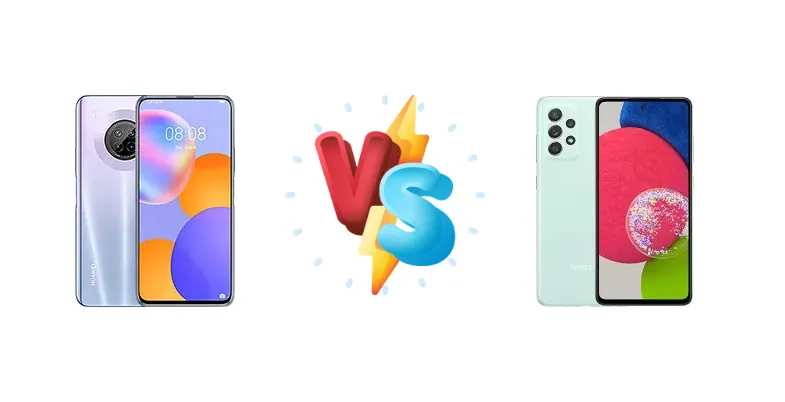
|
🏆 Quick Verdict
For most users, the Samsung Galaxy A52s 5G is the superior choice. Its Snapdragon 778G chipset provides significantly better performance and efficiency, translating to smoother multitasking, gaming, and a more future-proof experience. While the Y9a offers a potentially lower price point, the A52s 5G’s advantages outweigh the cost savings.
| PHONES | ||
|---|---|---|
| Phone Names | Huawei Y9a | Samsung Galaxy A52s 5G |
| Network | ||
|---|---|---|
| 2G bands | GSM 900 / 1800 / 1900 | GSM 850 / 900 / 1800 / 1900 |
| 3G bands | HSDPA 850 / 900 / 1700(AWS) / 1900 / 2100 | HSDPA 850 / 900 / 1700(AWS) / 1900 / 2100 |
| 4G bands | 1, 2, 3, 4, 5, 7, 8, 20, 28, 38, 40, 41 - FRL-L22 | 1, 2, 3, 4, 5, 7, 8, 12, 17, 20, 26, 28, 32, 38, 40, 41, 66 |
| 5G bands | - | 1, 3, 5, 7, 8, 20, 28, 38, 40, 41, 66, 78 SA/NSA/Sub6 |
| Speed | HSPA, LTE | HSPA 42.2/5.76 Mbps, LTE Cat18 1200/150 Mbps, 5G |
| Technology | GSM / HSPA / LTE | GSM / HSPA / LTE / 5G |
| 1, 2, 3, 4, 5, 7, 8, 20, 28, 38, 40, 41, 66 - FRL-L23 | - | |
| Launch | ||
|---|---|---|
| Announced | 2020, September 07. Released 2020, September 12 | 2021, August 17 |
| Status | Discontinued | Available. Released 2021, September 01 |
| Body | ||
|---|---|---|
| Build | - | Glass front (Gorilla Glass 5), plastic back |
| Dimensions | 163.5 x 76.5 x 9 mm (6.44 x 3.01 x 0.35 in) | 159.9 x 75.1 x 8.4 mm (6.30 x 2.96 x 0.33 in) |
| SIM | Nano-SIM + Nano-SIM | · Nano-SIM· Nano-SIM + Nano-SIM |
| Weight | 197 g (6.95 oz) | 189 g (6.67 oz) |
| - | IP67 dust/water resistant (up to 1m for 30 min) | |
| Display | ||
|---|---|---|
| Protection | - | Corning Gorilla Glass 5 |
| Resolution | 1080 x 2400 pixels, 20:9 ratio (~397 ppi density) | 1080 x 2400 pixels, 20:9 ratio (~405 ppi density) |
| Size | 6.63 inches, 106.1 cm2 (~84.8% screen-to-body ratio) | 6.5 inches, 102.0 cm2 (~84.9% screen-to-body ratio) |
| Type | IPS LCD | Super AMOLED, 120Hz, 800 nits (HBM) |
| Platform | ||
|---|---|---|
| CPU | Octa-core (2x2.0 GHz Cortex-A75 & 6x1.8 GHz Cortex-A55) | Octa-core (1x2.4 GHz Cortex-A78 & 3x2.2 GHz Cortex-A78 & 4x1.9 GHz Cortex-A55) |
| Chipset | Mediatek MT6769V/CU Helio G80 (12 nm) | Qualcomm SM7325 Snapdragon 778G 5G (6 nm) |
| GPU | Mali-G52 MC2 | Adreno 642L |
| OS | Android 10, EMUI 10.1, no Google Play Services | Android 11, upgradable to Android 14, One UI 6 |
| Memory | ||
|---|---|---|
| Card slot | Nano Memory (uses shared SIM slot) | microSDXC (uses shared SIM slot) |
| Internal | 128GB 6GB RAM, 128GB 8GB RAM | 128GB 4GB RAM, 128GB 6GB RAM, 128GB 8GB RAM, 256GB 6GB RAM, 256GB 8GB RAM |
| UFS 2.1 | - | |
| Main Camera | ||
|---|---|---|
| Features | Quad-LED flash, HDR, panorama | LED flash, panorama, HDR |
| Quad | 64 MP, f/1.8, 26mm (wide), 1/1.73", 0.8µm, PDAF 8 MP, f/2.4, 120˚ (ultrawide) 2 MP (macro) Auxiliary lens | 64 MP, f/1.8, 26mm (wide), 1/1.7", 0.8µm, PDAF, OIS 12 MP, f/2.2, 123˚ (ultrawide), 1.12µm 5 MP (macro) Auxiliary lens |
| Single | - | 32 MP, f/2.2, 26mm (wide), 1/2.8", 0.8µm |
| Video | 4K@30fps, 1080p@30fps, gyro-EIS | 4K@30fps, 1080p@30/60fps; gyro-EIS |
| Selfie camera | ||
|---|---|---|
| Features | HDR | HDR |
| Single | Motorized pop-up 16 MP, f/2.2, (wide), 1/3.1", 1.0µm | 32 MP, f/2.2, 26mm (wide), 1/2.8", 0.8µm |
| Video | 1080p@30fps | 4K@30fps, 1080p@30/60fps |
| Sound | ||
|---|---|---|
| 3.5mm jack | Yes | Yes |
| 35mm jack | Yes | Yes |
| Loudspeaker | Yes | Yes, with stereo speakers |
| Comms | ||
|---|---|---|
| Bluetooth | 5.1, A2DP, LE | 5.0, A2DP, LE |
| NFC | No | Yes (market/region dependent) |
| Positioning | GPS, GLONASS, BDS | GPS, GLONASS, GALILEO, BDS, QZSS |
| Radio | No | No |
| USB | USB Type-C 2.0, OTG | USB Type-C 2.0, OTG |
| WLAN | Wi-Fi 802.11 a/b/g/n/ac, dual-band, Wi-Fi Direct | Wi-Fi 802.11 a/b/g/n/ac/6, dual-band, Wi-Fi Direct |
| Features | ||
|---|---|---|
| Sensors | Fingerprint (side-mounted), accelerometer, gyro, proximity, compass | Fingerprint (under display, optical), accelerometer, gyro, compass |
| - | Virtual Proximity Sensing | |
| Battery | ||
|---|---|---|
| Charging | 22.5W / 40W wired (region dependent) | 25W wired |
| Type | Li-Po 4200 mAh or 4300 mAh (region dependent) | Li-Ion 4500 mAh |
| Misc | ||
|---|---|---|
| Colors | Space Silver, Sakura Pink, Midnight Black | Awesome Black, Awesome White, Awesome Purple, Awesome Mint |
| Models | FRL-22, FRL-23, FRL-L22, FRL-L23 | SM-A528B, SM-A528B/DS, SM-A528N |
| Price | About 200 EUR | £ 112.98 / € 249.47 |
| SAR | - | 0.72 W/kg (head) |
| SAR EU | - | 0.88 W/kg (head) 0.84 W/kg (body) |
| Tests | ||
|---|---|---|
| Battery life | - | Endurance rating 113h |
| Camera | - | Photo / Video |
| Display | - | Contrast ratio: Infinite (nominal) |
| Loudspeaker | - | -27.5 LUFS (Good) |
| Performance | - | AnTuTu: 429675 (v8), 506432(v9) GeekBench: 11060 (v4.4), 2801 (v5.1) GFXBench: 28fps (ES 3.1 onscreen) |
Huawei Y9a
- Potentially lower price point
- Faster charging (40W in some regions)
- Decent battery endurance
- Inferior chipset performance (Helio G80)
- Less efficient processor (12nm)
- Likely lower display quality
Samsung Galaxy A52s 5G
- Superior performance (Snapdragon 778G)
- Brighter and more vibrant display (800 nits)
- More efficient processor (6nm)
- Slightly slower charging (25W)
- Potentially higher price
- Similar battery endurance rating
Display Comparison
The Samsung Galaxy A52s 5G boasts a clear advantage in display quality, achieving a measured peak brightness of 800 nits. This significantly surpasses what is typically found in the Y9a’s panel, making the A52s 5G far more usable outdoors. While both displays have an 'infinite' (nominal) contrast ratio, the higher brightness of the A52s 5G contributes to a more vivid and engaging viewing experience. Details regarding the Y9a’s panel technology (LCD vs AMOLED) are missing, but given its price point, it’s likely an LCD, which generally offers less vibrant colors and narrower viewing angles than the A52s 5G’s Super AMOLED.
Camera Comparison
Both devices offer photo and video capabilities, but the Samsung Galaxy A52s 5G is expected to deliver superior image quality. While specific sensor details are missing for both, the Snapdragon 778G’s image signal processor (ISP) is more advanced, enabling better noise reduction, dynamic range, and overall image processing. The A52s 5G likely benefits from optical image stabilization (OIS), a feature often found in Samsung’s A-series phones, which helps reduce blur in low-light conditions. The Y9a’s camera system is likely more reliant on software processing to compensate for potentially smaller sensors and lack of OIS.
Performance
The core difference between these two phones lies in their chipsets. The Samsung Galaxy A52s 5G’s Qualcomm Snapdragon 778G 5G (6nm) is a substantial upgrade over the Huawei Y9a’s MediaTek Helio G80 (12nm). The Snapdragon 778G utilizes a more modern CPU architecture – a 1x2.4 GHz Cortex-A78 prime core alongside 3x2.2 GHz Cortex-A78 cores and 4x1.9 GHz Cortex-A55 cores – compared to the Y9a’s 2x2.0 GHz Cortex-A75 and 6x1.8 GHz Cortex-A55 configuration. The 6nm manufacturing process of the Snapdragon 778G also provides superior power efficiency, leading to less heat generation and sustained performance. This translates to smoother gaming, faster app loading times, and a more responsive overall experience on the A52s 5G.
Battery Life
Both phones achieve an endurance rating of 113 hours, suggesting comparable battery life in typical usage scenarios. However, the Snapdragon 778G’s superior power efficiency in the A52s 5G could translate to slightly longer real-world battery life, especially during demanding tasks. The A52s 5G supports 25W charging, while the Y9a offers 22.5W or 40W depending on the region. The 40W option on the Y9a provides faster charging speeds, potentially offsetting the A52s 5G’s efficiency advantage, but the difference in chipset performance is more impactful overall.
Buying Guide
Buy the Huawei Y9a if you prioritize a potentially lower upfront cost and are primarily focused on basic smartphone tasks like calling, texting, and light social media use. The 40W charging (region dependent) is a plus. Buy the Samsung Galaxy A52s 5G if you value performance, 5G connectivity, a brighter and more vibrant display, and a more refined camera experience. It’s the better investment for users who game, stream video, or demand a responsive user interface.