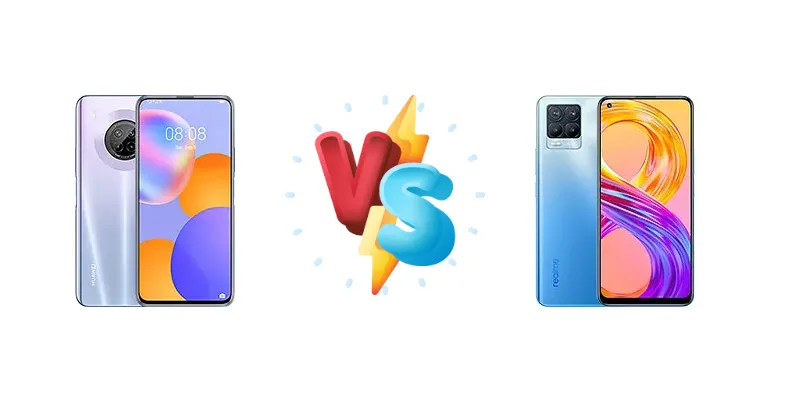
The Huawei Y9a and Realme 8 Pro represent compelling options in the competitive mid-range smartphone market. While both aim to deliver a balanced experience, they diverge significantly in their core hardware choices, particularly in chipset and charging technology. This comparison dissects these differences to determine which device best suits your priorities.
🏆 Quick Verdict
For most users, the Realme 8 Pro emerges as the stronger contender. Its Snapdragon 720G chipset, built on a more efficient 8nm process, provides a noticeable performance advantage and better thermal management compared to the Huawei Y9a’s Helio G80. The significantly faster 50W charging further solidifies its position.
| Network |
|---|
| 2G bands | GSM 900 / 1800 / 1900 | GSM 850 / 900 / 1800 / 1900 |
| 3G bands | HSDPA 850 / 900 / 1700(AWS) / 1900 / 2100 | HSDPA 850 / 900 / 2100 |
| 4G bands | 1, 2, 3, 4, 5, 7, 8, 20, 28, 38, 40, 41 - FRL-L22 | 1, 3, 5, 7, 8, 20, 28, 38, 40, 41 - International |
| Speed | HSPA, LTE | HSPA, LTE |
| Technology | GSM / HSPA / LTE | GSM / HSPA / LTE |
| | 1, 2, 3, 4, 5, 7, 8, 20, 28, 38, 40, 41, 66 - FRL-L23 | 1, 3, 5, 8, 38, 40, 41 - Asia |
| Launch |
|---|
| Announced | 2020, September 07. Released 2020, September 12 | 2021, March 24 |
| Status | Discontinued | Available. Released 2021, March 25 |
| Body |
|---|
| Build | - | Glass front, plastic frame, plastic back |
| Dimensions | 163.5 x 76.5 x 9 mm (6.44 x 3.01 x 0.35 in) | 160.6 x 73.9 x 8.1 mm (6.32 x 2.91 x 0.32 in) |
| SIM | Nano-SIM + Nano-SIM | Nano-SIM + Nano-SIM |
| Weight | 197 g (6.95 oz) | 176 g (6.21 oz) |
| Display |
|---|
| Resolution | 1080 x 2400 pixels, 20:9 ratio (~397 ppi density) | 1080 x 2400 pixels, 20:9 ratio (~411 ppi density) |
| Size | 6.63 inches, 106.1 cm2 (~84.8% screen-to-body ratio) | 6.4 inches, 98.9 cm2 (~83.3% screen-to-body ratio) |
| Type | IPS LCD | Super AMOLED, 430 nits (typ), 1000 nits (peak) |
| | - | Always-on display |
| Platform |
|---|
| CPU | Octa-core (2x2.0 GHz Cortex-A75 & 6x1.8 GHz Cortex-A55) | Octa-core (2x2.3 GHz Kryo 465 Gold & 6x1.8 GHz Kryo 465 Silver) |
| Chipset | Mediatek MT6769V/CU Helio G80 (12 nm) | Qualcomm SM7125 Snapdragon 720G (8 nm) |
| GPU | Mali-G52 MC2 | Adreno 618 |
| OS | Android 10, EMUI 10.1, no Google Play Services | Android 11, upgradable to Android 12, Realme UI 3.0 |
| Memory |
|---|
| Card slot | Nano Memory (uses shared SIM slot) | microSDXC (dedicated slot) |
| Internal | 128GB 6GB RAM, 128GB 8GB RAM | 128GB 6GB RAM, 128GB 8GB RAM |
| | UFS 2.1 | UFS 2.1 |
| Main Camera |
|---|
| Features | Quad-LED flash, HDR, panorama | LED flash, HDR, panorama |
| Quad | 64 MP, f/1.8, 26mm (wide), 1/1.73", 0.8µm, PDAF
8 MP, f/2.4, 120˚ (ultrawide)
2 MP (macro)
Auxiliary lens | 108 MP, f/1.9, 26mm (wide), 1/1.52", 0.7µm, PDAF
8 MP, f/2.3, 119˚, 16mm (ultrawide), 1/4.0", 1.12µm
2 MP (macro)
Auxiliary lens |
| Video | 4K@30fps, 1080p@30fps, gyro-EIS | 4K@30fps, 1080p@30/60/120/480fps, 720p@960fps, gyro-EIS |
| Selfie camera |
|---|
| Features | HDR | HDR, panorama |
| Single | Motorized pop-up 16 MP, f/2.2, (wide), 1/3.1", 1.0µm | 16 MP, f/2.5, (wide), 1/3.0", 1.0µm |
| Video | 1080p@30fps | 1080p@30/120fps, gyro-EIS |
| Sound |
|---|
| 3.5mm jack | Yes | Yes |
| 35mm jack | Yes | Yes |
| Loudspeaker | Yes | Yes |
| | - | 24-bit/192kHz audio |
| Comms |
|---|
| Bluetooth | 5.1, A2DP, LE | 5.0, A2DP, LE |
| NFC | No | Yes (market/region dependent) |
| Positioning | GPS, GLONASS, BDS | GPS, GLONASS, BDS |
| Radio | No | No |
| USB | USB Type-C 2.0, OTG | USB Type-C 2.0, OTG |
| WLAN | Wi-Fi 802.11 a/b/g/n/ac, dual-band, Wi-Fi Direct | Wi-Fi 802.11 a/b/g/n/ac, dual-band, Wi-Fi Direct |
| Features |
|---|
| Sensors | Fingerprint (side-mounted), accelerometer, gyro, proximity, compass | Fingerprint (under display, optical), accelerometer, gyro, proximity, compass |
| Battery |
|---|
| Charging | 22.5W / 40W wired (region dependent) | 50W wired, 50% in 17 min, 100% in 47 min |
| Type | Li-Po 4200 mAh or 4300 mAh (region dependent) | 4500 mAh |
| Misc |
|---|
| Colors | Space Silver, Sakura Pink, Midnight Black | Infinite Blue, Infinite Black, Punk Black, Illuminating Yellow |
| Models | FRL-22, FRL-23, FRL-L22, FRL-L23 | RMX3081 |
| Price | About 200 EUR | About 550 EUR |
| SAR | - | 1.10 W/kg (head) 0.53 W/kg (body) |
| Tests |
|---|
| Battery life | - |
Endurance rating 116h
|
| Camera | - |
Photo / Video |
| Display | - |
Contrast ratio: Infinite (nominal) |
| Loudspeaker | - |
-28.2 LUFS (Average)
|
| Performance | - |
AnTuTu: 286666 (v8)
GeekBench: 1678 (v5.1)
GFXBench: 16fps (ES 3.1 onscreen) |
Huawei Y9a
- Potentially lower price point
- Acceptable performance for basic tasks
- Decent battery endurance
- Less powerful chipset compared to Snapdragon 720G
- Slower charging speeds (region dependent)
- Less efficient 12nm process
Realme 8 Pro
- More powerful and efficient Snapdragon 720G chipset
- Significantly faster 50W charging
- Superior ISP for better image quality
- May be slightly more expensive
- Similar battery endurance to Y9a despite faster charging
- Display specs are not exceptional
Display Comparison
Both devices share an 'Infinite' (nominal) contrast ratio, suggesting typical IPS LCD characteristics. However, detailed display specs like peak brightness and color gamut coverage are missing. Given the market positioning, we can assume both offer adequate, but not exceptional, viewing experiences. The Realme 8 Pro’s display benefits from the more powerful ISP of the Snapdragon 720G, potentially leading to better image processing for displayed content.
Camera Comparison
While both phones feature photo and video capabilities, the specifics are limited. Without sensor size or aperture information, a direct comparison is difficult. However, the Snapdragon 720G’s image signal processor (ISP) is significantly more capable than the Helio G80’s. This means the Realme 8 Pro will likely deliver superior image quality, particularly in challenging lighting conditions, with better dynamic range and noise reduction. The Y9a may rely more heavily on software processing, which can sometimes lead to artificial-looking results. The absence of details on OIS or advanced camera features suggests both phones target casual photographers.
Performance
The core difference lies in the chipsets. The Realme 8 Pro’s Qualcomm Snapdragon 720G (8nm) boasts a more advanced fabrication process than the Huawei Y9a’s MediaTek Helio G80 (12nm). This translates to improved power efficiency and sustained performance under load. The Snapdragon 720G’s CPU, with 2x2.3 GHz Kryo 465 Gold cores, offers a clock speed advantage over the Y9a’s 2x2.0 GHz Cortex-A75 cores. While both utilize a 6x1.8 GHz cluster for efficiency, the Snapdragon’s architecture is generally more refined, resulting in a smoother user experience, especially during multitasking and gaming. The 8nm process also means less heat generation, reducing the likelihood of performance throttling during extended use.
Battery Life
Both devices have an endurance rating of 116 hours, indicating similar overall battery life. However, the Realme 8 Pro’s 50W charging is a game-changer. It can reach 50% charge in just 17 minutes and 100% in 47 minutes, significantly reducing downtime. The Huawei Y9a’s charging speed is region-dependent, ranging from 22.5W to 40W, making it considerably slower. This difference in charging speed is a major advantage for the Realme 8 Pro, especially for users who frequently need to top up their battery.
Buying Guide
Buy the Huawei Y9a if you prioritize a potentially lower price point and are primarily focused on basic smartphone tasks like social media and light browsing. However, buy the Realme 8 Pro if you value smoother performance in demanding applications, faster charging speeds, and a more future-proof chipset for gaming and software updates. The Realme 8 Pro is the better choice for users who want a phone that can keep up with their digital lives.
Frequently Asked Questions
❓ Does the Helio G80 in the Huawei Y9a struggle with demanding games like PUBG or Call of Duty?
Yes, the Helio G80, while capable of running these games, will likely require lower graphics settings and may experience frame drops during intense gameplay. The Snapdragon 720G in the Realme 8 Pro offers a smoother and more consistent gaming experience due to its more powerful GPU and efficient architecture.
❓ How much faster is the 50W charging on the Realme 8 Pro compared to the Huawei Y9a's 22.5W/40W options?
The Realme 8 Pro’s 50W charging is significantly faster. It can fully charge the phone in approximately 47 minutes, while the Huawei Y9a, even with the 40W variant, will take considerably longer – potentially over an hour and a half. The 22.5W version will take even longer, making the Realme 8 Pro a much more convenient option for users who need a quick power boost.
❓ Will I notice a difference in app loading times and multitasking between these two phones?
Yes, you will likely notice a difference. The Snapdragon 720G’s more efficient CPU and potentially faster RAM (though RAM specs are not provided) contribute to quicker app loading times and smoother multitasking. The Huawei Y9a’s Helio G80 may exhibit slight delays when switching between apps or launching resource-intensive applications.