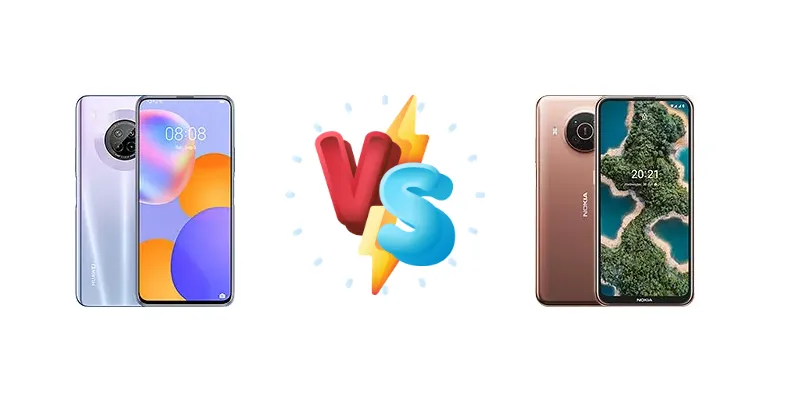
The Nokia X20 and Huawei Y9a represent distinct approaches to the mid-range smartphone market. The Nokia X20 champions 5G connectivity with Qualcomm’s Snapdragon 480, while the Huawei Y9a focuses on a more traditional feature set powered by MediaTek’s Helio G80. This comparison dissects their core components to determine which device delivers the best overall experience.
🏆 Quick Verdict
For the average user prioritizing future-proofing and 5G access, the Nokia X20 is the stronger choice. Its Snapdragon 480, built on a more efficient 8nm process, offers a performance edge and better long-term support despite slower charging. The Huawei Y9a remains a viable option for those without immediate 5G needs.
| Network |
|---|
| 2G bands | GSM 900 / 1800 / 1900 | GSM 850 / 900 / 1800 / 1900 |
| 3G bands | HSDPA 850 / 900 / 1700(AWS) / 1900 / 2100 | HSDPA 850 / 900 / 1700(AWS) / 1900 / 2100 |
| 4G bands | 1, 2, 3, 4, 5, 7, 8, 20, 28, 38, 40, 41 - FRL-L22 | 1, 2, 3, 4, 5, 7, 8, 12, 20, 28, 66, 38, 39, 40, 41 |
| 5G bands | - | 1, 2, 3, 5, 7, 28, 38, 41, 66, 78 SA/NSA/Sub6 |
| Speed | HSPA, LTE | HSPA, LTE, 5G |
| Technology | GSM / HSPA / LTE | GSM / HSPA / LTE / 5G |
| | 1, 2, 3, 4, 5, 7, 8, 20, 28, 38, 40, 41, 66 - FRL-L23 | - |
| Launch |
|---|
| Announced | 2020, September 07. Released 2020, September 12 | 2021, April 08 |
| Status | Discontinued | Available. Released 2021, May 12 |
| Body |
|---|
| Dimensions | 163.5 x 76.5 x 9 mm (6.44 x 3.01 x 0.35 in) | 168.9 x 79.7 x 9.1 mm (6.65 x 3.14 x 0.36 in) |
| SIM | Nano-SIM + Nano-SIM | · Nano-SIM· Nano-SIM + Nano-SIM |
| Weight | 197 g (6.95 oz) | 220 g (7.76 oz) |
| Display |
|---|
| Protection | - | Corning Gorilla Glass 5 |
| Resolution | 1080 x 2400 pixels, 20:9 ratio (~397 ppi density) | 1080 x 2400 pixels, 20:9 ratio (~395 ppi density) |
| Size | 6.63 inches, 106.1 cm2 (~84.8% screen-to-body ratio) | 6.67 inches, 107.4 cm2 (~79.8% screen-to-body ratio) |
| Type | IPS LCD | IPS LCD, 450 nits (typ) |
| Platform |
|---|
| CPU | Octa-core (2x2.0 GHz Cortex-A75 & 6x1.8 GHz Cortex-A55) | Octa-core (2x2.0 GHz Kryo 460 & 6x1.8 GHz Kryo 460) |
| Chipset | Mediatek MT6769V/CU Helio G80 (12 nm) | Qualcomm SM4350 Snapdragon 480 5G (8 nm) |
| GPU | Mali-G52 MC2 | Adreno 619 |
| OS | Android 10, EMUI 10.1, no Google Play Services | Android 11, upgradable to Android 14 |
| Memory |
|---|
| Card slot | Nano Memory (uses shared SIM slot) | microSDXC (uses shared SIM slot) |
| Internal | 128GB 6GB RAM, 128GB 8GB RAM | 128GB 6GB RAM, 128GB 8GB RAM |
| | UFS 2.1 | - |
| Main Camera |
|---|
| Features | Quad-LED flash, HDR, panorama | Zeiss optics, LED flash, HDR, panorama |
| Quad | 64 MP, f/1.8, 26mm (wide), 1/1.73", 0.8µm, PDAF
8 MP, f/2.4, 120˚ (ultrawide)
2 MP (macro)
Auxiliary lens | 64 MP, (wide), PDAF
5 MP, (ultrawide)
2 MP (macro)
Auxiliary lens |
| Single | - | 32 MP, (wide) |
| Video | 4K@30fps, 1080p@30fps, gyro-EIS | 1080p@30/60fps |
| Selfie camera |
|---|
| Features | HDR | - |
| Single | Motorized pop-up 16 MP, f/2.2, (wide), 1/3.1", 1.0µm | 32 MP, (wide) |
| Video | 1080p@30fps | 1080p@30fps |
| Sound |
|---|
| 3.5mm jack | Yes | Yes |
| 35mm jack | Yes | Yes |
| Loudspeaker | Yes | Yes |
| Comms |
|---|
| Bluetooth | 5.1, A2DP, LE | 5.0, A2DP, LE, aptX HD |
| NFC | No | Yes |
| Positioning | GPS, GLONASS, BDS | GPS, GLONASS, GALILEO |
| Radio | No | FM radio |
| USB | USB Type-C 2.0, OTG | USB Type-C 2.0, OTG |
| WLAN | Wi-Fi 802.11 a/b/g/n/ac, dual-band, Wi-Fi Direct | Wi-Fi 802.11 a/b/g/n/ac, dual-band, Wi-Fi Direct |
| Features |
|---|
| Sensors | Fingerprint (side-mounted), accelerometer, gyro, proximity, compass | Fingerprint (side-mounted), accelerometer, gyro, proximity |
| Battery |
|---|
| Charging | 22.5W / 40W wired (region dependent) | 18W wired |
| Type | Li-Po 4200 mAh or 4300 mAh (region dependent) | Li-Po 4470 mAh |
| Misc |
|---|
| Colors | Space Silver, Sakura Pink, Midnight Black | Midnight Sun, Nordic Blue |
| Models | FRL-22, FRL-23, FRL-L22, FRL-L23 | TA-1341, TA-1344 |
| Price | About 200 EUR | About 130 EUR |
| SAR | - | 1.04 W/kg (head) 0.62 W/kg (body) |
| SAR EU | - | 0.51 W/kg (head) 1.29 W/kg (body) |
Huawei Y9a
- Potentially faster charging (region dependent)
- Larger ecosystem of accessories (Huawei)
- Competitive price point
- Less efficient chipset (Helio G80)
- Limited 5G support
- Potential software concerns (Huawei Mobile Services)
Nokia X20
- 5G connectivity (Snapdragon 480)
- More efficient chipset (8nm process)
- Cleaner Android experience (Nokia)
- Guaranteed software updates (Nokia)
- Slower charging (18W)
- Less brand recognition (Nokia)
- Potentially higher price
Display Comparison
Neither device boasts a standout display. While specific panel details are unavailable, the focus here is on the underlying processing power impacting UI smoothness. The Nokia X20’s Snapdragon 480, with its Adreno 610 GPU, will likely deliver a more responsive experience when scrolling and navigating the interface, even if both phones share similar resolutions and refresh rates (assumed 60Hz based on market segment).
Camera Comparison
Without detailed sensor information, a direct camera comparison is difficult. However, the focus should be on image processing capabilities. Qualcomm’s Snapdragon SoCs typically offer superior image signal processors (ISPs) compared to MediaTek’s, leading to better dynamic range, noise reduction, and overall image quality in the Nokia X20. The presence of 5G also allows for faster cloud-based image processing if the user chooses to utilize such services. The Y9a's camera performance will likely rely more heavily on software optimization, and may struggle in low-light conditions compared to the X20.
Performance
The core difference lies in the chipsets. The Nokia X20’s Qualcomm Snapdragon 480 5G (8nm) offers a significant architectural advantage over the Huawei Y9a’s MediaTek Helio G80 (12nm). The 8nm process inherently provides better power efficiency, translating to less heat generation and potentially more sustained performance during demanding tasks. Both CPUs feature a similar core configuration (2x2.0GHz + 6x1.8GHz), but Qualcomm’s Kryo 460 cores are generally more efficient than MediaTek’s Cortex-A75/A55 combination. This means the Nokia X20 will likely handle multitasking and graphically intensive games with greater ease and less throttling.
Battery Life
The Huawei Y9a’s charging capabilities are region-dependent, offering either 22.5W or 40W wired charging. The Nokia X20 is limited to 18W. While the Y9a *could* charge faster, the Snapdragon 480’s superior power efficiency in the X20 means it will likely consume less energy during typical usage. This could offset the slower charging speed, resulting in comparable real-world battery life. The 8nm process is key here, minimizing wasted energy and maximizing battery endurance.
Buying Guide
Buy the Huawei Y9a if you need a phone with a potentially faster charging solution (depending on region) and are comfortable with the limitations of the Huawei ecosystem. Buy the Nokia X20 if you prioritize 5G connectivity, a cleaner Android experience, and a more modern, efficient chipset for sustained performance and software updates.
Frequently Asked Questions
❓ Does the Huawei Y9a's 40W charging actually deliver significantly faster speeds than the Nokia X20's 18W?
While 40W sounds impressive, the actual difference in charging time depends on several factors, including battery capacity and charging protocols. The Snapdragon 480's efficiency in the Nokia X20 means it consumes less power, potentially reducing the overall time to fully charge despite the slower wattage. Real-world tests are needed to confirm the exact difference.
❓ Is the Snapdragon 480 in the Nokia X20 powerful enough for modern mobile games like PUBG or Call of Duty?
The Snapdragon 480 is a capable chipset for mid-range gaming. While it won't deliver the highest frame rates at maximum settings, it should provide a playable experience in PUBG and Call of Duty at medium settings. The Adreno 610 GPU is a key component, offering a noticeable improvement over the GPU found in the Helio G80.
❓ What are the implications of using Huawei Mobile Services (HMS) on the Y9a instead of Google Mobile Services (GMS)?
Huawei Mobile Services lacks direct access to Google Play Store and core Google apps. Users must rely on the Huawei AppGallery and sideloading apps, which can be less convenient and may raise security concerns. App compatibility can also be an issue, as some apps may not function correctly or at all on HMS.