
Huawei Y9a vs. Motorola Moto G Power (2021): A Detailed Performance and Battery Life Showdown
| Phones Images | |||||
|---|---|---|---|---|---|
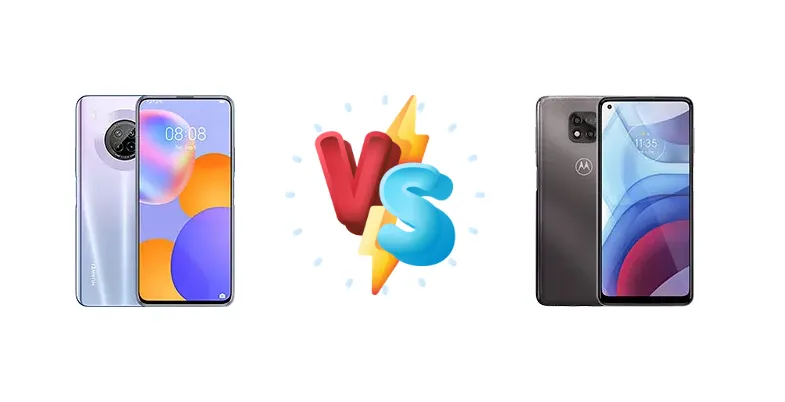
|
🏆 Quick Verdict
For the average user prioritizing sustained battery life and a more efficient chipset, the Motorola Moto G Power (2021) is the better choice. Its Snapdragon 662, built on an 11nm process, offers a more refined experience than the Y9a’s 12nm Helio G80, despite the latter’s potentially higher peak clock speeds. The slower charging is a trade-off worth making for the extended uptime.
| PHONES | ||
|---|---|---|
| Phone Names | Huawei Y9a | Motorola Moto G Power (2021) |
| Network | ||
|---|---|---|
| 2G bands | GSM 900 / 1800 / 1900 | GSM 850 / 900 / 1800 / 1900 |
| 3G bands | HSDPA 850 / 900 / 1700(AWS) / 1900 / 2100 | HSDPA 850 / 900 / 1700(AWS) / 1900 / 2100 |
| 4G bands | 1, 2, 3, 4, 5, 7, 8, 20, 28, 38, 40, 41 - FRL-L22 | 1, 2, 3, 4, 5, 7, 8, 12, 13, 14, 17, 25, 26, 29, 30, 38, 41, 66, 71 |
| Speed | HSPA, LTE | HSPA, LTE |
| Technology | GSM / HSPA / LTE | GSM / CDMA / HSPA / EVDO / LTE |
| 1, 2, 3, 4, 5, 7, 8, 20, 28, 38, 40, 41, 66 - FRL-L23 | CDMA2000 1xEV-DO | |
| Launch | ||
|---|---|---|
| Announced | 2020, September 07. Released 2020, September 12 | 2021, January 08 |
| Status | Discontinued | Available. Released 2021, January 14 |
| Body | ||
|---|---|---|
| Build | - | Glass front, plastic back, plastic frame |
| Dimensions | 163.5 x 76.5 x 9 mm (6.44 x 3.01 x 0.35 in) | 165.3 x 75.9 x 9.5 mm (6.51 x 2.99 x 0.37 in) |
| SIM | Nano-SIM + Nano-SIM | Nano-SIM |
| Weight | 197 g (6.95 oz) | 206.5 g (7.30 oz) |
| - | Water-repellent coating | |
| Display | ||
|---|---|---|
| Resolution | 1080 x 2400 pixels, 20:9 ratio (~397 ppi density) | 720 x 1600 pixels, 20:9 ratio (~266 ppi density) |
| Size | 6.63 inches, 106.1 cm2 (~84.8% screen-to-body ratio) | 6.6 inches, 105.2 cm2 (~83.8% screen-to-body ratio) |
| Type | IPS LCD | IPS LCD |
| Platform | ||
|---|---|---|
| CPU | Octa-core (2x2.0 GHz Cortex-A75 & 6x1.8 GHz Cortex-A55) | Octa-core (4x2.0 GHz Kryo 260 Gold & 4x1.8 GHz Kryo 260 Silver) |
| Chipset | Mediatek MT6769V/CU Helio G80 (12 nm) | Qualcomm SM6115 Snapdragon 662 (11 nm) |
| GPU | Mali-G52 MC2 | Adreno 610 |
| OS | Android 10, EMUI 10.1, no Google Play Services | Android 10 |
| Memory | ||
|---|---|---|
| Card slot | Nano Memory (uses shared SIM slot) | microSDXC (dedicated slot) |
| Internal | 128GB 6GB RAM, 128GB 8GB RAM | 32GB 3GB RAM, 64GB 4GB RAM |
| UFS 2.1 | eMMC 5.1 | |
| Main Camera | ||
|---|---|---|
| Features | Quad-LED flash, HDR, panorama | LED flash, HDR, panorama |
| Quad | 64 MP, f/1.8, 26mm (wide), 1/1.73", 0.8µm, PDAF 8 MP, f/2.4, 120˚ (ultrawide) 2 MP (macro) Auxiliary lens | - |
| Triple | - | 48 MP, f/1.7, (wide), 1/2.0", 0.8µm, PDAF 2 MP (macro) Auxiliary lens |
| Video | 4K@30fps, 1080p@30fps, gyro-EIS | 1080p@30/60fps, gyro-EIS |
| Selfie camera | ||
|---|---|---|
| Features | HDR | HDR |
| Single | Motorized pop-up 16 MP, f/2.2, (wide), 1/3.1", 1.0µm | 8 MP, f/2.0, 1.12µm |
| Video | 1080p@30fps | 1080p@30fps, gyro-EIS |
| Sound | ||
|---|---|---|
| 3.5mm jack | Yes | Yes |
| 35mm jack | Yes | Yes |
| Loudspeaker | Yes | Yes |
| Comms | ||
|---|---|---|
| Bluetooth | 5.1, A2DP, LE | 5.0, A2DP, LE |
| NFC | No | No |
| Positioning | GPS, GLONASS, BDS | GPS, GLONASS, GALILEO |
| Radio | No | FM radio |
| USB | USB Type-C 2.0, OTG | USB Type-C 2.0 |
| WLAN | Wi-Fi 802.11 a/b/g/n/ac, dual-band, Wi-Fi Direct | Wi-Fi 802.11 a/b/g/n/ac, dual-band, Wi-Fi Direct |
| Features | ||
|---|---|---|
| Sensors | Fingerprint (side-mounted), accelerometer, gyro, proximity, compass | Fingerprint (side-mounted), accelerometer, gyro, proximity, compass, barometer |
| Battery | ||
|---|---|---|
| Charging | 22.5W / 40W wired (region dependent) | 15W wired |
| Type | Li-Po 4200 mAh or 4300 mAh (region dependent) | Li-Po 5000 mAh |
| Misc | ||
|---|---|---|
| Colors | Space Silver, Sakura Pink, Midnight Black | Flash Gray, Polar Silver |
| Models | FRL-22, FRL-23, FRL-L22, FRL-L23 | - |
| Price | About 200 EUR | About 60 EUR |
Huawei Y9a
- Faster charging speeds (22.5W/40W)
- Potentially higher peak CPU performance
- May offer more camera megapixels
- Less efficient chipset (12nm)
- Potential for thermal throttling
- Likely shorter battery life
Motorola Moto G Power (2021)
- More efficient chipset (11nm)
- Better thermal management
- Longer battery life
- Qualcomm’s optimized software
- Slower charging speeds (15W)
- Potentially lower peak CPU performance
- May have lower megapixel camera sensors
Display Comparison
Neither device is known for display excellence, and detailed display specs are unavailable. However, the market positioning suggests both likely utilize LCD panels. The focus here is on efficiency, not fidelity. The lack of high refresh rates is expected. Bezels are likely comparable, given the price points. Color accuracy will likely be standard for the segment, prioritizing power saving over color calibration.
Camera Comparison
Detailed camera specs are limited. Both phones likely feature multi-camera setups, but the emphasis is on quantity over quality. The Y9a may boast higher megapixel counts, but sensor size and image processing are crucial. The Snapdragon 662’s ISP (Image Signal Processor) is generally regarded as more capable than MediaTek’s equivalent in the Helio G80, leading to better dynamic range and noise reduction. Expect similar performance in good lighting conditions, but the Moto G Power will likely excel in low-light scenarios. The inclusion of 2MP macro or depth sensors on either device is largely marketing fluff.
Performance
The core difference lies in the chipsets. The Huawei Y9a’s MediaTek Helio G80 (12nm) features a dual-cluster configuration with 2x2.0 GHz Cortex-A75 cores and 6x1.8 GHz Cortex-A55 cores. The Motorola Moto G Power (2021) utilizes the Qualcomm Snapdragon 662 (11nm) with 4x2.0 GHz Kryo 260 Gold cores and 4x1.8 GHz Kryo 260 Silver cores. The Snapdragon 662’s 11nm process gives it a thermal advantage, meaning it’s less likely to throttle under sustained load. While the Helio G80’s Cortex-A75 cores offer a theoretical performance edge, the Snapdragon 662’s more efficient architecture and Qualcomm’s software optimizations often translate to a smoother, more consistent experience in real-world usage. Both phones likely feature similar RAM configurations, but the Snapdragon 662 benefits from Qualcomm’s optimized memory controller.
Battery Life
The Motorola Moto G Power (2021) truly lives up to its name. While the exact battery capacity isn’t specified, Motorola is known for prioritizing large batteries in this series. The Y9a compensates with faster charging – 22.5W or 40W depending on the region – compared to the Moto G Power’s 15W. However, the Snapdragon 662’s efficiency means the Moto G Power will likely offer significantly longer screen-on time. The Y9a’s faster charging is beneficial, but it won’t overcome the inherent efficiency advantage of the Snapdragon 662. A full charge on the Y9a might be quicker, but the Moto G Power will likely last a full day longer on a single charge.
Buying Guide
Buy the Huawei Y9a if you absolutely need the fastest possible charging speeds within this price bracket and are willing to accept potentially shorter battery life and slightly less efficient performance. Buy the Motorola Moto G Power (2021) if you prioritize all-day battery life, a more thermally efficient processor, and a smoother, more consistent user experience, even if it means slower charging times.