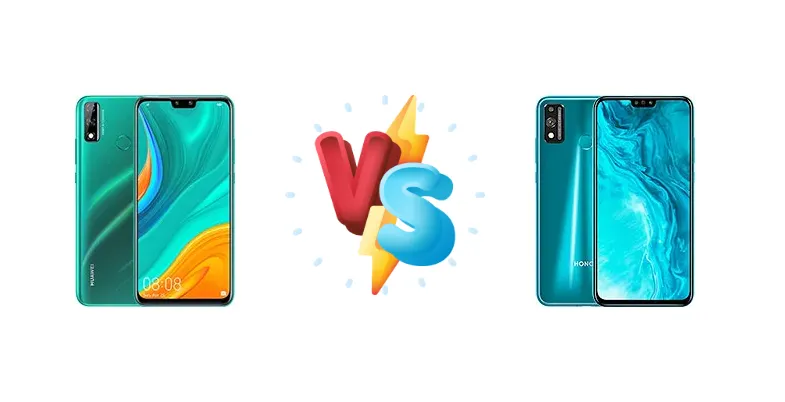
The Huawei Y8s and Honor 9X Lite represent a fascinating intersection in the budget smartphone market. Both devices leverage the Kirin 710 chipset, but subtle differences in branding and potential software optimization create a need for a detailed comparison. This analysis will dissect their similarities and differences to determine which phone offers the best value for cost-conscious consumers.
🏆 Quick Verdict
For the average user prioritizing a familiar brand experience, the Honor 9X Lite edges out the Huawei Y8s. While both share the same Kirin 710 chipset and 10W charging, Honor's generally cleaner software experience and slightly wider availability give it a marginal advantage. However, the difference is minimal.
| Network |
|---|
| 2G bands | GSM 850 / 900 / 1800 / 1900 | GSM 850 / 900 / 1800 / 1900 |
| 3G bands | HSDPA 850 / 900 / 2100 - JKM-LX2 | HSDPA 850 / 900 / 1900 / 2100 |
| 4G bands | 1, 3, 5, 7, 8, 28, 38, 40, 41 - JKM-LX2 | 1, 3, 7, 8, 20 |
| Speed | HSPA, LTE | HSPA 42.2/5.76 Mbps, LTE (2CA) Cat6 300/50 Mbps |
| Technology | GSM / HSPA / LTE | GSM / HSPA / LTE |
| | 1, 3, 5, 7, 8, 20 - JKM-LX1 | - |
| Launch |
|---|
| Announced | 2020, May 6. Released 2020, May 21 | 2020, April 17. Released 2020, May 14 |
| Status | Discontinued | Discontinued |
| Body |
|---|
| Dimensions | 162.4 x 77.1 x 8.1 mm (6.39 x 3.04 x 0.32 in) | 160.4 x 76.6 x 7.8 mm (6.31 x 3.02 x 0.31 in) |
| SIM | · Nano-SIM· Nano-SIM + Nano-SIM | Nano-SIM + Nano-SIM |
| Weight | 180 g (6.35 oz) | 188 g (6.63 oz) |
| Display |
|---|
| Resolution | 1080 x 2340 pixels, 19.5:9 ratio (~396 ppi density) | 1080 x 2340 pixels, 19.5:9 ratio (~397 ppi density) |
| Size | 6.5 inches, 103.7 cm2 (~82.8% screen-to-body ratio) | 6.5 inches, 103.2 cm2 (~84.0% screen-to-body ratio) |
| Type | IPS LCD | IPS LCD |
| Platform |
|---|
| CPU | Octa-core (4x2.2 GHz Cortex-A73 & 4x1.7 GHz Cortex-A53) | Octa-core (4x2.2 GHz Cortex-A73 & 4x1.7 GHz Cortex-A53) |
| Chipset | Kirin 710 (12 nm) | Kirin 710F (12 nm) |
| GPU | Mali-G51 MP4 | Mali-G51 MP4 |
| OS | Android 9.0 (Pie), EMUI 9.1, Google Play Services | Android 9.0 (Pie), EMUI 9.1, Google Play Services |
| Memory |
|---|
| Card slot | microSDXC | microSDXC (dedicated slot) |
| Internal | 64GB 4GB RAM, 128GB 4GB RAM | 128GB 4GB RAM |
| Main Camera |
|---|
| Dual | 48 MP, f/1.8, (wide), 1/2.0", 0.8µm, PDAF
Auxiliary lens | 48 MP, f/1.8, (wide), 1/2.0", 0.8µm, PDAF
Auxiliary lens |
| Features | LED flash, HDR, panorama | LED flash, HDR, panorama |
| Video | 1080p@30fps | 1080p@30fps |
| Selfie camera |
|---|
| Dual | 8 MP, f/2.0, (wide)
2 MP, f/2.4, (depth) | - |
| Features | HDR | - |
| Single | - | 8 MP, f/2.0, (wide) |
| Video | 1080p@30fps | 1080p@30fps |
| Sound |
|---|
| 3.5mm jack | Yes | Yes |
| 35mm jack | Yes | Yes |
| Loudspeaker | Yes | Yes |
| Comms |
|---|
| Bluetooth | 4.2, A2DP, LE | 4.2, A2DP, LE |
| NFC | No | Yes (market/region dependent) |
| Positioning | GPS, GLONASS, BDS | GPS, GLONASS, BDS |
| Radio | FM radio | FM radio |
| USB | microUSB 2.0 | microUSB 2.0 |
| WLAN | Wi-Fi 802.11 b/g/n, Wi-Fi Direct | Wi-Fi 802.11 a/b/g/n/ac, dual-band, Wi-Fi Direct |
| Features |
|---|
| Sensors | Fingerprint (rear-mounted), accelerometer, proximity, compass | Fingerprint (rear-mounted), accelerometer, proximity, compass |
| Battery |
|---|
| Charging | 10W wired | 10W wired |
| Type | Li-Po 4000 mAh | Li-Po 3750 mAh |
| Misc |
|---|
| Colors | Emerald Green, Midnight Black | Emerald Green, Midnight Black |
| Models | JKM-LX1, JKM-LX2, JKM-LX3 | JSN-L21, JSN-L22, JSN-L23 |
| Price | About 140 EUR | About 220 EUR |
Huawei Y8s
- Familiar Huawei UI
- Potentially lower price (depending on region)
- Access to Huawei ecosystem
- Potential software limitations due to geopolitical factors
- Slower charging speed (10W)
- Likely less frequent software updates
Honor 9X Lite
- Cleaner Android experience
- Potentially faster software updates
- Wider retail availability
- Slower charging speed (10W)
- Less brand recognition than Huawei in some markets
Display Comparison
Both the Huawei Y8s and Honor 9X Lite lack detailed display specifications in the provided data. However, given their market segment, we can infer both likely utilize LCD panels. The absence of information regarding resolution, brightness, or color gamut suggests neither device prioritizes display quality as a key selling point. Users seeking vibrant colors or high brightness should consider alternatives. Bezels are likely to be substantial on both, typical for this price range.
Camera Comparison
Detailed camera specifications are absent, making a direct comparison challenging. However, given the price point, both devices likely feature a multi-camera setup with a primary sensor and supporting lenses (potentially depth or macro). Without knowing sensor sizes or apertures, it's difficult to assess image quality. The image processing algorithms employed by Huawei and Honor may differ, leading to variations in color reproduction and dynamic range. Users should not expect flagship-level camera performance from either device.
Performance
The core of both devices is the Kirin 710 (12nm) and Kirin 710F (12nm) chipset. The 'F' designation in the 710F typically indicates a slightly refined version, potentially with minor optimizations for power efficiency. Both feature an octa-core CPU configuration with 4x2.2 GHz Cortex-A73 cores for performance and 4x1.7 GHz Cortex-A53 cores for efficiency. In real-world usage, the performance difference between the two will be negligible for everyday tasks like browsing, social media, and light gaming. The 12nm process node, while not cutting-edge, provides a reasonable balance between performance and power consumption. Neither device is expected to excel in demanding 3D games.
Battery Life
Both the Huawei Y8s and Honor 9X Lite are equipped with 10W wired charging. This is a relatively slow charging speed by modern standards, meaning a full charge will take a significant amount of time. The actual battery capacity isn't specified, but given the target market, it's likely in the 3000-4000 mAh range. Users who heavily utilize their smartphones will likely need to charge these devices daily. The slow charging speed is a significant drawback for power users.
Buying Guide
Buy the Huawei Y8s if you specifically prefer the Huawei user interface and ecosystem, and are comfortable with potential regional software limitations. Buy the Honor 9X Lite if you prioritize a cleaner Android experience, potentially faster software updates (depending on region), and a slightly broader range of retail availability. Both are excellent choices for basic smartphone tasks and media consumption.
Frequently Asked Questions
❓ Will the Kirin 710 handle popular games like PUBG Mobile or Call of Duty Mobile?
The Kirin 710 can run PUBG Mobile and Call of Duty Mobile, but expect to play at lower graphics settings (Medium or Low) and frame rates to maintain a smooth experience. Demanding titles may exhibit frame drops or lag, especially during intense action sequences. It's not a gaming-focused chipset.
❓ Is the software on the Huawei Y8s affected by the US trade restrictions?
Yes, the Huawei Y8s likely ships without full Google Mobile Services (GMS). This means no pre-installed Google apps like Gmail, YouTube, or the Play Store. Huawei provides its own app ecosystem (AppGallery) and workarounds for accessing Google services, but the experience may be less seamless for users accustomed to GMS.
❓ How long will it take to fully charge either phone with the 10W charger?
With the 10W charging, expect a full charge to take approximately 2.5 to 3.5 hours, depending on the battery capacity (estimated 3000-4000mAh). This is significantly slower than modern fast-charging technologies.