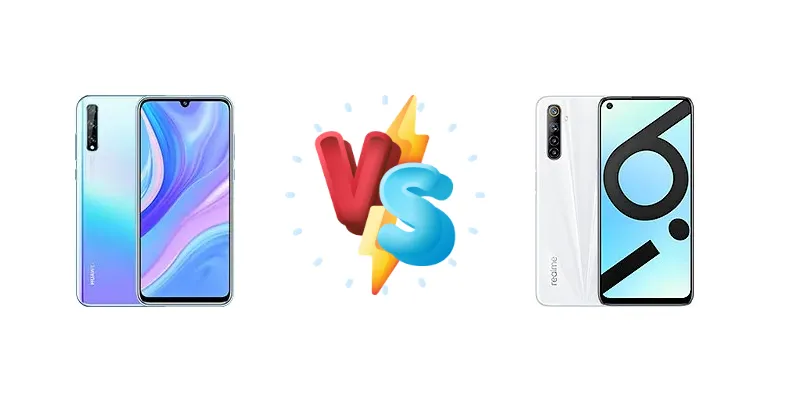
The sub-$200 smartphone market is fiercely competitive, and the Realme 6i (India) and Huawei Y8p represent compelling options. While both aim for affordability, they take distinctly different approaches. The Realme 6i prioritizes performance with a gaming-focused chipset and rapid charging, while the Huawei Y8p leans towards a balanced experience with a more conservative design and software approach. This comparison dissects their key differences to help you choose the right device.
🏆 Quick Verdict
For the average user prioritizing gaming and fast charging, the Realme 6i (India) is the clear winner. Its Helio G90T chipset offers significantly better performance than the Kirin 710F, and the 30W charging is a game-changer. However, users seeking a simpler software experience and less emphasis on demanding tasks might find the Y8p adequate.
| Network |
|---|
| 2G bands | GSM 900 / 1800 / 1900 | GSM 850 / 900 / 1800 / 1900 |
| 3G bands | HSDPA 850 / 900 / 1700(AWS) / 1900 / 2100 | HSDPA 850 / 900 / 2100 |
| 4G bands | 1, 2, 3, 4, 5, 7, 8, 26, 20, 28, 38, 40, 41 | 1, 3, 5, 8, 38, 40, 41 |
| Speed | HSPA, LTE | HSPA 42.2/11.5 Mbps, LTE (2CA) Cat6 300/75 Mbps |
| Technology | GSM / HSPA / LTE | GSM / HSPA / LTE |
| Launch |
|---|
| Announced | 2020, May 18. Released 2020, June 15 | 2020, July 24. Released 2020, July 31 |
| Status | Discontinued | Discontinued |
| Body |
|---|
| Build | - | Glass front (Gorilla Glass 3), plastic back, plastic frame |
| Dimensions | 157.4 x 73.2 x 7.8 mm (6.20 x 2.88 x 0.31 in) | 162.1 x 74.8 x 8.9 mm (6.38 x 2.94 x 0.35 in) |
| SIM | Nano-SIM + Nano-SIM | Nano-SIM + Nano-SIM |
| Weight | 163 g (5.75 oz) | 191 g (6.74 oz) |
| | - | Weather-sealed ports & loudspeaker |
| Display |
|---|
| Protection | - | Corning Gorilla Glass 3 |
| Resolution | 1080 x 2400 pixels, 20:9 ratio (~418 ppi density) | 1080 x 2400 pixels, 20:9 ratio (~405 ppi density) |
| Size | 6.3 inches, 95.8 cm2 (~83.2% screen-to-body ratio) | 6.5 inches, 102.0 cm2 (~84.1% screen-to-body ratio) |
| Type | OLED | IPS LCD, 90Hz, 480 nits (typ) |
| Platform |
|---|
| CPU | Octa-core (4x2.2 GHz Cortex-A73 & 4x1.7 GHz Cortex-A53) | Octa-core (2x2.05 GHz Cortex-A76 & 6x2.0 GHz Cortex-A55) |
| Chipset | Kirin 710F (12 nm) | Mediatek MT6785 Helio G90T (12 nm) |
| GPU | Mali-G51 MP4 | Mali-G76 MC4 |
| OS | Android 10, EMUI 10.1, no Google Play Services | Android 10, Realme UI |
| Memory |
|---|
| Card slot | Nano Memory (uses shared SIM slot) | microSDXC (dedicated slot) |
| Internal | 128GB 4GB RAM, 128GB 6GB RAM | 64GB 4GB RAM, 64GB 6GB RAM |
| | - | UFS 2.1 |
| Main Camera |
|---|
| Features | LED flash, HDR, panorama | LED flash, HDR, panorama |
| Quad | - | 48 MP, f/1.8, 26mm (wide), 1/2.0", 0.8µm, PDAF
8 MP, f/2.3, 119˚ (ultrawide), 1/4.0", 1.12µm
2 MP (macro)
Auxiliary lens |
| Triple | 48 MP, f/1.8, 27mm (wide), 1/2.0", 0.8µm, PDAF
8 MP, f/2.4, 120˚ (ultrawide)
Auxiliary lens | - |
| Video | 1080p@30fps | 4K@30fps, 1080p@30/60/120fps, gyro-EIS |
| Selfie camera |
|---|
| Features | HDR | HDR, panorama |
| Single | 16 MP, f/2.0 | 16 MP, f/2.0, 26mm (wide), 1/3.06", 1.0µm |
| Video | 1080p@30fps | 1080p@30fps |
| Sound |
|---|
| 3.5mm jack | Yes | Yes |
| 35mm jack | Yes | Yes |
| Loudspeaker | Yes | Yes |
| Comms |
|---|
| Bluetooth | 5.0, A2DP, LE | 5.0, A2DP, LE |
| NFC | Yes | No |
| Positioning | GPS, GLONASS, BDS | GPS, GLONASS, BDS |
| Radio | FM radio | FM radio |
| USB | USB Type-C 2.0, OTG | USB Type-C 2.0, OTG |
| WLAN | Wi-Fi 802.11 a/b/g/n/ac, dual-band, Wi-Fi Direct | Wi-Fi 802.11 a/b/g/n/ac, dual-band, Wi-Fi Direct |
| Features |
|---|
| Sensors | Fingerprint (under display, optical), accelerometer, proximity, compass | Fingerprint (side-mounted), accelerometer, gyro, proximity, compass |
| Battery |
|---|
| Charging | 10W wired | 30W wired, PD, 100% in 55 min |
| Type | Li-Po 4000 mAh | 4300 mAh |
| Misc |
|---|
| Colors | Breathing Crystal, Midnight Black | Eclipse Black, Lunar White |
| Models | AQM-LX1 | RMX2002 |
| Price | About 240 EUR | About 150 EUR |
Huawei Y8p
- Faster charging (30W vs 10W)
- Superior gaming performance with Helio G90T
- More powerful CPU architecture (Cortex-A76)
- Likely better camera versatility
- Potentially more aggressive software with Realme UI
- May lack some of Huawei’s software optimizations
Realme 6i (India)
- Simpler software experience (EMUI)
- Potentially better battery optimization due to less demanding chipset
- Sleek design (subjective)
- Huawei's image processing algorithms
- Significantly slower charging (10W)
- Inferior gaming performance with Kirin 710F
- Older CPU architecture (Cortex-A73)
- Limited multitasking capabilities
Display Comparison
Neither device boasts a standout display. Both utilize 12nm chipsets, suggesting similar power constraints impacting display capabilities. While specific display specs (resolution, panel type) are missing for the Y8p, the Realme 6i’s focus is clearly not on display quality. Expect both to offer adequate viewing experiences for everyday tasks, but neither will impress enthusiasts seeking vibrant colors or high refresh rates. The absence of high peak brightness or HDR support on either device suggests they are best suited for indoor use.
Camera Comparison
Without detailed camera specs beyond the presence of cameras, a direct comparison is difficult. However, the Realme 6i’s marketing often emphasizes its camera capabilities, suggesting a more robust imaging experience. The Y8p likely relies on Huawei’s image processing algorithms, which are generally good, but constrained by the Kirin 710F’s processing power. The absence of Optical Image Stabilization (OIS) on either device suggests image stabilization will be primarily digital, potentially leading to softer images in low light. Expect both to offer acceptable results in good lighting conditions, but the Realme 6i likely has an edge in overall versatility and low-light performance.
Performance
The performance gap is the most significant differentiator. The Realme 6i’s MediaTek Helio G90T, built on a 12nm process, features a more modern CPU architecture – two Cortex-A76 cores clocked at 2.05 GHz alongside six Cortex-A55 cores – compared to the Huawei Y8p’s Kirin 710F (also 12nm) with its older Cortex-A73 and A53 configuration. This translates to a substantial advantage for the 6i in CPU-intensive tasks and, crucially, gaming. The G90T’s Mali-G76 MC4 GPU further solidifies its gaming prowess. The Y8p’s Kirin 710F will handle everyday tasks adequately, but will struggle with demanding games or heavy multitasking. The Realme 6i is the clear choice for gamers.
Battery Life
The Realme 6i’s 30W wired charging is a standout feature, capable of charging the device to 100% in approximately 55 minutes. This is a massive advantage over the Huawei Y8p’s slow 10W charging. While battery capacity isn’t specified for either device, the faster charging of the 6i effectively mitigates any potential capacity disadvantage. Users who frequently find themselves needing to top up their phone will greatly appreciate the 6i’s charging speed. The Y8p’s 10W charging will require significantly longer to achieve a full charge.
Buying Guide
Buy the Huawei Y8p if you need a phone primarily for basic communication, social media, and light web browsing, and value a clean, if limited, software experience. Buy the Realme 6i (India) if you prefer a device capable of handling mobile games, multitasking, and benefit from significantly faster charging speeds, even if it means a more feature-rich, and potentially more complex, software environment.
Frequently Asked Questions
❓ Does the Realme 6i (India) get noticeably hot during extended gaming sessions?
The Helio G90T is known to generate some heat under sustained load. While the Realme 6i includes cooling solutions, expect some warmth during prolonged gaming. However, the performance gains generally outweigh the thermal concerns, and throttling is typically managed effectively.
❓ Is the Huawei Y8p a good choice for someone upgrading from a very old smartphone?
Yes, the Huawei Y8p provides a substantial upgrade in terms of processing power and features compared to older smartphones. It's a suitable option for users primarily focused on basic smartphone functions like calls, messaging, and social media, and who don't require demanding performance.
❓ Will the Huawei Y8p receive software updates and security patches?
Huawei's software update situation is complex due to ongoing restrictions. While the Y8p will likely receive some updates, the frequency and duration of support may be limited compared to other brands. Users should be aware of this potential limitation before purchasing.
❓ Can the Realme 6i (India) run PUBG Mobile at high settings?
Yes, the Realme 6i (India) can run PUBG Mobile at high settings with smooth frame rates. The Helio G90T is well-equipped to handle the game, although you may need to adjust settings slightly for optimal performance on the highest graphical presets.