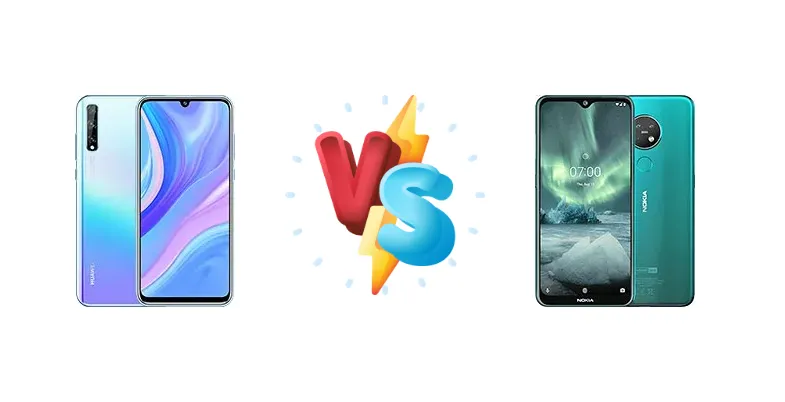
The Huawei Y8p and Nokia 7.2 represent compelling options in the crowded budget smartphone market. Both devices aim to deliver a solid experience without breaking the bank, but they take different approaches to achieving this. This comparison dissects their key specifications, focusing on performance, display, and battery life to determine which phone offers the best value.
🏆 Quick Verdict
For the average user prioritizing consistent performance and a slightly brighter display, the Nokia 7.2 emerges as the better choice. While both phones share a 10W charging limitation, the Snapdragon 660’s architecture provides a more stable experience than the Kirin 710F, despite the latter’s higher clock speeds.
| Network |
|---|
| 2G bands | GSM 900 / 1800 / 1900 | GSM 850 / 900 / 1800 / 1900 |
| 3G bands | HSDPA 850 / 900 / 1700(AWS) / 1900 / 2100 | HSDPA 850 / 900 / 2100 - ROW |
| 4G bands | 1, 2, 3, 4, 5, 7, 8, 26, 20, 28, 38, 40, 41 | 1, 3, 5, 7, 8, 20, 28, 38, 40, 41 - ROW |
| Speed | HSPA, LTE | HSPA 42.2/5.76 Mbps, LTE (2CA) Cat6 300/50 Mbps or LTE Cat4 150/50 Mbps |
| Technology | GSM / HSPA / LTE | GSM / HSPA / LTE |
| | - | 1, 3, 5, 8, 40, 41 - IN |
| Launch |
|---|
| Announced | 2020, May 18. Released 2020, June 15 | 2019, September 05. Released 2019, September 23 |
| Status | Discontinued | Discontinued |
| Body |
|---|
| Build | - | Glass front (Gorilla Glass 3), glass back (Gorilla Glass 3), plastic frame |
| Dimensions | 157.4 x 73.2 x 7.8 mm (6.20 x 2.88 x 0.31 in) | 159.9 x 75.2 x 8.3 mm (6.30 x 2.96 x 0.33 in) |
| SIM | Nano-SIM + Nano-SIM | · Nano-SIM· Nano-SIM + Nano-SIM |
| Weight | 163 g (5.75 oz) | 180 g (6.35 oz) |
| Display |
|---|
| Protection | - | Corning Gorilla Glass 3 |
| Resolution | 1080 x 2400 pixels, 20:9 ratio (~418 ppi density) | 1080 x 2280 pixels, 19:9 ratio (~400 ppi density) |
| Size | 6.3 inches, 95.8 cm2 (~83.2% screen-to-body ratio) | 6.3 inches, 99.1 cm2 (~82.4% screen-to-body ratio) |
| Type | OLED | IPS LCD, HDR10 |
| Platform |
|---|
| CPU | Octa-core (4x2.2 GHz Cortex-A73 & 4x1.7 GHz Cortex-A53) | Octa-core (4x2.2 GHz Kryo 260 Gold & 4x1.8 GHz Kryo 260 Silver) |
| Chipset | Kirin 710F (12 nm) | Qualcomm SDM660 Snapdragon 660 (14 nm) |
| GPU | Mali-G51 MP4 | Adreno 512 |
| OS | Android 10, EMUI 10.1, no Google Play Services | Android 9.0 (Pie), upgradable to Android 11, Android One |
| Memory |
|---|
| Card slot | Nano Memory (uses shared SIM slot) | microSDXC (dedicated slot) |
| Internal | 128GB 4GB RAM, 128GB 6GB RAM | 64GB 4GB RAM, 64GB 6GB RAM, 128GB 4GB RAM, 128GB 6GB RAM |
| | - | eMMC 5.1 |
| Main Camera |
|---|
| Features | LED flash, HDR, panorama | Zeiss optics, LED flash, panorama, HDR |
| Triple | 48 MP, f/1.8, 27mm (wide), 1/2.0", 0.8µm, PDAF
8 MP, f/2.4, 120˚ (ultrawide)
Auxiliary lens | 48 MP, f/1.8, (wide), 1/2.0", 0.8µm, PDAF
8 MP, f/2.2, 13mm (ultrawide), 1/4.0", 1.12µm
Auxiliary lens |
| Video | 1080p@30fps | 4K@30fps, 1080p@30fps (gyro-EIS) |
| Selfie camera |
|---|
| Features | HDR | Zeiss optics, HDR |
| Single | 16 MP, f/2.0 | 20 MP, f/2.0, (wide), 1/3", 0.9µm |
| Video | 1080p@30fps | 1080p@30fps |
| Sound |
|---|
| 3.5mm jack | Yes | Yes |
| 35mm jack | Yes | Yes |
| Loudspeaker | Yes | Yes |
| Comms |
|---|
| Bluetooth | 5.0, A2DP, LE | 5.0, A2DP, EDR, LE, aptX |
| NFC | Yes | Yes (excl. India) |
| Positioning | GPS, GLONASS, BDS | GPS, GLONASS, GALILEO, BDS |
| Radio | FM radio | FM radio |
| USB | USB Type-C 2.0, OTG | USB Type-C 2.0, OTG |
| WLAN | Wi-Fi 802.11 a/b/g/n/ac, dual-band, Wi-Fi Direct | Wi-Fi 802.11 b/g/n/ac, dual-band, Wi-Fi Direct |
| Features |
|---|
| Sensors | Fingerprint (under display, optical), accelerometer, proximity, compass | Fingerprint (rear-mounted), accelerometer, gyro, proximity, compass |
| Battery |
|---|
| Charging | 10W wired | 10W wired |
| Type | Li-Po 4000 mAh | Li-Po 3500 mAh, non-removable |
| Misc |
|---|
| Colors | Breathing Crystal, Midnight Black | Cyan Green, Charcoal, Ice |
| Models | AQM-LX1 | TA-1193, TA-1178, TA-1196, TA-1181 |
| Price | About 240 EUR | About 240 EUR |
| SAR | - | 1.15 W/kg (head) 0.90 W/kg (body) |
| SAR EU | - | 0.99 W/kg (head) 1.44 W/kg (body) |
| Tests |
|---|
| Audio quality | - |
Noise -93.0dB / Crosstalk -93.4dB |
| Battery life | - |
Endurance rating 69h
|
| Camera | - |
Photo / Video |
| Display | - |
Contrast ratio: 1342:1 (nominal) |
| Loudspeaker | - |
-29.6 LUFS (Average)
|
| Performance | - |
AnTuTu: 139495 (v7), 164484 (v8)
GeekBench: 5440 (v4.4), 1398 (v5.1)
GFXBench: 8.1fps (ES 3.1 onscreen) |
Huawei Y8p
- Potentially smoother UI due to EMUI optimizations
- Slightly newer chipset (though not necessarily better)
- Competitive price point
- Kirin 710F prone to throttling under sustained load
- Limited software update support
- Uncertain camera performance
Nokia 7.2
- More efficient Snapdragon 660 processor
- Brighter and higher contrast display
- Clean Android One software with guaranteed updates
- 10W charging is slow
- May not have the latest software features
- Design is somewhat dated
Display Comparison
The Nokia 7.2 boasts a noticeably brighter display, reaching a measured 585 nits compared to an unmeasured value for the Y8p. Both share a 1342:1 contrast ratio, suggesting similar color depth and black levels. This higher brightness on the Nokia 7.2 translates to better outdoor visibility, a significant advantage for users frequently exposed to sunlight. While panel technology isn’t specified, the Nokia 7.2’s display is likely to offer a more pleasant viewing experience in various lighting conditions.
Camera Comparison
Both devices feature 'Photo / Video' capabilities, but detailed sensor information is lacking. Without specifics, it’s difficult to make a definitive judgment. However, the Nokia 7.2’s brand reputation suggests a focus on image processing quality, potentially delivering more natural-looking photos. The Y8p’s camera performance is likely reliant on Huawei’s AI scene detection, which can sometimes result in over-processed images. The absence of details regarding sensor size and aperture makes a precise comparison impossible, but the Nokia 7.2’s history suggests a more refined camera experience.
Performance
Both the Huawei Y8p and Nokia 7.2 utilize octa-core CPUs clocked at 2.2 GHz, but the underlying architectures differ significantly. The Nokia 7.2’s Snapdragon 660 employs Qualcomm’s Kryo 260 cores built on a 14nm process, known for its efficiency and sustained performance. The Y8p’s Kirin 710F, fabricated on a 12nm node, features Cortex-A73 and A53 cores. While the A73 cores offer higher peak performance, the Snapdragon 660’s architecture is generally more efficient at handling sustained workloads, potentially leading to less throttling during extended gaming sessions. The Snapdragon 660 also benefits from Qualcomm’s optimized software support.
Battery Life
Both the Huawei Y8p and Nokia 7.2 achieve an endurance rating of 69 hours, indicating comparable battery life under similar usage patterns. However, the Snapdragon 660’s superior efficiency may allow the Nokia 7.2 to maintain its battery life for slightly longer under heavy load. Both phones are limited to 10W wired charging, resulting in relatively slow charging times. Expect approximately 2-3 hours to fully charge from 0% to 100% on both devices.
Buying Guide
Buy the Huawei Y8p if you prioritize a potentially smoother user interface experience due to Huawei’s EMUI optimizations, and are comfortable with the limitations of the Kirin 710F chipset. Buy the Nokia 7.2 if you value a more balanced performance profile, a brighter and higher contrast display, and the clean Android One software experience, which guarantees faster updates and a bloatware-free environment.
Frequently Asked Questions
❓ Does the Kirin 710F in the Huawei Y8p struggle with demanding games like PUBG Mobile?
Yes, the Kirin 710F, while capable of running PUBG Mobile, is likely to exhibit noticeable frame drops and throttling during extended gaming sessions. The Snapdragon 660 in the Nokia 7.2 offers a more stable and consistent gaming experience, even at medium settings.
❓ How does the Android One software on the Nokia 7.2 impact the user experience compared to Huawei's EMUI?
Android One provides a clean, bloatware-free experience with guaranteed software updates directly from Google. This contrasts with Huawei’s EMUI, which includes pre-installed apps and a customized interface. Android One prioritizes simplicity and timely updates, while EMUI offers more features and customization options, but at the cost of potential bloat and slower updates.
❓ Is the 10W charging speed on either phone a significant drawback?
Yes, 10W charging is relatively slow by today's standards. Expect approximately 2-3 hours to fully charge either device. This is a significant limitation for users who require quick top-ups throughout the day.