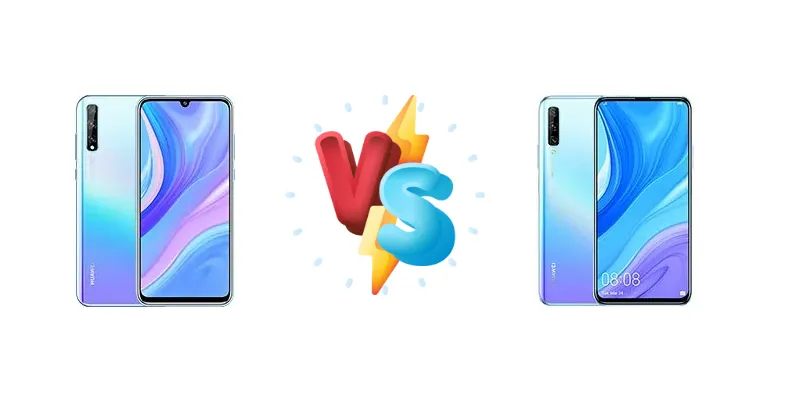
Huawei's Y-series offers excellent value, but choosing between the Y8p and Y9s can be tricky. Both phones share a similar core chipset, but subtle differences in design, camera features, and display could sway your decision. Let's dive into a comprehensive comparison to help you pick the perfect phone.
🏆 Quick Verdict
The Huawei Y9s edges out the Y8p primarily due to its larger display and pop-up selfie camera, offering a more modern aesthetic and immersive viewing experience. Both offer similar performance, but the Y9s's design and slightly improved camera features make it the better overall choice for most users.
| Network |
|---|
| 2G bands | GSM 900 / 1800 / 1900 | GSM 850 / 900 / 1800 / 1900 |
| 3G bands | HSDPA 850 / 900 / 1700(AWS) / 1900 / 2100 | HSDPA 850 / 900 / 1900 / 2100 |
| 4G bands | 1, 2, 3, 4, 5, 7, 8, 26, 20, 28, 38, 40, 41 | 1, 3, 5, 7, 8, 28, 38, 40, 41 - International |
| Speed | HSPA, LTE | HSPA, LTE |
| Technology | GSM / HSPA / LTE | GSM / HSPA / LTE |
| Launch |
|---|
| Announced | 2020, May 18. Released 2020, June 15 | 2019, November 08. Released 2019, November 08 |
| Status | Discontinued | Discontinued |
| Body |
|---|
| Build | - | Glass front, glass back, aluminum frame |
| Dimensions | 157.4 x 73.2 x 7.8 mm (6.20 x 2.88 x 0.31 in) | 163.1 x 77.2 x 8.8 mm (6.42 x 3.04 x 0.35 in) |
| SIM | Nano-SIM + Nano-SIM | Nano-SIM + Nano-SIM |
| Weight | 163 g (5.75 oz) | 206 g (7.27 oz) |
| Display |
|---|
| Resolution | 1080 x 2400 pixels, 20:9 ratio (~418 ppi density) | 1080 x 2340 pixels, 19.5:9 ratio (~391 ppi density) |
| Size | 6.3 inches, 95.8 cm2 (~83.2% screen-to-body ratio) | 6.59 inches, 106.6 cm2 (~84.7% screen-to-body ratio) |
| Type | OLED | IPS LCD |
| Platform |
|---|
| CPU | Octa-core (4x2.2 GHz Cortex-A73 & 4x1.7 GHz Cortex-A53) | Octa-core (4x2.2 GHz Cortex-A73 & 4x1.7 GHz Cortex-A53) |
| Chipset | Kirin 710F (12 nm) | Kirin 710F (12 nm) |
| GPU | Mali-G51 MP4 | Mali-G51 MP4 |
| OS | Android 10, EMUI 10.1, no Google Play Services | Android 9.0 (Pie), EMUI 9.1 |
| Memory |
|---|
| Card slot | Nano Memory (uses shared SIM slot) | microSDXC (uses shared SIM slot) |
| Internal | 128GB 4GB RAM, 128GB 6GB RAM | 128GB 6GB RAM |
| | - | UFS 2.1 |
| Main Camera |
|---|
| Features | LED flash, HDR, panorama | LED flash, HDR, panorama |
| Triple | 48 MP, f/1.8, 27mm (wide), 1/2.0", 0.8µm, PDAF
8 MP, f/2.4, 120˚ (ultrawide)
Auxiliary lens | 48 MP, f/1.8, (wide), 1/2.0", 0.8µm, PDAF
8 MP, f/2.4, 13mm (ultrawide)
Auxiliary lens |
| Video | 1080p@30fps | 1080p@30fps |
| Selfie camera |
|---|
| Features | HDR | HDR |
| Single | 16 MP, f/2.0 | Motorized pop-up 16 MP, f/2.2 |
| Video | 1080p@30fps | 1080p@60fps |
| Sound |
|---|
| 3.5mm jack | Yes | Yes |
| 35mm jack | Yes | Yes |
| Loudspeaker | Yes | Yes |
| Comms |
|---|
| Bluetooth | 5.0, A2DP, LE | 4.2, A2DP, LE |
| NFC | Yes | No |
| Positioning | GPS, GLONASS, BDS | GPS, GLONASS, BDS |
| Radio | FM radio | FM radio |
| USB | USB Type-C 2.0, OTG | USB Type-C 2.0 |
| WLAN | Wi-Fi 802.11 a/b/g/n/ac, dual-band, Wi-Fi Direct | Wi-Fi 802.11 b/g/n, Wi-Fi Direct |
| Features |
|---|
| Sensors | Fingerprint (under display, optical), accelerometer, proximity, compass | Fingerprint (side-mounted), accelerometer, gyro, proximity, compass |
| Battery |
|---|
| Charging | 10W wired | 10W wired |
| Type | Li-Po 4000 mAh | Li-Po 4000 mAh, non-removable |
| Misc |
|---|
| Colors | Breathing Crystal, Midnight Black | Midnight Black, Breathing Crystal, Phantom Purple |
| Models | AQM-LX1 | STK-L21, STK-LX3, STK-L22 |
| Price | About 240 EUR | About 220 EUR |
Huawei Y8p
- Compact and ergonomic design
- Good camera performance
- Reliable Kirin 710F chipset
- Decent battery life
- Slightly dated design
- 10W charging is slow
- Smaller display compared to Y9s
Huawei Y9s
- Larger, immersive display
- Modern bezel-less design with pop-up selfie camera
- Good camera performance
- Reliable Kirin 710F chipset
- 10W charging is slow
- Potentially slightly shorter battery life due to larger screen
- Larger size may not be ideal for everyone
Display Comparison
The Y9s boasts a 6.59-inch IPS LCD display compared to the Y8p's 6.3-inch display. This larger screen provides a more immersive experience for watching videos and playing games. Both displays offer a resolution of 1080 x 2340 pixels, ensuring sharp visuals. The Y9s's edge-to-edge design also contributes to a more modern look.
Camera Comparison
The Y8p features a triple-camera setup (48MP main, 8MP ultra-wide, 2MP depth sensor) and a 16MP front camera. The Y9s has a triple-camera setup (48MP main, 8MP ultra-wide, 2MP depth sensor) and a 16MP pop-up front camera. The pop-up camera on the Y9s offers a cleaner, bezel-less display, and the image quality is comparable between both devices.
Performance
Both phones are powered by the Kirin 710F chipset, so performance will be very similar. Expect smooth multitasking and adequate performance for everyday tasks and moderate gaming. However, the Y9s might have slightly better thermal management due to its larger chassis.
Battery Life
Both phones have a 4000mAh battery. Battery life should be similar, providing a full day of moderate use. However, the Y9s's larger screen might consume slightly more power, potentially resulting in marginally shorter battery life.
Buying Guide
The Huawei Y8p is a good choice for users prioritizing a compact design and slightly better grip. The Huawei Y9s is ideal for those who want a larger screen for media consumption and a more modern, bezel-less look with a pop-up selfie camera.
Frequently Asked Questions
❓ Is the Kirin 710F a good chipset?
The Kirin 710F is a capable chipset for everyday tasks and moderate gaming. It's not the most powerful, but it provides a smooth user experience for most users.
❓ How long does the battery last on these phones?
Both phones offer a full day of battery life with moderate use. Expect around 8-10 hours of screen-on time.
❓ Are these phones 5G compatible?
No, neither the Huawei Y8p nor the Y9s support 5G connectivity. They both rely on 4G LTE.