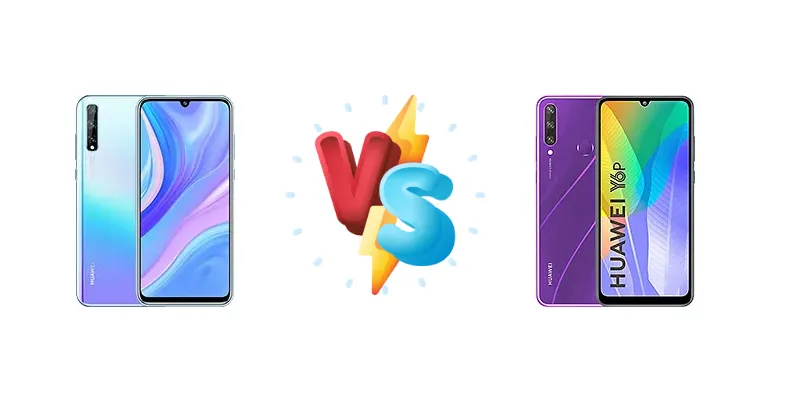
Huawei's Y-series offers excellent value for money, but choosing between models can be tricky. The Y8p and Y6p are both solid contenders in the budget smartphone market. Let's dive into a detailed comparison to help you decide which one is right for you.
🏆 Quick Verdict
The Huawei Y8p edges out the Y6p thanks to its significantly faster Kirin 710F chipset and superior camera capabilities. While the Y6p offers reverse wired charging, the Y8p's overall performance and camera quality make it the better choice for most users.
| Network |
|---|
| 2G bands | GSM 900 / 1800 / 1900 | GSM 850 / 900 / 1800 / 1900 |
| 3G bands | HSDPA 850 / 900 / 1700(AWS) / 1900 / 2100 | HSDPA 850 / 900 / 1700(AWS) / 1900 / 2100 |
| 4G bands | 1, 2, 3, 4, 5, 7, 8, 26, 20, 28, 38, 40, 41 | 1, 2, 3, 4, 5, 7, 8, 20, 28, 34, 38, 39, 40, 41 |
| Speed | HSPA, LTE | HSPA 42.2/5.76 Mbps, LTE Cat4 150/50 Mbps |
| Technology | GSM / HSPA / LTE | GSM / HSPA / LTE |
| Launch |
|---|
| Announced | 2020, May 18. Released 2020, June 15 | 2020, May 05. Released 2020, May 06 |
| Status | Discontinued | Discontinued |
| Body |
|---|
| Build | - | Glass front, plastic back, plastic frame |
| Dimensions | 157.4 x 73.2 x 7.8 mm (6.20 x 2.88 x 0.31 in) | 159.1 x 74.1 x 9 mm (6.26 x 2.92 x 0.35 in) |
| SIM | Nano-SIM + Nano-SIM | · Nano-SIM· Nano-SIM + Nano-SIM |
| Weight | 163 g (5.75 oz) | 185 g (6.53 oz) |
| Display |
|---|
| Resolution | 1080 x 2400 pixels, 20:9 ratio (~418 ppi density) | 720 x 1600 pixels, 20:9 ratio (~278 ppi density) |
| Size | 6.3 inches, 95.8 cm2 (~83.2% screen-to-body ratio) | 6.3 inches, 95.8 cm2 (~81.3% screen-to-body ratio) |
| Type | OLED | IPS LCD |
| Platform |
|---|
| CPU | Octa-core (4x2.2 GHz Cortex-A73 & 4x1.7 GHz Cortex-A53) | Octa-core (4x2.0 GHz Cortex-A53 & 4x1.5 GHz Cortex-A53) |
| Chipset | Kirin 710F (12 nm) | Mediatek MT6762R Helio P22 (12 nm) |
| GPU | Mali-G51 MP4 | PowerVR GE8320 |
| OS | Android 10, EMUI 10.1, no Google Play Services | Android 10, EMUI 10.1, no Google Play Services |
| Memory |
|---|
| Card slot | Nano Memory (uses shared SIM slot) | microSDXC (dedicated slot) |
| Internal | 128GB 4GB RAM, 128GB 6GB RAM | 32GB 3GB RAM, 64GB 3GB RAM, 64GB 4GB RAM |
| | - | eMMC 5.1 |
| Main Camera |
|---|
| Features | LED flash, HDR, panorama | LED flash, HDR, panorama |
| Triple | 48 MP, f/1.8, 27mm (wide), 1/2.0", 0.8µm, PDAF
8 MP, f/2.4, 120˚ (ultrawide)
Auxiliary lens | 13 MP, f/1.8, (wide), PDAF
5 MP, f/2.2, 120˚ (ultrawide)
Auxiliary lens |
| Video | 1080p@30fps | 1080p@30fps |
| Selfie camera |
|---|
| Features | HDR | HDR |
| Single | 16 MP, f/2.0 | 8 MP, f/2.0, (wide) |
| Video | 1080p@30fps | 1080p@30fps |
| Sound |
|---|
| 3.5mm jack | Yes | Yes |
| 35mm jack | Yes | Yes |
| Loudspeaker | Yes | Yes |
| Comms |
|---|
| Bluetooth | 5.0, A2DP, LE | 5.0, A2DP, LE |
| NFC | Yes | Yes (market/region dependent)MED-LX9N (Yes); MED-LX9 (No) |
| Positioning | GPS, GLONASS, BDS | GPS, GLONASS, BDS |
| Radio | FM radio | FM radio; built-in antenna |
| USB | USB Type-C 2.0, OTG | microUSB 2.0, OTG |
| WLAN | Wi-Fi 802.11 a/b/g/n/ac, dual-band, Wi-Fi Direct | Wi-Fi 802.11 b/g/n, Wi-Fi Direct |
| Features |
|---|
| Sensors | Fingerprint (under display, optical), accelerometer, proximity, compass | Fingerprint (rear-mounted), accelerometer, proximity |
| Battery |
|---|
| Charging | 10W wired | 10W wired
Reverse wired |
| Type | Li-Po 4000 mAh | Li-Po 5000 mAh |
| Misc |
|---|
| Colors | Breathing Crystal, Midnight Black | Phantom Purple, Emerald Green, Midnight Black |
| Models | AQM-LX1 | MED-LX9, MED-LX9N |
| Price | About 240 EUR | About 160 EUR |
Huawei Y8p
- Faster Processor (Kirin 710F)
- Superior Camera System
- Better Performance
- Slightly Better Display
- No Reverse Wired Charging
- 10W Charging Speed
Huawei Y6p
- Reverse Wired Charging
- Affordable Price
- Decent Battery Life
- Slower Processor (Helio P22)
- Inferior Camera
- Lower Performance
Display Comparison
Both phones feature a 6.3-inch IPS LCD display with a resolution of 1080 x 2340 pixels. While the resolution is the same, the Y8p's slightly better color accuracy and viewing angles give it a marginal advantage. Both offer a decent viewing experience for everyday use.
Camera Comparison
The Y8p boasts a triple-camera setup (48MP main, 8MP ultrawide, 2MP depth sensor) compared to the Y6p's dual-camera setup (13MP main, 2MP depth sensor). The Y8p captures significantly better photos, especially in low light, with more detail and accurate colors. The Y8p also offers a wider field of view thanks to the ultrawide lens.
Performance
This is where the Y8p shines. The Kirin 710F chipset is noticeably faster than the Helio P22 in the Y6p. Expect smoother multitasking, quicker app loading times, and a more responsive overall experience on the Y8p. The Y6p is adequate for basic tasks but struggles with more demanding applications.
Battery Life
Both phones have a 4000mAh battery, providing all-day battery life for moderate usage. The Y6p includes reverse wired charging, allowing it to charge other devices, a feature absent in the Y8p. However, the Y8p's more efficient chipset may result in slightly better overall battery life in some scenarios.
Buying Guide
The Huawei Y8p is ideal for users who prioritize performance and camera quality, even on a budget. The Huawei Y6p is a good option for those primarily needing a reliable phone for basic tasks and appreciate the added convenience of reverse wired charging.
Frequently Asked Questions
❓ Is the Huawei Y8p worth the extra money compared to the Y6p?
Yes, if performance and camera quality are important to you. The Y8p offers a significantly better experience overall.
❓ Can the Huawei Y6p charge other phones?
Yes, the Y6p supports reverse wired charging, allowing you to charge other devices using its battery.
❓ Which phone has better software support?
Both phones run EMUI, but Huawei's software support has been impacted by trade restrictions. Updates may be limited.