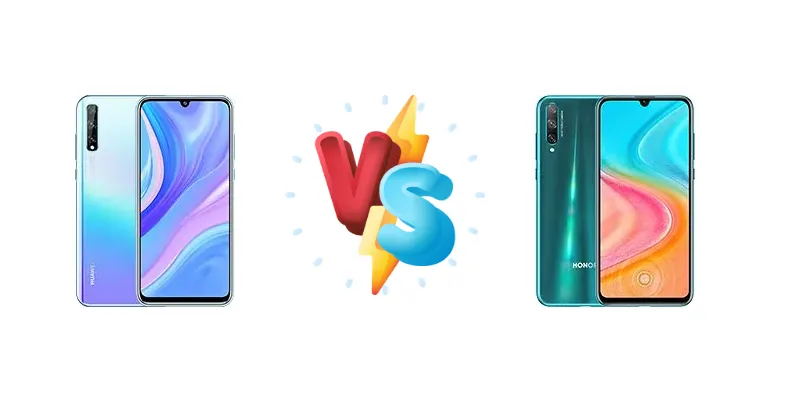
The Huawei Y8p and Honor 20 Lite (China) represent a fascinating case study in brand segmentation. Both devices utilize the same Kirin 710F chipset, suggesting similar core performance. However, a key difference emerges in their charging capabilities, making the Honor 20 Lite a potentially more convenient option for users prioritizing quick top-ups. This comparison dissects these nuances to determine which device delivers the best overall experience.
🏆 Quick Verdict
For the average user, the Honor 20 Lite (China) is the superior choice. While both phones share the Kirin 710F, the 20W fast charging significantly reduces downtime, a practical advantage over the Y8p’s slower 10W charging. This convenience justifies a potential price premium.
| Network |
|---|
| 2G bands | GSM 900 / 1800 / 1900 | GSM 900 / 1800 / 1900 |
| 3G bands | HSDPA 850 / 900 / 1700(AWS) / 1900 / 2100 | HSDPA 850 / 900 / 1900 / 2100 |
| 4G bands | 1, 2, 3, 4, 5, 7, 8, 26, 20, 28, 38, 40, 41 | 1, 3, 5, 8, 38, 39, 40, 41 |
| Speed | HSPA, LTE | HSPA, LTE |
| Technology | GSM / HSPA / LTE | GSM / CDMA / HSPA / LTE |
| | - | CDMA 800 & TD-SCDMA |
| Launch |
|---|
| Announced | 2020, May 18. Released 2020, June 15 | 2019, October. Released 2019, October |
| Status | Discontinued | Discontinued |
| Body |
|---|
| Dimensions | 157.4 x 73.2 x 7.8 mm (6.20 x 2.88 x 0.31 in) | 157.2 x 73.2 x 7.7 mm (6.19 x 2.88 x 0.30 in) |
| SIM | Nano-SIM + Nano-SIM | Nano-SIM + Nano-SIM |
| Weight | 163 g (5.75 oz) | 171.5 g (6.07 oz) |
| Display |
|---|
| Resolution | 1080 x 2400 pixels, 20:9 ratio (~418 ppi density) | 1080 x 2400 pixels, 20:9 ratio (~418 ppi density) |
| Size | 6.3 inches, 95.8 cm2 (~83.2% screen-to-body ratio) | 6.3 inches, 95.8 cm2 (~83.3% screen-to-body ratio) |
| Type | OLED | AMOLED, 600 nits (typ) |
| Platform |
|---|
| CPU | Octa-core (4x2.2 GHz Cortex-A73 & 4x1.7 GHz Cortex-A53) | Octa-core (4x2.2 GHz Cortex-A73 & 4x1.7 GHz Cortex-A53) |
| Chipset | Kirin 710F (12 nm) | Kirin 710F (12 nm) |
| GPU | Mali-G51 MP4 | Mali-G51 MP4 |
| OS | Android 10, EMUI 10.1, no Google Play Services | Android 9.0 (Pie), EMUI 9.1 |
| Memory |
|---|
| Card slot | Nano Memory (uses shared SIM slot) | microSDXC (uses shared SIM slot) |
| Internal | 128GB 4GB RAM, 128GB 6GB RAM | 64GB 4GB RAM, 64GB 6GB RAM, 128GB 6GB RAM, 128GB 8GB RAM |
| Main Camera |
|---|
| Features | LED flash, HDR, panorama | LED flash, HDR, panorama |
| Triple | 48 MP, f/1.8, 27mm (wide), 1/2.0", 0.8µm, PDAF
8 MP, f/2.4, 120˚ (ultrawide)
Auxiliary lens | 48 MP, f/1.8, 28mm (wide), 1/2.0", 0.8µm, PDAF
8 MP, f/2.4, 13mm (ultrawide)
Auxiliary lens |
| Video | 1080p@30fps | 1080p@30fps |
| Selfie camera |
|---|
| Features | HDR | HDR |
| Single | 16 MP, f/2.0 | 16 MP, f/2.0, 26mm (wide), 1/3.06", 1.0µm |
| Video | 1080p@30fps | 1080p@30fps |
| Sound |
|---|
| 3.5mm jack | Yes | Yes |
| 35mm jack | Yes | Yes |
| Loudspeaker | Yes | Yes |
| Comms |
|---|
| Bluetooth | 5.0, A2DP, LE | 5.0, A2DP, LE |
| NFC | Yes | No |
| Positioning | GPS, GLONASS, BDS | GPS, GLONASS, BDS |
| Radio | FM radio | FM radio |
| USB | USB Type-C 2.0, OTG | USB Type-C 2.0, OTG |
| WLAN | Wi-Fi 802.11 a/b/g/n/ac, dual-band, Wi-Fi Direct | Wi-Fi 802.11 a/b/g/n/ac, dual-band, Wi-Fi Direct |
| Features |
|---|
| Sensors | Fingerprint (under display, optical), accelerometer, proximity, compass | Fingerprint (under display, optical), accelerometer, proximity, compass |
| Battery |
|---|
| Charging | 10W wired | 20W wired |
| Type | Li-Po 4000 mAh | Li-Po 4000 mAh, non-removable |
| Misc |
|---|
| Colors | Breathing Crystal, Midnight Black | Black, Green, Blue/Pink |
| Models | AQM-LX1 | LRA-AL00, LRA-TL00 |
| Price | About 240 EUR | About 220 EUR |
Huawei Y8p
- Potentially lower price point
- Identical CPU performance to Honor 20 Lite
- Likely similar display quality
- Significantly slower 10W charging
- May have a less optimized software experience
- Potentially lower resale value
Honor 20 lite (China)
- 20W fast charging for quicker top-ups
- Potentially better software optimization (Honor)
- More convenient for active users
- May be slightly more expensive
- Identical CPU performance to Huawei Y8p
- Likely similar display quality
Display Comparison
Both the Huawei Y8p and Honor 20 Lite likely feature LCD panels, typical for this price segment. Specific details like resolution and peak brightness are not provided, but we can assume they are comparable, aiming for a 1080p+ resolution. The absence of high refresh rate technology is expected. The user experience will likely be similar in terms of visual clarity, though color accuracy may vary slightly due to different panel calibrations.
Camera Comparison
Without detailed camera specifications, a direct comparison is difficult. Both phones likely feature a multi-camera setup, but the quality will depend on sensor size, lens aperture, and image processing algorithms. The presence of a 2MP macro camera on either device is unlikely to significantly enhance the photography experience, serving primarily as a marketing feature. Image processing styles will likely differ between Huawei and Honor, potentially resulting in different color profiles and levels of detail.
Performance
The core of both devices is the Kirin 710F (12 nm) chipset, featuring an octa-core CPU configuration with 4x2.2 GHz Cortex-A73 and 4x1.7 GHz Cortex-A53 cores. This means CPU performance will be virtually identical between the two. The GPU performance will also be the same. However, sustained performance could differ slightly based on thermal design. The Kirin 710F is a capable chip for everyday tasks and light gaming, but will struggle with demanding titles at high settings. RAM configurations are not specified, but will impact multitasking capabilities.
Battery Life
Battery capacity is not specified for either device. However, the key differentiator is charging speed. The Honor 20 Lite’s 20W wired charging is double the speed of the Huawei Y8p’s 10W charging. This translates to significantly faster charging times – potentially reducing a full charge from over 2 hours to around 1.5 hours. For users who frequently need to top up their battery, this is a substantial advantage. A larger battery capacity on the Y8p would partially offset the slower charging, but without that information, the Honor 20 Lite holds the edge.
Buying Guide
Buy the Huawei Y8p if you prioritize a potentially lower price point and are comfortable with slower charging speeds. It’s a solid option for users who don’t mind overnight charging or infrequent top-ups. Buy the Honor 20 Lite (China) if you value convenience and faster charging. The 20W charging capability is a significant benefit for users who need to quickly replenish their battery throughout the day, making it ideal for those with active lifestyles.
Frequently Asked Questions
❓ Is the Kirin 710F chipset capable of running demanding games like PUBG Mobile?
The Kirin 710F can run PUBG Mobile, but likely at medium graphics settings and frame rates for a smooth experience. Expect some frame drops during intense action sequences. It's not a gaming-focused chipset, so don't expect flagship-level performance.
❓ How much faster is the 20W charging on the Honor 20 Lite compared to the 10W charging on the Huawei Y8p?
The 20W charging on the Honor 20 Lite can potentially reduce a full charge time by 30-50 minutes compared to the Huawei Y8p’s 10W charging. This difference is particularly noticeable when topping up the battery from a low percentage.
❓ Will I notice a significant difference in performance between the Huawei Y8p and Honor 20 Lite for everyday tasks like browsing and social media?
No, you likely won't notice a significant difference in performance for everyday tasks. Both phones share the same Kirin 710F chipset and will handle browsing, social media, and basic apps with ease. The difference will be more apparent during demanding tasks like gaming or video editing.