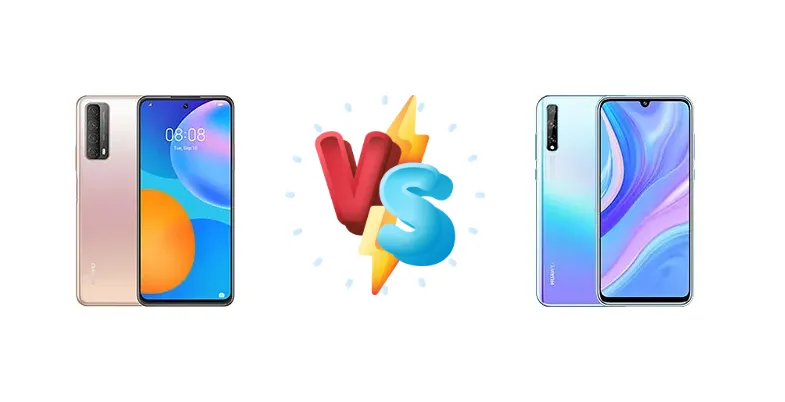
Huawei's Y series offers budget-friendly smartphones packed with features. The Y7a and Y8p are two popular contenders, but which one reigns supreme? This comprehensive comparison will delve into their specs, performance, and overall value to help you make an informed decision.
🏆 Quick Verdict
The Huawei Y7a edges out the Y8p thanks to its significantly faster charging and slightly better performance. While the Y8p boasts a slightly more efficient chipset, the Y7a's charging speed and overall power make it the more compelling choice for most users.
| Network |
|---|
| 2G bands | GSM 900 / 1800 / 1900 | GSM 900 / 1800 / 1900 |
| 3G bands | HSDPA 850 / 900 / 1900 / 2100 | HSDPA 850 / 900 / 1700(AWS) / 1900 / 2100 |
| 4G bands | 1, 3, 5, 7, 8, 20, 28, 38, 40, 41 | 1, 2, 3, 4, 5, 7, 8, 26, 20, 28, 38, 40, 41 |
| Speed | HSPA, LTE | HSPA, LTE |
| Technology | GSM / HSPA / LTE | GSM / HSPA / LTE |
| Launch |
|---|
| Announced | 2020, October 21. Released 2020, October 30 | 2020, May 18. Released 2020, June 15 |
| Status | Discontinued | Discontinued |
| Body |
|---|
| Dimensions | 165.7 x 76.9 x 9.3 mm (6.52 x 3.03 x 0.37 in) | 157.4 x 73.2 x 7.8 mm (6.20 x 2.88 x 0.31 in) |
| Keyboard | QWERTY | - |
| SIM | Nano-SIM + Nano-SIM | Nano-SIM + Nano-SIM |
| Weight | 206 g (7.27 oz) | 163 g (5.75 oz) |
| Display |
|---|
| Resolution | 1080 x 2400 pixels, 20:9 ratio (~395 ppi density) | 1080 x 2400 pixels, 20:9 ratio (~418 ppi density) |
| Size | 6.67 inches, 107.4 cm2 (~84.3% screen-to-body ratio) | 6.3 inches, 95.8 cm2 (~83.2% screen-to-body ratio) |
| Type | IPS LCD | OLED |
| Platform |
|---|
| CPU | Octa-core (4x2.0 GHz Cortex-A73 & 4x1.7 GHz Cortex-A53) | Octa-core (4x2.2 GHz Cortex-A73 & 4x1.7 GHz Cortex-A53) |
| Chipset | Kirin 710A (14 nm) | Kirin 710F (12 nm) |
| GPU | Mali-G51 MP4 | Mali-G51 MP4 |
| OS | Android 10, EMUI 10.1, no Google Play Services | Android 10, EMUI 10.1, no Google Play Services |
| Memory |
|---|
| Card slot | microSDXC (dedicated slot) | Nano Memory (uses shared SIM slot) |
| Internal | 64GB 4GB RAM, 128GB 4GB RAM | 128GB 4GB RAM, 128GB 6GB RAM |
| Main Camera |
|---|
| Features | LED flash, HDR, panorama | LED flash, HDR, panorama |
| Quad | 48 MP, f/1.8, 26mm (wide), 1/2.0", 0.8µm, PDAF
8 MP, f/2.4, 120˚ (ultrawide), 1/4.0", 1.12µm
2 MP (macro)
Auxiliary lens | - |
| Single | 5 MP, AF | - |
| Triple | - | 48 MP, f/1.8, 27mm (wide), 1/2.0", 0.8µm, PDAF
8 MP, f/2.4, 120˚ (ultrawide)
Auxiliary lens |
| Video | 1080p@30/60fps | 1080p@30fps |
| Selfie camera |
|---|
| Features | HDR | HDR |
| Single | 8 MP, f/2.0, (wide) | 16 MP, f/2.0 |
| Video | 1080p@30fps | 1080p@30fps |
| Sound |
|---|
| 3.5mm jack | Yes | Yes |
| 35mm jack | Yes | Yes |
| Loudspeaker | Yes | Yes |
| Comms |
|---|
| Bluetooth | 5.1, A2DP, LE | 5.0, A2DP, LE |
| NFC | No | Yes |
| Positioning | GPS, GLONASS, BDS | GPS, GLONASS, BDS |
| Radio | FM radio | FM radio |
| USB | USB Type-C 2.0, OTG | USB Type-C 2.0, OTG |
| WLAN | Wi-Fi 802.11 b/g/n, Wi-Fi Direct | Wi-Fi 802.11 a/b/g/n/ac, dual-band, Wi-Fi Direct |
| Features |
|---|
| Sensors | Fingerprint (side-mounted), accelerometer, proximity | Fingerprint (under display, optical), accelerometer, proximity, compass |
| Battery |
|---|
| Charging | 22.5W wired, 46% in 30 min | 10W wired |
| Stand-by | Up to 144 h (3G) | - |
| Talk time | Up to 15 h (3G) | - |
| Type | Li-Po 5000 mAh | Li-Po 4000 mAh |
| Misc |
|---|
| Colors | Crush Green, Blush Gold, Midnight Black | Breathing Crystal, Midnight Black |
| Models | PPA-LX3 | AQM-LX1 |
| Price | About 160 EUR | About 240 EUR |
| SAR | 0.37 W/kg (head) 0.90 W/kg (body) | - |
Huawei Y7a
- Faster Charging (22.5W)
- Larger Display (6.63")
- Slightly Better Performance
- Larger Battery (5000mAh)
- Potentially larger size may not suit everyone
- Design may be considered less premium
Huawei Y8p
- More compact design
- Potentially slightly longer battery life (usage dependent)
- Slightly more efficient chipset (12nm)
- Slow Charging (10W)
- Smaller Display (6.3")
- Slightly slower performance
Display Comparison
The Y7a features a larger 6.63-inch display compared to the Y8p's 6.3-inch screen. Both utilize an IPS LCD panel, offering decent color accuracy and viewing angles. The Y7a's larger size makes it better for media consumption and gaming, while the Y8p's smaller size offers better one-handed usability.
Camera Comparison
Both phones feature a triple-camera setup. The Y7a typically has a 48MP main sensor, an 8MP ultrawide, and a 2MP depth sensor. The Y8p often includes a 13MP main sensor, an 8MP ultrawide, and a 2MP depth sensor. Image quality is comparable in good lighting conditions, but the Y7a's higher resolution main sensor *can* capture slightly more detail. Low-light performance is adequate on both.
Performance
The Y7a's Kirin 710A, built on a 14nm process, generally outperforms the Y8p's 12nm Kirin 710F. The slightly higher clock speeds on the Y7a's CPU cores contribute to snappier performance in everyday tasks and gaming. Both phones handle multitasking adequately, but the Y7a feels more responsive.
Battery Life
The Y7a typically has a larger 5000mAh battery compared to the Y8p's 4000mAh battery. However, the Y7a's 22.5W fast charging significantly offsets any potential battery life advantage the Y8p might have. The Y8p's 10W charging is considerably slower.
Buying Guide
The Huawei Y7a is ideal for users prioritizing fast charging, a larger display, and a more modern chipset. The Huawei Y8p is a good option for those seeking a slightly more compact design and a potentially longer battery life (though real-world usage will vary).
Frequently Asked Questions
❓ Is the Huawei Y7a worth buying in 2024?
Yes, the Y7a remains a solid budget option, especially if fast charging and a large display are priorities. However, consider newer models if available in your region.
❓ Which Huawei phone has better battery life, the Y7a or Y8p?
While the Y8p has a slightly smaller battery, real-world battery life is often comparable due to the Y7a's faster charging. The Y7a can quickly top up when needed.