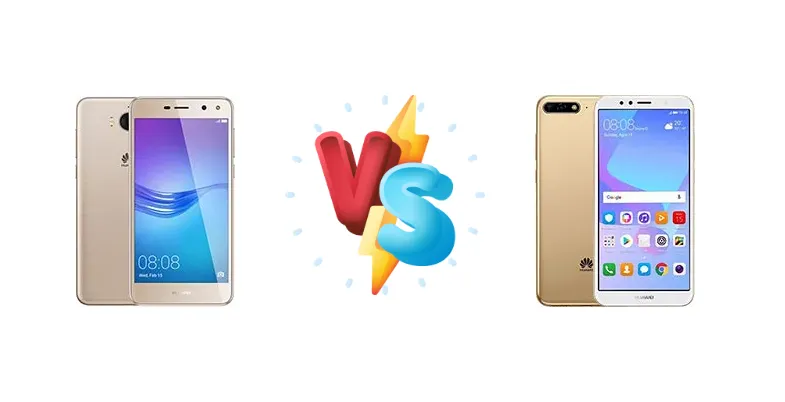
The Huawei Y6 series aimed to deliver affordable smartphones with decent features. The 2017 and 2018 models are similar in many ways, but subtle differences can impact your user experience. Let's dive into a detailed comparison to help you decide which one is right for you.
🏆 Quick Verdict
The Huawei Y6 (2018) edges out the 2017 model thanks to its Qualcomm Snapdragon 425 chipset, offering slightly improved performance and efficiency. While both are budget phones, the 2018 version provides a more polished and reliable experience for everyday tasks.
| Network |
|---|
| 2G bands | GSM 850 / 900 / 1800 / 1900 - SIM 1 & SIM 2 (dual-SIM model only) | GSM 850 / 900 / 1800 / 1900 |
| 3G bands | HSDPA 850 / 900 / 1900 / 2100 | HSDPA 850 / 900 / 1900 / 2100 |
| 4G bands | 1, 3, 7, 8, 20 | 1, 3, 7, 8, 20 |
| Speed | HSPA 42.2/5.76 Mbps, LTE Cat4 150/50 Mbps | HSPA 42.2/5.76 Mbps, LTE Cat4 150/50 Mbps |
| Technology | GSM / HSPA / LTE | GSM / HSPA / LTE |
| Launch |
|---|
| Announced | 2017, May. Released 2017, July | 2018, April. Released 2018, May |
| Status | Discontinued | Discontinued |
| Body |
|---|
| Build | Glass front, plastic back, plastic frame | - |
| Dimensions | 143.8 x 72 x 8.4 mm (5.66 x 2.83 x 0.33 in) | 152.4 x 73 x 7.8 mm (6.00 x 2.87 x 0.31 in) |
| SIM | · Nano-SIM· Nano-SIM + Nano-SIM | Nano-SIM + Nano-SIM |
| Weight | 150 g (5.29 oz) | 150 g (5.29 oz) |
| Display |
|---|
| Resolution | 720 x 1280 pixels, 16:9 ratio (~294 ppi density) | 720 x 1440 pixels, 18:9 ratio (~282 ppi density) |
| Size | 5.0 inches, 68.9 cm2 (~66.6% screen-to-body ratio) | 5.7 inches, 83.8 cm2 (~75.4% screen-to-body ratio) |
| Type | IPS LCD | S-IPS LCD |
| Platform |
|---|
| CPU | Quad-core 1.4 GHz Cortex-A53 | Quad-core 1.4 GHz Cortex-A53 |
| Chipset | Mediatek MT6737T (28 nm) | Qualcomm MSM8917 Snapdragon 425 (28 nm) |
| GPU | Mali-T720MP2 | Adreno 308 |
| OS | Android 6.0 (Marshmallow), EMUI 4.1 | Android 8.0 (Oreo), EMUI 8 |
| Memory |
|---|
| Card slot | microSDXC (dedicated slot) | microSDXC (dedicated slot) |
| Internal | 16GB 2GB RAM | 16GB 2GB RAM, 16GB 3GB RAM |
| | eMMC 5.0 | eMMC 5.1 |
| Main Camera |
|---|
| Features | Dual-LED flash | LED flash, HDR, panorama |
| Single | 13 MP, AF | 13 MP, PDAF |
| Video | 1080p@30fps | 1080p@30fps |
| Selfie camera |
|---|
| Features | LED flash | LED flash |
| Single | 5 MP | 5 MP |
| Video | 720p | 720p@30fps |
| Sound |
|---|
| 3.5mm jack | Yes | Yes |
| 35mm jack | Yes | Yes |
| Loudspeaker | Yes | Yes |
| Comms |
|---|
| Bluetooth | 4.0, A2DP, LE | v4.2, A2DP, LE |
| NFC | Yes | Yes (ATU-L11 only) |
| Positioning | GPS, GLONASS | GPS, GLONASS |
| Radio | FM radio | FM radio |
| USB | microUSB 2.0 | microUSB 2.0 |
| WLAN | Wi-Fi 802.11 b/g/n | Wi-Fi 802.11 b/g/n, Wi-Fi Direct |
| Features |
|---|
| Sensors | Accelerometer, proximity, compass | Accelerometer, proximity |
| Battery |
|---|
| Stand-by | Up to 560 h (3G) | - |
| Talk time | Up to 12 h 10 min (3G) | - |
| Type | Li-Ion 3000 mAh, non-removable | Li-Ion 3000 mAh, non-removable |
| Misc |
|---|
| Colors | White, Gold, Gray | Black, Gold, Blue |
| Models | MYA-AL10, MYA-TL10, MYA-L03/L23, MYA-L02/L22, MYA-L11, MYA-L41 | ATU-L11, ATU-LX3, ATU-L21, ATU-L22 |
| Price | About 140 EUR | About 150 EUR |
| SAR EU | 0.42 W/kg (head) | - |
Huawei Y6 (2017)
- Very affordable
- Decent display for the price
- Sufficient storage (typically 16GB expandable)
- Mediocre performance
- Less efficient chipset
- Older software updates
Huawei Y6 (2018)
- Improved performance with Snapdragon 425
- Slightly better camera
- More efficient battery
- Potentially better software support
- Still a budget phone with limitations
- 2GB RAM can be restrictive
- May lack advanced features
Display Comparison
Both phones feature a 5.7-inch IPS LCD display with a resolution of 1440 x 720 pixels (HD+). While the display quality is similar, the 2018 model might have slightly improved color accuracy due to potential software optimizations. Viewing angles and brightness are comparable on both devices.
Camera Comparison
The Y6 (2017) typically has a 13MP rear camera and a 5MP front camera. The Y6 (2018) also features a 13MP rear camera, but often includes improved image processing algorithms and a slightly better 8MP front camera. Expect slightly better low-light performance and more natural-looking selfies from the 2018 model. Video recording capabilities are similar on both.
Performance
The key difference lies in the chipset. The Y6 (2018)'s Qualcomm Snapdragon 425 generally outperforms the Mediatek MT6737T in the Y6 (2017). Expect smoother multitasking, faster app loading times, and slightly better gaming performance on the 2018 model. Both phones have 2GB of RAM, which can be limiting for demanding applications.
Battery Life
Both phones are equipped with a 3000mAh battery. While the battery capacity is identical, the Snapdragon 425 in the Y6 (2018) is generally more power-efficient, potentially leading to slightly longer battery life under similar usage conditions.
Buying Guide
The Huawei Y6 (2017) is a good option for users on an extremely tight budget who prioritize basic functionality. The Huawei Y6 (2018) is recommended for those seeking a slightly more responsive and reliable device for everyday use, social media, and light gaming.
Frequently Asked Questions
❓ Is the Huawei Y6 (2018) worth the extra cost over the Y6 (2017)?
Yes, the slight performance and camera improvements, along with potentially better software support, make the Y6 (2018) a worthwhile upgrade if your budget allows.
❓ Can I expand the storage on either of these phones?
Yes, both the Huawei Y6 (2017) and Y6 (2018) support microSD card expansion, typically up to 128GB or 256GB.