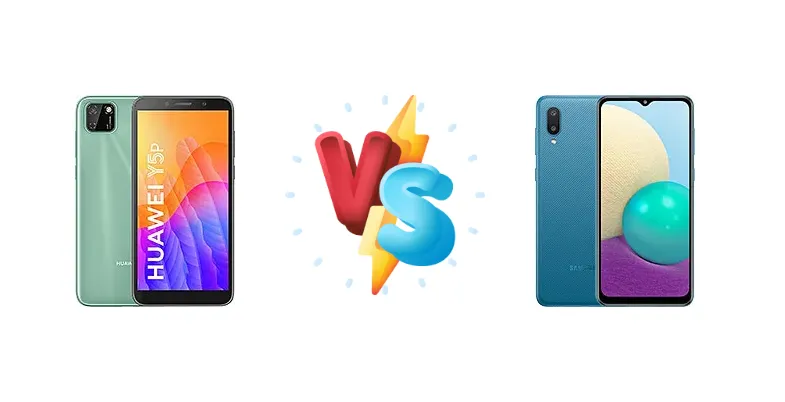
The ultra-budget smartphone segment is fiercely competitive, and the Huawei Y5p and Samsung Galaxy A02 represent two of the most popular options. Both aim to deliver essential smartphone functionality at the lowest possible price, but significant differences in their underlying hardware dictate vastly different user experiences. This comparison dissects those differences, focusing on performance, value, and real-world usability.
🏆 Quick Verdict
For the average user prioritizing responsiveness and multitasking, the Huawei Y5p emerges as the better choice. Its Mediatek Helio P22 chipset, with its octa-core CPU, offers a substantial performance advantage over the Samsung Galaxy A02’s quad-core MT6739W, making it noticeably smoother for everyday tasks. However, the A02’s wider range of RAM/storage configurations offers more flexibility.
| Network |
|---|
| 2G bands | GSM 850 / 900 / 1800 / 1900 | GSM 850 / 900 / 1800 / 1900 |
| 3G bands | HSDPA 850 / 900 / 1700(AWS) / 1900 / 2100 | HSDPA 850 / 900 / 2100 |
| 4G bands | 1, 2, 3, 4, 5, 7, 8, 20, 28, 38, 40, 41 | 1, 3, 5, 7, 8, 20, 28, 38, 40, 41 |
| Speed | HSPA, LTE | HSPA 42.2/5.76 Mbps, LTE Cat4 150/50 Mbps |
| Technology | GSM / HSPA / LTE | GSM / HSPA / LTE |
| Launch |
|---|
| Announced | 2020, May 05. Released 2020, May 06 | 2021, January 27 |
| Status | Discontinued | Available. Released 2021, January 27 |
| Body |
|---|
| Build | - | Glass front, plastic back, plastic frame |
| Dimensions | 146.5 x 70.9 x 8.4 mm (5.77 x 2.79 x 0.33 in) | 164 x 75.9 x 9.1 mm (6.46 x 2.99 x 0.36 in) |
| SIM | · Nano-SIM· Nano-SIM + Nano-SIM | · Nano-SIM· Nano-SIM + Nano-SIM |
| Weight | 144 g (5.08 oz) | 206 g (7.27 oz) |
| Display |
|---|
| Resolution | 720 x 1440 pixels, 18:9 ratio (~295 ppi density) | 720 x 1600 pixels, 20:9 ratio (~270 ppi density) |
| Size | 5.45 inches, 76.7 cm2 (~73.8% screen-to-body ratio) | 6.5 inches, 102.0 cm2 (~81.9% screen-to-body ratio) |
| Type | IPS LCD | PLS LCD |
| Platform |
|---|
| CPU | Octa-core (4x2.0 GHz Cortex-A53 & 4x1.5 GHz Cortex-A53) | Quad-core 1.5 GHz Cortex-A53 |
| Chipset | Mediatek MT6762R Helio P22 (12 nm) | Mediatek MT6739W (28 nm) |
| GPU | PowerVR GE8320 | PowerVR GE8100 |
| OS | Android 10, EMUI 10.1, no Google Play Services | Android 10, upgradable to Android 11, One UI Core 3.1 |
| Memory |
|---|
| Card slot | microSDXC (dedicated slot) | microSDXC (dedicated slot) |
| Internal | 32GB 2GB RAM | 32GB 2GB RAM, 32GB 3GB RAM, 32GB 4GB RAM, 64GB 3GB RAM |
| | eMMC 5.1 | eMMC 5.1 |
| Main Camera |
|---|
| Dual | - | 13 MP, f/1.9, (wide), AF
2 MP (macro) |
| Features | LED flash, HDR, panorama | LED flash |
| Single | 8 MP, f/2.0, (wide), AF | - |
| Video | 1080p@30fps | 1080p@30fps |
| Selfie camera |
|---|
| Single | 5 MP, f/2.2 | 5 MP, f/2.0 |
| Video | 1080p@30fps | - |
| Sound |
|---|
| 3.5mm jack | Yes | Yes |
| 35mm jack | Yes | Yes |
| Loudspeaker | Yes | Yes |
| Comms |
|---|
| Bluetooth | 5.0, A2DP, LE | 5.1, A2DP, LE |
| NFC | No | No |
| Positioning | GPS, GLONASS, BDS | GPS, GLONASS |
| Radio | FM radio | FM radio |
| USB | microUSB 2.0 | microUSB 2.0 |
| WLAN | Wi-Fi 802.11 b/g/n, Wi-Fi Direct | Wi-Fi 802.11 b/g/n, Wi-Fi Direct |
| Features |
|---|
| Sensors | Accelerometer, proximity | Accelerometer |
| | - | Virtual proximity sensing |
| Battery |
|---|
| Type | Li-Po 3020 mAh | Li-Po 5000 mAh |
| Misc |
|---|
| Colors | Mint Green, Midnight Black, Phantom Blue | Black, Blue |
| Models | DRA-LX9 | SM-A022F, SM-A022F/DS, SM-A022M, SM-A022M/DS, SM-A022G, SM-A022G/DS |
| Price | About 110 EUR | € 97.46 |
| SAR EU | - | 0.65 W/kg (head) 1.71 W/kg (body) |
| Pricing |
|---|
| 32GB 2GB RAM | - | $ 149.99 |
| 32GB 3GB RAM | - | $ 129.99 |
| 64GB 3GB RAM | - | $ 199.99 |
| RENEWED | - | £ 113.00 |
Huawei Y5p
- Significantly faster processor for smoother performance
- More efficient chipset potentially leading to better battery life
- Better multitasking capabilities
- Limited storage options
- Camera performance likely to be basic
Samsung Galaxy A02
- Wider range of storage/RAM configurations
- Samsung’s One UI software experience
- Potentially lower price point depending on configuration
- Significantly slower processor leading to lag
- Less efficient chipset impacting battery life
- Limited performance for demanding apps
Display Comparison
Neither device boasts a standout display. Both are likely to feature LCD panels, typical for this price bracket. Specifics like resolution and brightness are not provided, but we can infer that both will offer adequate, but not exceptional, viewing experiences. The focus here isn't on visual fidelity, but on basic usability. Bezels are likely to be substantial on both devices, maximizing screen real estate within a compact form factor.
Camera Comparison
Camera performance on both devices will be limited. Details are sparse, but it’s safe to assume both rely on basic sensors. The Galaxy A02’s available configurations (32GB/2GB, 32GB/3GB, 64GB/3GB) suggest storage is a consideration, potentially allowing for more photos to be stored locally. However, the image quality will be heavily reliant on software processing, and neither phone is likely to excel in low-light conditions. The presence of a 2MP macro camera on the A02 is largely a marketing gimmick, offering minimal practical benefit due to its low resolution.
Performance
The core difference lies in the chipsets. The Huawei Y5p’s Mediatek Helio P22 (12nm) is a significant upgrade over the Samsung Galaxy A02’s Mediatek MT6739W (28nm). The P22’s octa-core configuration (4x2.0 GHz Cortex-A53 & 4x1.5 GHz Cortex-A53) provides substantially more processing power than the A02’s quad-core 1.5 GHz Cortex-A53. The 12nm manufacturing process also contributes to better power efficiency. This translates to faster app loading times, smoother multitasking, and a more responsive user interface on the Y5p. The A02 will struggle with demanding applications and may exhibit noticeable lag even during basic operations. The A02's RAM options (2GB or 3GB) attempt to mitigate this, but the weaker chipset remains the bottleneck.
Battery Life
Battery capacity isn’t specified for either device. However, given the less power-hungry chipset in the Y5p, it’s likely to offer comparable or even slightly better battery life than the A02, despite potentially having a similar capacity. The A02’s MT6739W, built on a larger 28nm process, will consume more power for the same tasks. Charging wattage is also unknown for both, suggesting slow charging speeds are the norm.
Buying Guide
Buy the Huawei Y5p if you need a phone that feels responsive for basic tasks like browsing, social media, and messaging, and you value a smoother overall experience. It’s ideal for first-time smartphone users or those on a very tight budget. Buy the Samsung Galaxy A02 if you prioritize storage options and are willing to trade some performance for a potentially larger capacity, or if you prefer the Samsung ecosystem and One UI.
Frequently Asked Questions
❓ Will the Samsung Galaxy A02 struggle with popular apps like Facebook or WhatsApp?
Yes, the MT6739W chipset in the Galaxy A02 is relatively weak. While it can run these apps, you may experience noticeable lag when switching between them or loading content, especially with multiple apps open simultaneously. The Huawei Y5p will provide a smoother experience.
❓ Is the Huawei Y5p a good choice for mobile gaming?
The Huawei Y5p is not ideal for demanding mobile games. While it can handle simpler games, more graphically intensive titles will likely run at low settings with significant frame rate drops. The Helio P22 is a basic gaming chip, and the phone lacks dedicated gaming features.
❓ Does the Samsung Galaxy A02 support expandable storage?
While not explicitly stated in the provided data, Samsung Galaxy A-series phones typically include a microSD card slot for expandable storage. This is a significant advantage if you plan to store a large number of photos, videos, or apps.
❓ What is the impact of the RAM difference (2GB vs 3GB) on the Samsung Galaxy A02?
The 3GB RAM variant of the Samsung Galaxy A02 will offer a noticeably smoother multitasking experience compared to the 2GB version. It will allow you to keep more apps open in the background without them constantly reloading, reducing lag and improving overall responsiveness.