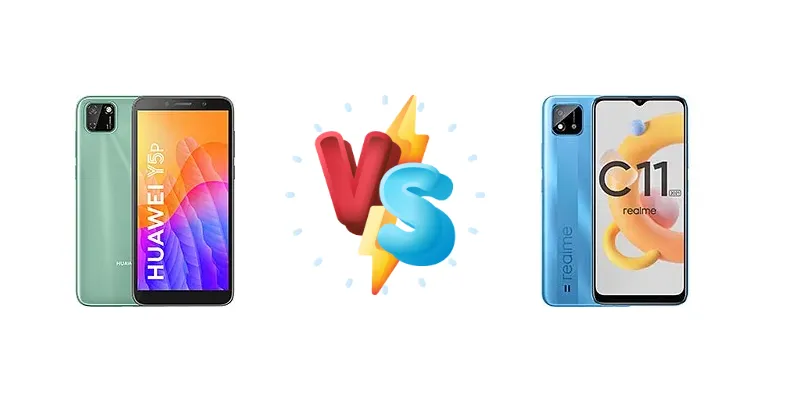
The Huawei Y5p and Realme C11 (2021) represent the fiercely competitive sub-$150 smartphone market. While both aim to deliver essential smartphone functionality at an accessible price, they take fundamentally different approaches to achieving this, primarily through their chipset choices. This comparison dissects those differences, focusing on performance, efficiency, and the user experience each offers.
🏆 Quick Verdict
For the average user prioritizing consistent, if modest, performance and a slightly more refined software experience, the Huawei Y5p emerges as the better choice. Its Mediatek Helio P22, built on a smaller 12nm process, offers a performance edge over the Realme C11’s Unisoc SC9863A, despite the latter’s newer Cortex-A55 cores.
| Network |
|---|
| 2G bands | GSM 850 / 900 / 1800 / 1900 | GSM 850 / 900 / 1800 / 1900 |
| 3G bands | HSDPA 850 / 900 / 1700(AWS) / 1900 / 2100 | HSDPA 850 / 900 / 1900 / 2100 |
| 4G bands | 1, 2, 3, 4, 5, 7, 8, 20, 28, 38, 40, 41 | 1, 3, 5, 8, 38, 40, 41 |
| Speed | HSPA, LTE | HSPA, LTE |
| Technology | GSM / HSPA / LTE | GSM / HSPA / LTE |
| Launch |
|---|
| Announced | 2020, May 05. Released 2020, May 06 | 2021, June 28 |
| Status | Discontinued | Available. Released 2021, June 28 |
| Body |
|---|
| Build | - | Glass front, plastic frame, plastic back |
| Dimensions | 146.5 x 70.9 x 8.4 mm (5.77 x 2.79 x 0.33 in) | 165.2 x 76.4 x 8.9 mm (6.50 x 3.01 x 0.35 in) |
| SIM | · Nano-SIM· Nano-SIM + Nano-SIM | Nano-SIM + Nano-SIM |
| Weight | 144 g (5.08 oz) | 190 g (6.70 oz) |
| | - | Splash resistant design |
| Display |
|---|
| Resolution | 720 x 1440 pixels, 18:9 ratio (~295 ppi density) | 720 x 1600 pixels, 20:9 ratio (~269 ppi density) |
| Size | 5.45 inches, 76.7 cm2 (~73.8% screen-to-body ratio) | 6.52 inches, 102.6 cm2 (~81.3% screen-to-body ratio) |
| Type | IPS LCD | IPS LCD, 400 nits (typ) |
| Platform |
|---|
| CPU | Octa-core (4x2.0 GHz Cortex-A53 & 4x1.5 GHz Cortex-A53) | Octa-core (4x1.6 GHz Cortex-A55 & 4x1.2 GHz Cortex-A55) |
| Chipset | Mediatek MT6762R Helio P22 (12 nm) | Unisoc SC9863A (28 nm) |
| GPU | PowerVR GE8320 | IMG8322 |
| OS | Android 10, EMUI 10.1, no Google Play Services | Android 11, Realme Go UI |
| Memory |
|---|
| Card slot | microSDXC (dedicated slot) | microSDXC (dedicated slot) |
| Internal | 32GB 2GB RAM | 32GB 2GB RAM, 64GB 4GB RAM |
| | eMMC 5.1 | eMMC 5.1 |
| Main Camera |
|---|
| Features | LED flash, HDR, panorama | LED flash, HDR, panorama |
| Single | 8 MP, f/2.0, (wide), AF | 8 MP, f/2.0, (wide), AF |
| Video | 1080p@30fps | 1080p@30fps |
| Selfie camera |
|---|
| Features | - | HDR, panorama |
| Single | 5 MP, f/2.2 | 5 MP, f/2.2, (wide) |
| Video | 1080p@30fps | 1080p@30fps |
| Sound |
|---|
| 3.5mm jack | Yes | Yes |
| 35mm jack | Yes | Yes |
| Loudspeaker | Yes | Yes |
| Comms |
|---|
| Bluetooth | 5.0, A2DP, LE | 4.2, A2DP |
| NFC | No | No |
| Positioning | GPS, GLONASS, BDS | GPS, GLONASS, GALILEO, BDS |
| Radio | FM radio | Unspecified |
| USB | microUSB 2.0 | microUSB 2.0, OTG |
| WLAN | Wi-Fi 802.11 b/g/n, Wi-Fi Direct | Wi-Fi 802.11 b/g/n |
| Features |
|---|
| Sensors | Accelerometer, proximity | Accelerometer, gyro, proximity, compass |
| Battery |
|---|
| Charging | - | 10W wired
Reverse wired |
| Type | Li-Po 3020 mAh | 5000 mAh |
| Misc |
|---|
| Colors | Mint Green, Midnight Black, Phantom Blue | Cool Blue, Cool Grey |
| Models | DRA-LX9 | RMX3231 |
| Price | About 110 EUR | About 80 EUR |
Huawei Y5p
- More powerful chipset for smoother performance
- Potentially better image processing
- More compact form factor
- Likely smaller battery capacity
- No reverse charging
Realme C11 (2021)
- Larger battery capacity for extended usage
- Reverse wired charging capability
- Larger display size
- Less powerful chipset
- Less efficient processor due to larger node
Display Comparison
Neither device boasts a standout display. Both likely feature 720p+ LCD panels, typical for this price bracket. However, detailed panel specifications (brightness, color gamut coverage) are unavailable. The Realme C11’s larger screen size (typically 6.5 inches vs. the Y5p’s 6.1 inches) may appeal to media consumers, but this comes at the cost of potentially lower pixel density. Bezels are expected to be substantial on both devices, reflecting their budget positioning.
Camera Comparison
Camera performance is expected to be similar, and largely unimpressive. Both phones likely feature a primary camera around 13MP, accompanied by lower-resolution depth or macro sensors. The image processing capabilities of both devices will be limited. Focusing on the primary sensor, the Y5p’s ISP (Image Signal Processor) within the Helio P22 may offer slightly better noise reduction and dynamic range, but real-world differences will be minimal. The 2MP macro sensors on both are largely marketing filler and offer limited practical benefit.
Performance
The core difference lies in the chipsets. The Huawei Y5p’s Mediatek Helio P22 (12nm) utilizes older Cortex-A53 cores clocked up to 2.0 GHz. The Realme C11 (2021) employs the Unisoc SC9863A (28nm) with newer Cortex-A55 cores, but at lower clock speeds (1.6 GHz). While the A55 architecture is more efficient *per clock cycle*, the larger process node (28nm vs 12nm) of the Unisoc chip and lower clock speeds likely result in lower overall performance. The Helio P22’s GPU will also provide a more capable graphics experience, making it the better choice for casual gaming. The Y5p’s RAM configuration (likely 3GB or 4GB) is crucial; insufficient RAM will negate the chipset’s advantages.
Battery Life
The Realme C11 (2021) holds a clear advantage in charging capabilities with its 10W wired charging and reverse wired charging feature. This allows it to act as a power bank for other devices. While the Y5p’s battery capacity is likely around 3020mAh, the C11 typically features a 5000mAh battery. The Unisoc SC9863A’s lower power consumption further extends the C11’s battery life. However, the Y5p’s more efficient chipset may partially offset the battery capacity difference in light usage scenarios.
Buying Guide
Buy the Huawei Y5p if you need a phone for everyday tasks like messaging, social media, and light web browsing, and value a slightly smoother user experience. Buy the Realme C11 (2021) if you prioritize battery life and reverse wired charging, and are willing to accept a trade-off in processing power for extended usage and the ability to charge other devices.
Frequently Asked Questions
❓ Will the Realme C11 (2021) struggle with multitasking?
The Unisoc SC9863A, while utilizing newer cores, is limited by its lower clock speeds and the 28nm process. Expect noticeable slowdowns when running multiple apps simultaneously, especially demanding ones. The Y5p, with its Helio P22, will handle multitasking slightly better.
❓ Is the reverse charging feature on the Realme C11 (2021) useful in practice?
Yes, the 10W reverse charging is a genuinely useful feature for emergencies. It allows you to top up other devices like wireless earbuds or smartwatches, though charging speeds will be slow. It's a significant advantage over the Huawei Y5p, which lacks this capability.
❓ Can either of these phones handle popular games like PUBG Mobile?
Both phones will struggle with PUBG Mobile at higher settings. The Helio P22 in the Y5p will offer a slightly smoother experience at the lowest settings, but expect frame drops and lag. The Unisoc SC9863A in the C11 will likely require even lower settings to achieve playable frame rates.
❓ What about software updates for these devices?
Software update support is a concern for both devices. Huawei's EMUI, while feature-rich, has a history of inconsistent updates, particularly for budget models. Realme UI, based on Android, generally receives more frequent updates, but long-term support cannot be guaranteed for either phone.