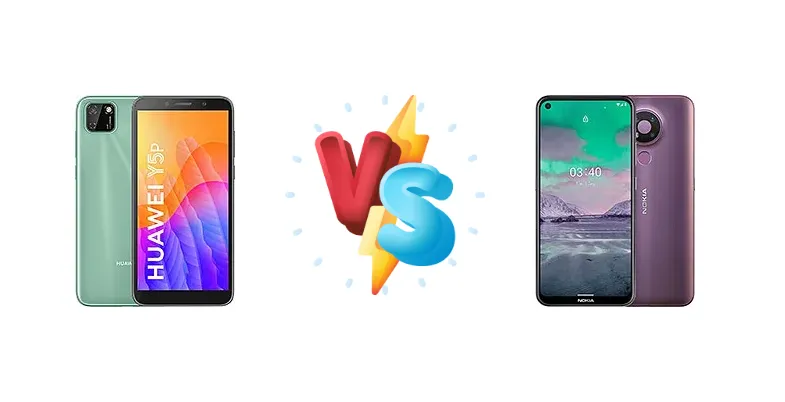
The Huawei Y5p and Nokia 3.4 represent two distinct approaches to the ultra-budget smartphone market. The Y5p, leveraging Huawei’s established presence, aims for affordability, while the Nokia 3.4, backed by HMD Global, focuses on a cleaner Android experience and Qualcomm’s chipset efficiency. This comparison dissects their core components to determine which device delivers the most value for users seeking a functional and reliable smartphone without breaking the bank.
🏆 Quick Verdict
For the average user prioritizing a smoother, more responsive experience and a cleaner software interface, the Nokia 3.4 is the better choice. Its Snapdragon 460 chipset, built on an 11nm process, offers a noticeable performance advantage over the Y5p’s older Helio P22, despite the Y5p’s slightly higher CPU clock speeds on some cores.
| Network |
|---|
| 2G bands | GSM 850 / 900 / 1800 / 1900 | GSM 850 / 900 / 1800 / 1900 |
| 3G bands | HSDPA 850 / 900 / 1700(AWS) / 1900 / 2100 | HSDPA 850 / 900 / 1700(AWS) / 1900 / 2100 |
| 4G bands | 1, 2, 3, 4, 5, 7, 8, 20, 28, 38, 40, 41 | 1, 2, 3, 4, 5, 7, 8, 12, 17, 13, 28, 66 |
| Speed | HSPA, LTE | HSPA, LTE |
| Technology | GSM / HSPA / LTE | GSM / HSPA / LTE |
| Launch |
|---|
| Announced | 2020, May 05. Released 2020, May 06 | 2020, September 22. Released 2020, October 26 |
| Status | Discontinued | Discontinued |
| Body |
|---|
| Dimensions | 146.5 x 70.9 x 8.4 mm (5.77 x 2.79 x 0.33 in) | 161 x 76 x 8.7 mm (6.34 x 2.99 x 0.34 in) |
| SIM | · Nano-SIM· Nano-SIM + Nano-SIM | · Nano-SIM· Nano-SIM + Nano-SIM |
| Weight | 144 g (5.08 oz) | 180 g (6.35 oz) |
| Display |
|---|
| Resolution | 720 x 1440 pixels, 18:9 ratio (~295 ppi density) | 720 x 1560 pixels, 19.5:9 ratio (~269 ppi density) |
| Size | 5.45 inches, 76.7 cm2 (~73.8% screen-to-body ratio) | 6.39 inches, 100.2 cm2 (~81.9% screen-to-body ratio) |
| Type | IPS LCD | IPS LCD, 400 nits (typ) |
| Platform |
|---|
| CPU | Octa-core (4x2.0 GHz Cortex-A53 & 4x1.5 GHz Cortex-A53) | Octa-core (4x1.8 GHz Cortex-A73 & 4x1.8 GHz Cortex-A53) |
| Chipset | Mediatek MT6762R Helio P22 (12 nm) | Qualcomm SM4250 Snapdragon 460 (11 nm) |
| GPU | PowerVR GE8320 | Adreno 610 |
| OS | Android 10, EMUI 10.1, no Google Play Services | Android 10, upgradable to Android 11 |
| Memory |
|---|
| Card slot | microSDXC (dedicated slot) | microSDXC (dedicated slot) |
| Internal | 32GB 2GB RAM | 32GB 3GB RAM, 64GB 3GB RAM, 64GB 4GB RAM |
| | eMMC 5.1 | eMMC 5.1 |
| Main Camera |
|---|
| Features | LED flash, HDR, panorama | LED flash, HDR, panorama |
| Single | 8 MP, f/2.0, (wide), AF | - |
| Triple | - | 13 MP, (wide), PDAF
5 MP, (ultrawide)
Auxiliary lens |
| Video | 1080p@30fps | 1080p@30fps |
| Selfie camera |
|---|
| Single | 5 MP, f/2.2 | 8 MP, (wide) |
| Video | 1080p@30fps | 1080p@30fps |
| Sound |
|---|
| 3.5mm jack | Yes | Yes |
| 35mm jack | Yes | Yes |
| Loudspeaker | Yes | Yes |
| Comms |
|---|
| Bluetooth | 5.0, A2DP, LE | 4.2, A2DP, aptX |
| NFC | No | Yes (market/region dependent) |
| Positioning | GPS, GLONASS, BDS | GPS, GLONASS, GALILEO, BDS |
| Radio | FM radio | FM radio |
| USB | microUSB 2.0 | USB Type-C 2.0 |
| WLAN | Wi-Fi 802.11 b/g/n, Wi-Fi Direct | Wi-Fi 802.11 b/g/n |
| Features |
|---|
| Sensors | Accelerometer, proximity | Fingerprint (rear-mounted), accelerometer, gyro, proximity |
| Battery |
|---|
| Charging | - | 10W wired |
| Type | Li-Po 3020 mAh | Li-Po 4000 mAh |
| Misc |
|---|
| Colors | Mint Green, Midnight Black, Phantom Blue | Fjord, Dusk, Charcoal |
| Models | DRA-LX9 | TA-1288, TA-1285, TA-1283 |
| Price | About 110 EUR | About 100 EUR |
| SAR | - | 0.83 W/kg (head) 1.05 W/kg (body) |
| SAR EU | - | 0.36 W/kg (head) 1.56 W/kg (body) |
Huawei Y5p
- Potentially lower price point
- Lightweight design (likely)
- Huawei’s established brand recognition
- Older, less efficient chipset
- Less responsive user experience
- EMUI software may not appeal to all users
Nokia 3.4
- More powerful and efficient Snapdragon 460 chipset
- Cleaner Android One software experience
- Better multitasking and app performance
- Slower 10W charging
- May be slightly more expensive
- Less brand recognition than Huawei in some markets
Display Comparison
Neither device boasts a standout display. Both likely utilize LCD panels, common in this price bracket. The key difference lies under the hood: the Nokia 3.4 benefits from the Snapdragon 460’s improved image signal processor (ISP), potentially leading to slightly better image quality from the camera, even when viewed on the display. While specific brightness nits aren't provided, the Nokia 3.4’s newer chipset suggests a more optimized display calibration.
Camera Comparison
Without detailed sensor information, a direct camera comparison is difficult. However, the Snapdragon 460’s ISP in the Nokia 3.4 provides a processing advantage. It’s likely the Nokia 3.4 will produce more detailed and dynamic range-rich images, particularly in challenging lighting conditions. The Y5p’s camera system likely relies heavily on software processing to compensate for a potentially less capable sensor. The prevalence of 2MP macro/depth sensors on both devices suggests limited utility; focusing on the main sensor’s quality is more important.
Performance
The Nokia 3.4’s Qualcomm Snapdragon 460 (11nm) represents a significant architectural leap over the Huawei Y5p’s MediaTek Helio P22 (12nm). While the Y5p features an octa-core CPU with a higher peak clock speed (2.0 GHz vs 1.8 GHz on the Nokia), the Snapdragon 460 utilizes more modern Cortex-A73 cores in its quad-cluster configuration. These A73 cores deliver substantially better single-core performance, crucial for app launch times and general responsiveness. The 11nm process node further enhances efficiency, meaning the Nokia 3.4 is likely to maintain performance under sustained load with less thermal throttling. The Y5p’s older Cortex-A53 cores, while efficient, lack the performance headroom of the A73s.
Battery Life
Both phones likely feature similar battery capacities, typical for this segment. However, the Nokia 3.4’s Snapdragon 460’s superior power efficiency translates to longer real-world battery life. The Y5p’s Helio P22, while efficient, is less so than the 11nm Snapdragon. Furthermore, the Nokia 3.4’s 10W charging, while slow, is standard for this price point. The Y5p’s charging speed is not specified, but is likely similar. The efficiency gains of the Snapdragon 460 will likely offset the slower charging, providing more usable time between charges.
Buying Guide
Buy the Huawei Y5p if you need a phone primarily for basic communication – calls, texts, and light social media – and are comfortable with Huawei’s EMUI software. Its lower price point makes it ideal for first-time smartphone users or as a secondary device. Buy the Nokia 3.4 if you prefer a cleaner Android One experience, demand better performance for multitasking and occasional gaming, and value Qualcomm’s reputation for efficient power management, even with its slower 10W charging.
Frequently Asked Questions
❓ Will the Nokia 3.4 struggle with demanding games like PUBG Mobile?
While the Snapdragon 460 isn’t a gaming powerhouse, it can handle PUBG Mobile at lower settings (balanced graphics, medium frame rate). Expect occasional frame drops during intense action. The Huawei Y5p’s Helio P22 will likely struggle even more, requiring significantly lower settings for a playable experience.
❓ Does the Huawei Y5p’s EMUI software come with Google Mobile Services (GMS)?
This is a critical consideration. Due to ongoing restrictions, the Huawei Y5p likely ships *without* Google Mobile Services (GMS). This means no pre-installed Google apps like Gmail, YouTube, or the Play Store. Users will need to rely on Huawei’s AppGallery and alternative methods for installing apps.
❓ How does the Android One software on the Nokia 3.4 impact long-term usability?
Android One guarantees at least two years of OS updates and three years of security patches. This is a significant advantage over the Huawei Y5p, which may receive fewer updates. This ensures the Nokia 3.4 remains secure and compatible with newer apps for a longer period.
❓ Is the 10W charging on the Nokia 3.4 a major drawback?
While 10W charging is slow by modern standards, the Snapdragon 460’s efficiency means you won’t need to charge the Nokia 3.4 as frequently. A full charge will take around 2.5-3 hours, but the longer battery life mitigates the inconvenience.