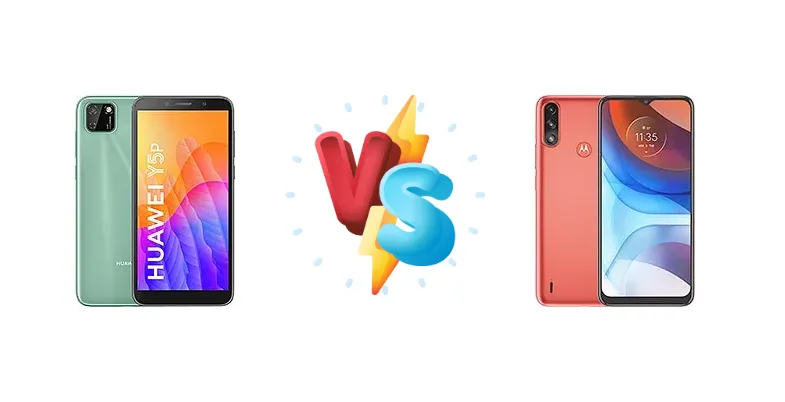
The Huawei Y5p and Motorola Moto E7i Power represent the extreme end of the smartphone price spectrum. Both aim to deliver essential functionality at a minimal cost, but they take drastically different approaches to achieving this. The Y5p, leveraging a more modern (though still entry-level) chipset architecture, focuses on efficiency. The E7i Power, conversely, prioritizes extended battery life, even if it means compromising on processing power and manufacturing efficiency.
🏆 Quick Verdict
For the average user prioritizing responsiveness and a slightly smoother experience, the Huawei Y5p is the better choice. Its Mediatek Helio P22, built on a 12nm process, offers a performance edge over the Motorola Moto E7i Power’s older 28nm Unisoc SC9863A. However, if maximizing battery life is paramount, the Moto E7i Power’s larger battery and lower power draw will be more appealing.
| Network |
|---|
| 2G bands | GSM 850 / 900 / 1800 / 1900 | GSM 850 / 900 / 1800 / 1900 |
| 3G bands | HSDPA 850 / 900 / 1700(AWS) / 1900 / 2100 | HSDPA 850 / 900 / 1700(AWS) / 1900 / 2100 |
| 4G bands | 1, 2, 3, 4, 5, 7, 8, 20, 28, 38, 40, 41 | LTE |
| Speed | HSPA, LTE | HSPA, LTE |
| Technology | GSM / HSPA / LTE | GSM / HSPA / LTE |
| Launch |
|---|
| Announced | 2020, May 05. Released 2020, May 06 | 2021, February 23 |
| Status | Discontinued | Available. Released 2021, March 15 |
| Body |
|---|
| Build | - | Glass front, plastic back, plastic frame |
| Dimensions | 146.5 x 70.9 x 8.4 mm (5.77 x 2.79 x 0.33 in) | 165.1 x 75.9 x 9.2 mm (6.5 x 2.99 x 0.36 in) |
| SIM | · Nano-SIM· Nano-SIM + Nano-SIM | Nano-SIM + Nano-SIM |
| Weight | 144 g (5.08 oz) | 200 g (7.05 oz) |
| | - | Water-repellent design |
| Display |
|---|
| Resolution | 720 x 1440 pixels, 18:9 ratio (~295 ppi density) | 720 x 1600 pixels, 20:9 ratio (~270 ppi density) |
| Size | 5.45 inches, 76.7 cm2 (~73.8% screen-to-body ratio) | 6.51 inches, 102.3 cm2 (~81.7% screen-to-body ratio) |
| Type | IPS LCD | IPS LCD, 380 nits (typ) |
| Platform |
|---|
| CPU | Octa-core (4x2.0 GHz Cortex-A53 & 4x1.5 GHz Cortex-A53) | Octa-core (4x1.6 GHz Cortex-A55 & 4x1.2 GHz Cortex-A55) |
| Chipset | Mediatek MT6762R Helio P22 (12 nm) | Unisoc SC9863A (28 nm) |
| GPU | PowerVR GE8320 | IMG8322 |
| OS | Android 10, EMUI 10.1, no Google Play Services | Android 10 (Go edition) |
| Memory |
|---|
| Card slot | microSDXC (dedicated slot) | microSDXC (uses shared SIM slot) |
| Internal | 32GB 2GB RAM | 32GB 2GB RAM |
| | eMMC 5.1 | eMMC 5.1 |
| Main Camera |
|---|
| Dual | - | 13 MP, f/2.0, 26mm (wide), 1/3.1", 1.12µm, PDAF
2 MP (macro) |
| Features | LED flash, HDR, panorama | LED flash, HDR, panorama |
| Single | 8 MP, f/2.0, (wide), AF | - |
| Video | 1080p@30fps | 1080p@30fps |
| Selfie camera |
|---|
| Features | - | HDR |
| Single | 5 MP, f/2.2 | 5 MP, f/2.2, 27mm (wide), 1.12µm |
| Video | 1080p@30fps | 1080p@30fps |
| Sound |
|---|
| 3.5mm jack | Yes | Yes |
| 35mm jack | Yes | Yes |
| Loudspeaker | Yes | Yes |
| Comms |
|---|
| Bluetooth | 5.0, A2DP, LE | 4.2, A2DP |
| NFC | No | No |
| Positioning | GPS, GLONASS, BDS | GPS, GLONASS, GALILEO |
| Radio | FM radio | Unspecified |
| USB | microUSB 2.0 | USB Type-C 2.0 |
| WLAN | Wi-Fi 802.11 b/g/n, Wi-Fi Direct | Wi-Fi 802.11 b/g/n |
| Features |
|---|
| Sensors | Accelerometer, proximity | Fingerprint (rear-mounted), accelerometer, proximity |
| Battery |
|---|
| Charging | - | 10W wired |
| Type | Li-Po 3020 mAh | Li-Ion 5000 mAh |
| Misc |
|---|
| Colors | Mint Green, Midnight Black, Phantom Blue | Tahiti Blue, Coral Red |
| Models | DRA-LX9 | XT2097-13 |
| Price | About 110 EUR | About 120 EUR |
Huawei Y5p
- More efficient processor (Helio P22)
- Potentially smoother user experience
- Likely better multitasking performance
- Potentially smaller battery capacity
- May require more frequent charging
Motorola Moto E7i Power
- Longer battery life (due to larger capacity and focus)
- Lower power consumption during basic tasks
- More affordable (potentially)
- Less powerful processor (Unisoc SC9863A)
- Slower charging speed (10W)
Display Comparison
Neither device is expected to deliver a premium display experience. Specifics regarding panel type (IPS vs. TFT) and resolution are not provided, but both will likely target a 720p+ resolution. The lack of information suggests neither phone will excel in brightness or color accuracy. Bezels are likely to be substantial on both, reflecting their budget positioning. The absence of high refresh rate support is a given.
Camera Comparison
Camera performance is likely to be similar, and underwhelming, on both devices. Without sensor size or aperture information, it’s difficult to make definitive claims. Both will likely feature a primary camera paired with depth or macro sensors of limited utility. Image processing will be basic, and low-light performance will be poor. Expect acceptable results in well-lit conditions, but don't anticipate flagship-level image quality. The focus should be on functional photography, not artistic expression.
Performance
The core difference lies in the chipsets. The Huawei Y5p’s Mediatek Helio P22 (12nm) utilizes Cortex-A53 cores clocked up to 2.0 GHz. This architecture, while not cutting-edge, is more efficient than the Unisoc SC9863A (28nm) found in the Moto E7i Power. The E7i Power’s SC9863A uses Cortex-A55 cores, but clocked lower at 1.6 GHz and 1.2 GHz. The 28nm manufacturing process of the Unisoc chip is significantly less efficient, leading to higher power consumption for similar tasks. While both are octa-core, the Y5p’s architecture will provide a snappier experience, particularly when multitasking. The Y5p will likely handle basic gaming better, though neither is suited for demanding titles.
Battery Life
The Motorola Moto E7i Power’s name highlights its key strength: battery life. While the exact capacity isn’t specified, it’s reasonable to assume a larger battery than the Y5p, given the E7i Power’s focus. However, the Unisoc SC9863A’s 28nm process is less efficient, meaning more power is consumed even during idle states. The Y5p’s Helio P22, despite potentially having a smaller battery, will likely offer comparable or even better battery life *per charge* due to its superior efficiency. The E7i Power’s 10W charging is slow, meaning longer recharge times.
Buying Guide
Buy the Huawei Y5p if you need a phone that feels more responsive for everyday tasks like browsing, social media, and light app usage, and you value a more efficient processor. Buy the Motorola Moto E7i Power if you prioritize maximum battery life above all else, frequently find yourself away from a charger, and primarily use your phone for calls, texts, and very basic apps. The E7i Power is ideal for users who need a reliable, long-lasting device without demanding performance.
Frequently Asked Questions
❓ Will the Unisoc SC9863A in the Moto E7i Power struggle with multiple apps open simultaneously?
Yes, the Unisoc SC9863A, coupled with its 28nm process, is less efficient at handling multitasking compared to the Huawei Y5p’s Helio P22. Expect noticeable slowdowns and app reloading when switching between several applications.
❓ How long will it take to fully charge the Motorola Moto E7i Power with its 10W charging?
With its 10W charging, the Motorola Moto E7i Power will likely take over 3 hours to fully charge from 0% to 100%. This is significantly slower than phones with fast charging capabilities, so plan accordingly.
❓ Is the Huawei Y5p a good choice for playing mobile games?
The Huawei Y5p is suitable for very light gaming, such as casual puzzle games or older titles. However, its Helio P22 chipset will struggle with demanding 3D games, resulting in low frame rates and potential lag. It's not designed for serious mobile gaming.
❓ Does either phone support software updates beyond the initial Android version?
Given their budget nature, long-term software support is unlikely for either device. Huawei's situation with Google Mobile Services further complicates updates for the Y5p. Expect limited or no major Android version updates.