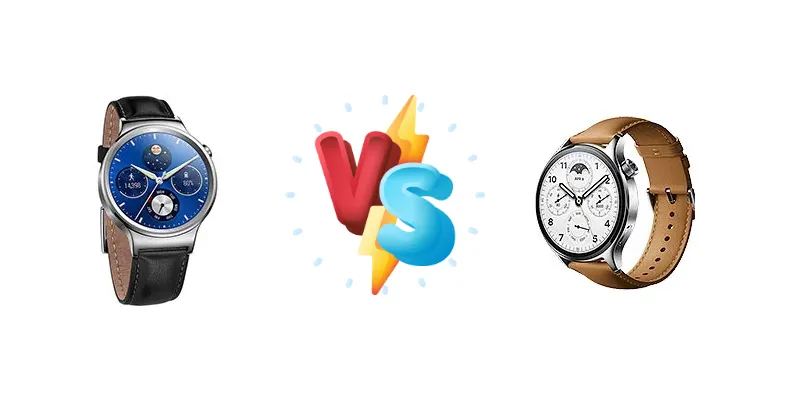
The smartwatch market offers a diverse range of options, but narrowing down the choices can be challenging. We pit the Huawei Watch, powered by a Qualcomm Snapdragon 400, against the Xiaomi Watch S1 Pro, boasting wireless charging, to determine which device delivers the best overall experience for the modern user.
🏆 Quick Verdict
For users prioritizing convenience and modern charging solutions, the Xiaomi Watch S1 Pro is the clear winner. Its wireless charging capability and estimated 85-minute full charge time offer a significant advantage over the Huawei Watch’s wired 10W charging. However, the Huawei Watch’s Snapdragon 400 may offer a more established app ecosystem.
| Network |
|---|
| 2G bands | N/A | N/A |
| 3G bands | - | N/A |
| 4G bands | - | N/A |
| EDGE | No | No |
| GPRS | No | No |
| Speed | - | No |
| Technology | No cellular connectivity | No cellular connectivity |
| Launch |
|---|
| Announced | 2015, March. Released 2015, September | 2022, August 12 |
| Status | Discontinued | Available. Released 2022, August 12 |
| Body |
|---|
| Build | Glass front (Sapphire crystal), stainless steel 316L frame | Sapphire crystal front, stainless steel frame, sapphire crystal (heart rate zone), plastic back |
| Dimensions | 42 x 42 x 11.3 mm (1.65 x 1.65 x 0.44 in) | 46 x 46 x 11.3 mm (1.81 x 1.81 x 0.44 in) |
| SIM | No | No |
| Weight | 60.5 g (2.15 oz) | 48.5 g (1.73 oz) |
| | - | Waterproof (5ATM) |
| Display |
|---|
| Protection | Sapphire crystal glass | - |
| Resolution | 400 x 400 pixels (~286 ppi density) | 480 x 480 pixels (~462 ppi density) |
| Size | 1.4 inches | 1.47 inches |
| Type | OLED | AMOLED, 600 nits (typ) |
| Platform |
|---|
| CPU | Quad-core 1.2 GHz Cortex-A7 | - |
| Chipset | Qualcomm MSM8926 Snapdragon 400 (28 nm) | - |
| GPU | Adreno 305 | - |
| OS | Android Wear OS 2.1 | MIUI Watch OS |
| Memory |
|---|
| Card slot | No | No |
| Internal | 4GB 512MB RAM | Unspecified storage |
| Sound |
|---|
| 3.5mm jack | - | No |
| 35mm jack | No | No |
| Loudspeaker | Yes | Yes |
| Comms |
|---|
| Bluetooth | 4.1, LE | 5.2, A2DP, LE |
| NFC | No | Yes |
| Positioning | No | GPS (L1+L5), GLONASS, GALILEO, BDS, QZSS |
| Radio | No | No |
| USB | No | No |
| WLAN | Wi-Fi 802.11 b/g (market/region dependent) | Wi-Fi 802.11 b/g/n (China only) |
| Features |
|---|
| Sensors | Accelerometer, gyro, heart rate, barometer | Accelerometer, gyro, compass, barometer, heart rate, SpO2, thermometer (body temperature) |
| Battery |
|---|
| Charging | 10W wired | Wireless, 100% in 85 min |
| Type | Li-Ion 300 mAh, non-removable | Li-Po 500 mAh |
| Misc |
|---|
| Colors | Silver, Black, Rose Gold/ Black Leather, Steel Link Bracelet, Stainless Steel Mesh, Black-plated Link Bracelet, Alligator-pressed Brown Leather, Rose Gold-plated Link Bracelet, Wat | Black, Silver |
| Models | - | M2135W1, M2134W1 |
| Price | About 290 EUR | About 220 EUR |
Huawei Watch
- Potentially more established app ecosystem due to longer market presence.
- Qualcomm Snapdragon 400 provides a known platform.
- Wired charging is universally compatible.
- Older Snapdragon 400 chipset is less power efficient.
- Slower 10W wired charging.
- Likely utilizes an older display technology.
Xiaomi Watch S1 Pro
- Convenient wireless charging.
- Faster charging time (100% in 85 minutes).
- Likely benefits from newer display and chipset technology.
- Wireless charging requires a compatible charging pad.
- Chipset details are unknown.
- Potentially less mature software ecosystem.
Display Comparison
Display specifications are absent from the provided data, making a direct comparison impossible. However, given the Huawei Watch’s age, it likely utilizes an older AMOLED panel. The Xiaomi Watch S1 Pro, being a newer device, likely benefits from advancements in display technology, potentially offering higher brightness and improved color accuracy. The absence of LTPO specification on either device suggests neither offers adaptive refresh rates for power saving.
Camera Comparison
Neither device is marketed for its camera capabilities, and no camera specifications are provided. Therefore, a meaningful comparison is not possible. Smartwatches generally prioritize functionality over photographic quality.
Performance
The Huawei Watch’s Qualcomm MSM8926 Snapdragon 400 (28nm) is a quad-core 1.2 GHz processor. While adequate for basic smartwatch functions, its 28nm manufacturing process is significantly less efficient than modern chipsets. This implies potentially higher power consumption and heat generation compared to a more recent processor. The Xiaomi Watch S1 Pro’s chipset is unspecified, but its focus on wireless charging suggests a design prioritizing efficiency. The Snapdragon 400’s Cortex-A7 architecture is older, meaning the Xiaomi Watch S1 Pro likely offers a smoother, more responsive user experience, especially when handling multiple apps or complex tasks.
Battery Life
Battery capacity is not specified for either device. However, the Xiaomi Watch S1 Pro’s wireless charging, achieving 100% charge in 85 minutes, is a significant advantage over the Huawei Watch’s 10W wired charging. Wireless charging offers convenience, while the faster charging time minimizes downtime. Without knowing the battery capacities, it’s difficult to determine which device offers superior battery life, but the Xiaomi’s charging speed is a clear benefit.
Buying Guide
Buy the Huawei Watch if you prioritize a potentially more mature software experience and are comfortable with a wired charging solution. Its Qualcomm Snapdragon 400 chipset, while older, may offer broader app compatibility. Buy the Xiaomi Watch S1 Pro if you value the convenience of wireless charging and a sleek, modern design. The faster charging time is ideal for users who frequently forget to charge their devices.
Frequently Asked Questions
❓ How does the Snapdragon 400 in the Huawei Watch compare to the processing power of more modern smartwatches?
The Snapdragon 400 is a relatively old processor. While capable of handling basic smartwatch functions, it will likely struggle with demanding apps or complex tasks compared to newer chipsets found in the Xiaomi Watch S1 Pro and other contemporary smartwatches. Expect slower app loading times and less fluid animations.
❓ Is wireless charging on the Xiaomi Watch S1 Pro significantly more convenient than wired charging on the Huawei Watch?
Yes, wireless charging offers a substantial convenience factor. You can simply place the Xiaomi Watch S1 Pro on a compatible charging pad, eliminating the need to fumble with cables. The 85-minute full charge time is also competitive, making it easy to top up the battery quickly.
❓ Does the lack of information about the Xiaomi Watch S1 Pro's chipset raise concerns about its performance?
While the chipset is unspecified, Xiaomi typically prioritizes efficiency and user experience in their wearables. The focus on wireless charging suggests a design geared towards power management. It's reasonable to assume the Xiaomi Watch S1 Pro’s chipset is more modern and efficient than the Snapdragon 400 in the Huawei Watch.