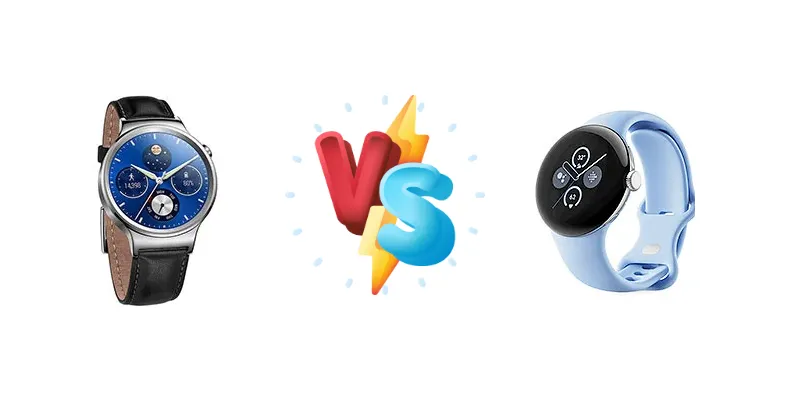
The smartwatch market is increasingly competitive, with both Huawei and Google offering compelling options. The Huawei Watch, leveraging its established hardware, faces off against the newer Google Pixel Watch 2, which benefits from Google’s software expertise and a more modern chipset. This comparison dissects the key differences to help you choose the right wearable.
🏆 Quick Verdict
For the average user prioritizing a seamless software experience and faster charging, the Google Pixel Watch 2 is the better choice. While the Huawei Watch offers a functional experience, its older chipset and slower charging are noticeable drawbacks in comparison.
| Network |
|---|
| 2G bands | N/A | GSM 850 / 900 / 1800 / 1900 |
| 3G bands | - | HSDPA 850 / 900 / 1700(AWS) / 1900 / 2100 |
| 4G bands | - | LTE |
| EDGE | No | - |
| GPRS | No | - |
| Speed | - | HSPA, LTE |
| Technology | No cellular connectivity | GSM / HSPA / LTE |
| Launch |
|---|
| Announced | 2015, March. Released 2015, September | 2023, October 04 |
| Status | Discontinued | Available. Released 2023, October 12 |
| Body |
|---|
| Build | Glass front (Sapphire crystal), stainless steel 316L frame | Glass front (Gorilla Glass 5), aluminum frame |
| Dimensions | 42 x 42 x 11.3 mm (1.65 x 1.65 x 0.44 in) | 41 x 41 x 12.3 mm (1.61 x 1.61 x 0.48 in) |
| SIM | No | eSIM |
| Weight | 60.5 g (2.15 oz) | 31 g (1.09 oz) |
| Display |
|---|
| Protection | Sapphire crystal glass | Corning Gorilla Glass 5 |
| Resolution | 400 x 400 pixels (~286 ppi density) | 450 x 450 pixels (~320 ppi density) |
| Size | 1.4 inches | 1.2 inches |
| Type | OLED | AMOLED, 1000 nits (peak) |
| Platform |
|---|
| CPU | Quad-core 1.2 GHz Cortex-A7 | - |
| Chipset | Qualcomm MSM8926 Snapdragon 400 (28 nm) | Qualcomm 5100 |
| GPU | Adreno 305 | - |
| OS | Android Wear OS 2.1 | Android Wear OS 4 |
| Memory |
|---|
| Card slot | No | No |
| Internal | 4GB 512MB RAM | 32GB 2GB RAM |
| Sound |
|---|
| 35mm jack | No | No |
| Loudspeaker | Yes | Yes |
| Comms |
|---|
| Bluetooth | 4.1, LE | 5.0, A2DP, LE |
| NFC | No | Yes |
| Positioning | No | GPS, GLONASS, GALILEO, BDS, QZSS |
| Radio | No | No |
| USB | No | No |
| WLAN | Wi-Fi 802.11 b/g (market/region dependent) | Wi-Fi 802.11 b/g/n |
| Features |
|---|
| Sensors | Accelerometer, gyro, heart rate, barometer | Accelerometer, gyro, heart rate, altimeter, compass, SpO2, thermometer (skin temperature), skin conductance |
| Battery |
|---|
| Charging | 10W wired | Wired, 80% in 45 min |
| Type | Li-Ion 300 mAh, non-removable | Li-Ion 306 mAh |
| Misc |
|---|
| Colors | Silver, Black, Rose Gold/ Black Leather, Steel Link Bracelet, Stainless Steel Mesh, Black-plated Link Bracelet, Alligator-pressed Brown Leather, Rose Gold-plated Link Bracelet, Wat | Polished Silver, Matte Black, Champagne Gold |
| Models | - | G4TSL, GC3G8, GD2WG |
| Price | About 290 EUR | About 160 EUR |
Huawei Watch
- Potentially lower price point
- Established Huawei ecosystem integration
- Functional smartwatch features
- Outdated Qualcomm Snapdragon 400 chipset
- Slow 10W charging
- HarmonyOS may have limited app availability
Google Pixel Watch 2
- Modern Qualcomm 5100 chipset for improved performance
- Fast charging (80% in 45 minutes)
- Seamless Wear OS integration with Google services
- Higher price point
- Battery life may be impacted by performance demands
- Reliance on Google ecosystem
Display Comparison
Display specifications are absent from the provided data, but considering the market positioning, the Pixel Watch 2 likely features an AMOLED display with potentially LTPO technology for improved power efficiency. The Huawei Watch, while also likely AMOLED, may lack the advanced power-saving features of LTPO. Bezels and color accuracy will be key differentiators, but without specific data, we can only speculate that the Pixel Watch 2, being a newer device, will offer a more vibrant and efficient display.
Camera Comparison
Neither device is primarily marketed for its camera capabilities, and the provided data doesn't mention camera specs. Smartwatches generally feature limited camera functionality, focusing on quick snapshots or video calls. It's reasonable to assume the Pixel Watch 2, benefiting from Google’s image processing expertise, will offer slightly better image quality, but this is a minor consideration.
Performance
The core difference lies in the chipsets. The Google Pixel Watch 2’s Qualcomm 5100 represents a significant leap over the Huawei Watch’s Qualcomm MSM8926 Snapdragon 400 (28nm). The 5100, built on a more modern process node (likely 12nm or smaller, though unspecified), delivers substantially improved performance and power efficiency. The Snapdragon 400, while adequate for basic smartwatch functions, will struggle with demanding applications or complex watch faces. This translates to smoother animations, faster app loading times, and a more responsive user experience on the Pixel Watch 2. The older chipset in the Huawei Watch will likely exhibit more noticeable lag and slower processing speeds.
Battery Life
Battery capacity is not specified for either device. However, the Pixel Watch 2’s charging speed – 80% in 45 minutes – is a clear advantage over the Huawei Watch’s 10W wired charging. Faster charging mitigates the impact of a potentially smaller battery, allowing for quicker top-ups throughout the day. The Huawei Watch’s slower charging will require longer periods plugged in, potentially impacting usability.
Buying Guide
Buy the Huawei Watch if you prioritize a potentially lower price point and are comfortable with the HarmonyOS ecosystem, potentially integrating with other Huawei devices. Buy the Google Pixel Watch 2 if you value a fluid Wear OS experience, tight integration with Google services, and the convenience of significantly faster charging, even if it comes at a higher cost.
Frequently Asked Questions
❓ Does the older Snapdragon 400 chipset in the Huawei Watch significantly impact daily usability?
Yes, the Snapdragon 400 is a considerably older chipset. While it can handle basic smartwatch functions like notifications and step tracking, you'll likely experience noticeable lag when launching apps, navigating complex watch faces, or using more demanding features. The Pixel Watch 2's Qualcomm 5100 provides a much smoother and more responsive experience.
❓ How does the charging speed difference affect real-world usage between the two watches?
The Pixel Watch 2's 80% charge in 45 minutes is a game-changer. If you frequently forget to charge your watch overnight, a quick 15-20 minute top-up can provide a significant boost in battery life. The Huawei Watch's 10W charging will require considerably longer to achieve a similar charge level, potentially leaving you with a depleted battery during peak usage times.
❓ Is the HarmonyOS ecosystem on the Huawei Watch as robust as Wear OS on the Pixel Watch 2?
HarmonyOS has been steadily improving, but it still lags behind Wear OS in terms of app availability and integration with third-party services. Wear OS benefits from Google’s extensive developer network and seamless connectivity with Google Assistant, Google Maps, and other popular apps. The Huawei Watch relies on Huawei’s app gallery, which has a more limited selection.