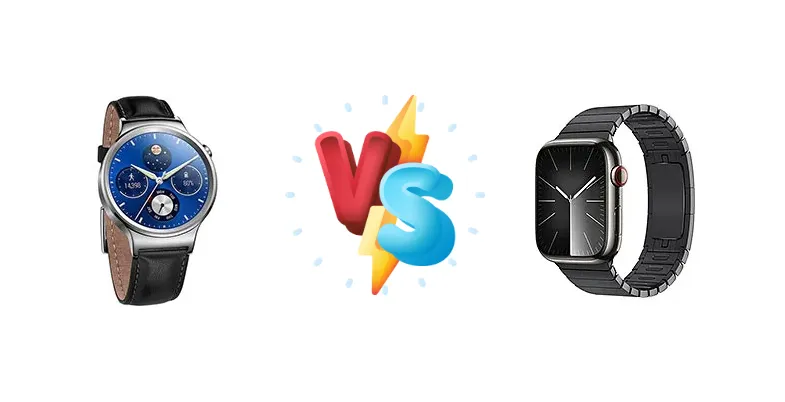
The smartwatch market presents a clear dichotomy: feature-rich, premium experiences like the Apple Watch Series 9, and more affordable, often longer-lasting options like the Huawei Watch. This comparison dissects the core hardware differences – specifically the Qualcomm Snapdragon 400 in the Huawei Watch versus the Apple S9 in the Series 9 – to determine which device best suits your needs and budget.
🏆 Quick Verdict
For the average user prioritizing seamless integration with the Apple ecosystem and advanced health features, the Apple Watch Series 9 is the clear winner. However, the Huawei Watch offers a compelling value proposition for those seeking a functional smartwatch experience without the premium price tag, despite its older chipset.
| Network |
|---|
| 2G bands | N/A | GSM 850 / 900 / 1800 / 1900 |
| 3G bands | - | HSDPA 850 / 900 / 1700(AWS) / 1900 / 2100 - International, China, HK |
| 4G bands | - | 1, 2, 3, 4, 5, 6, 7, 8, 18, 19, 20, 25, 26, 28, 39, 40, 41, 66 - International, China, HK |
| EDGE | No | - |
| GPRS | No | - |
| Speed | - | HSPA, LTE |
| Technology | No cellular connectivity | GSM / HSPA / LTE |
| Launch |
|---|
| Announced | 2015, March. Released 2015, September | 2023, September 12 |
| Status | Discontinued | Available. Released 2023, September 22 |
| Body |
|---|
| Build | Glass front (Sapphire crystal), stainless steel 316L frame | Sapphire crystal front, ceramic/sapphire crystal back, stainless steel frame |
| Dimensions | 42 x 42 x 11.3 mm (1.65 x 1.65 x 0.44 in) | 45 x 38 x 10.7 mm (1.77 x 1.50 x 0.42 in) |
| SIM | No | eSIM |
| Weight | 60.5 g (2.15 oz) | 42.3 g (41mm), 51.5 g (45mm) (1.48 oz) |
| Display |
|---|
| Protection | Sapphire crystal glass | Sapphire crystal glass |
| Resolution | 400 x 400 pixels (~286 ppi density) | 484 x 396 pixels (~326 ppi density) |
| Size | 1.4 inches | 1.9 inches |
| Type | OLED | Retina LTPO OLED, 2000 nits (peak) |
| Platform |
|---|
| CPU | Quad-core 1.2 GHz Cortex-A7 | Dual-core |
| Chipset | Qualcomm MSM8926 Snapdragon 400 (28 nm) | Apple S9 |
| GPU | Adreno 305 | PowerVR |
| OS | Android Wear OS 2.1 | watchOS 10, upgradable to watchOS 26.1 |
| Memory |
|---|
| Card slot | No | No |
| Internal | 4GB 512MB RAM | 64GB |
| Sound |
|---|
| 35mm jack | No | No |
| Loudspeaker | Yes | Yes |
| Comms |
|---|
| Bluetooth | 4.1, LE | 5.3, A2DP, LE |
| NFC | No | Yes |
| Positioning | No | GPS, GLONASS, GALILEO, QZSS, BDS |
| Radio | No | No |
| USB | No | No |
| WLAN | Wi-Fi 802.11 b/g (market/region dependent) | Wi-Fi 802.11 b/g/n, dual-band |
| Features |
|---|
| Sensors | Accelerometer, gyro, heart rate, barometer | Accelerometer, gyro, heart rate, barometer, always-on altimeter, compass, SpO2, VO2max, temperature (body) |
| Battery |
|---|
| Charging | 10W wired | Wireless, 0-80% in 45 min |
| Type | Li-Ion 300 mAh, non-removable | Li-Ion 308 mAh |
| Misc |
|---|
| Colors | Silver, Black, Rose Gold/ Black Leather, Steel Link Bracelet, Stainless Steel Mesh, Black-plated Link Bracelet, Alligator-pressed Brown Leather, Rose Gold-plated Link Bracelet, Wat | Graphite, Silver, Gold, Red |
| Models | - | A2982, A2984, A2983, A2985, Watch7,3, Watch7,4 |
| Price | About 290 EUR | About 630 EUR |
| SAR | - | 1.02 W/kg (head) |
| SAR EU | - | 0.64 W/kg (head) |
Huawei Watch
- More affordable price point
- Potentially longer battery life due to less demanding chipset
- Wired charging offers universal compatibility
- Significantly slower processor
- Outdated chipset architecture
- Likely inferior display technology
Apple Watch Series 9
- Superior performance with the Apple S9 chip
- Faster wireless charging
- Advanced health tracking features
- Higher price tag
- Reliance on the Apple ecosystem
- Wireless charging can be less convenient for some
Display Comparison
While display specifications aren't provided for the Huawei Watch, it's reasonable to assume a standard LCD panel given its market positioning. The Apple Watch Series 9, however, benefits from Apple's advancements, likely featuring an LTPO OLED display for always-on functionality and power efficiency. The lack of LTPO on the Huawei Watch will translate to higher power consumption when the display is active. Bezels are also likely more pronounced on the Huawei Watch, reflecting its older design. Color accuracy is expected to be superior on the Apple Watch Series 9 due to its OLED technology.
Camera Comparison
Neither device is primarily marketed for its camera capabilities, and detailed camera specs are absent. Smartwatches generally feature limited camera functionality. However, the Apple Watch Series 9 likely benefits from Apple’s image processing algorithms, potentially offering slightly better image quality for quick snapshots or video calls, even with a similar sensor.
Performance
The core difference lies in the chipsets. The Huawei Watch's Qualcomm MSM8926 Snapdragon 400 (28nm) is a significantly older architecture compared to the Apple S9. The Snapdragon 400, with its quad-core 1.2 GHz Cortex-A7, prioritizes power efficiency over raw performance. The Apple S9, while dual-core, is built on a more advanced process node (likely 4nm or 5nm, though not specified) and benefits from Apple’s custom silicon design, resulting in substantially faster processing speeds and improved graphics performance. This translates to smoother animations, quicker app loading times, and more responsive interactions on the Apple Watch Series 9. The older Snapdragon 400 may exhibit noticeable lag with complex tasks.
Battery Life
The Huawei Watch's 10W wired charging is comparatively slow. The Apple Watch Series 9’s wireless charging, achieving 0-80% in 45 minutes, offers a significantly faster charging experience. While the Huawei Watch may have a larger battery capacity (not specified), the Apple Watch Series 9’s more efficient chipset and optimized software likely result in comparable, or even superior, real-world battery life despite a potentially smaller battery size. The faster charging of the Apple Watch is a significant convenience factor.
Buying Guide
Buy the Huawei Watch if you need a reliable smartwatch with basic fitness tracking and extended battery life, and aren't heavily invested in the Apple ecosystem. It's ideal for users who prioritize value and don't require the latest and greatest features. Buy the Apple Watch Series 9 if you demand the most advanced health sensors, fastest performance, and tight integration with iPhones, iPads, and other Apple devices. It's geared towards users who prioritize a premium experience and are willing to pay for it.
Frequently Asked Questions
❓ Is the Snapdragon 400 in the Huawei Watch sufficient for everyday tasks like notifications and fitness tracking?
Yes, the Snapdragon 400 is capable of handling basic smartwatch functions like displaying notifications, tracking steps, and monitoring heart rate. However, it will struggle with more demanding tasks like running complex apps or displaying graphically intensive interfaces. Expect some lag and slower response times compared to the Apple Watch Series 9.
❓ How does the Apple Watch Series 9's S9 chip improve upon previous generations in terms of performance and efficiency?
While specific details about the S9 are limited, Apple typically focuses on both performance and power efficiency with each new chip generation. The S9 likely features a more advanced process node (potentially 4nm or 5nm) and architectural improvements, resulting in faster processing speeds, improved graphics performance, and longer battery life compared to previous Apple Watch models. This allows for smoother animations, quicker app loading, and more responsive interactions.
❓ Does the Huawei Watch support the same range of third-party apps as the Apple Watch Series 9?
No. The Huawei Watch typically runs a proprietary operating system or a limited version of Wear OS, offering a smaller selection of third-party apps compared to the Apple Watch Series 9's watchOS, which boasts a vast app ecosystem. This is a significant consideration for users who rely on specific apps for their smartwatch experience.