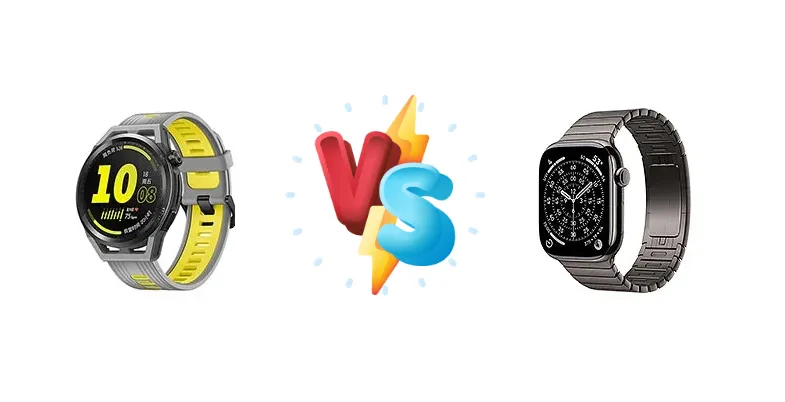
The smartwatch market offers a spectrum of choices, from feature-rich ecosystems to dedicated fitness companions. We pit the Huawei Watch GT Runner, known for its focus on running metrics and battery life, against the Apple Watch Series 11, a strong contender leveraging Apple’s established ecosystem and processing power. This comparison will dissect their capabilities to determine which device delivers the best value for different user profiles.
🏆 Quick Verdict
For the average user prioritizing long battery life and dedicated running features, the Huawei Watch GT Runner emerges as the winner. However, Apple Watch Series 11’s dual-core Apple S10 chipset and integration within the Apple ecosystem make it the superior choice for those heavily invested in iOS and seeking a more versatile smartwatch experience.
| Network |
|---|
| 2G bands | N/A | GSM 850 / 900 / 1800 / 1900 |
| 3G bands | N/A | HSDPA 850 / 900 / 1700(AWS) / 1900 / 2100 - International, China, HK |
| 4G bands | N/A | 1, 2, 3, 4, 5, 6, 7, 8, 18, 19, 20, 25, 26, 28, 39, 40, 41, 66 - International, China, HK |
| 5G bands | - | SA/NSA |
| EDGE | No | - |
| GPRS | No | - |
| Speed | No | HSPA, LTE, 5G |
| Technology | No cellular connectivity | GSM / HSPA / LTE / 5G |
| Launch |
|---|
| Announced | 2021, November 18 | 2025, September 09 |
| Status | Available. Released 2021, November 26 | Available. Released 2025, September 19 |
| Body |
|---|
| Build | Glass front, plastic frame, plastic back | Sapphire crystal front, ceramic/sapphire crystal back, titanium frame (grade 5) |
| Dimensions | 46.4 x 46.4 x 11 mm (1.83 x 1.83 x 0.43 in) | 46 x 39 x 9.7 mm (1.81 x 1.54 x 0.38 in) |
| SIM | No | eSIM |
| Weight | 38.5 g (1.38 oz) | 34.6 g (42mm), 43.1 g (46mm) (1.52 oz) |
| | 50m water resistant
5 ATM
IP68
Compatible with standard 22mm straps | - |
| Display |
|---|
| Protection | - | Sapphire crystal glass |
| Resolution | 466 x 466 pixels (~326 ppi density) | 496 x 416 pixels (~330 ppi density) |
| Size | 1.43 inches | 1.96 inches |
| Type | AMOLED | Retina LTPO3 OLED, 2000 nits (peak) |
| Platform |
|---|
| CPU | - | Dual-core |
| Chipset | - | Apple S10 |
| GPU | - | PowerVR |
| OS | HarmonyOS 2.0 | watchOS 26, upgradable to watchOS 26.1 |
| Memory |
|---|
| Card slot | No | No |
| Internal | 4GB | 64GB |
| Sound |
|---|
| 3.5mm jack | No | - |
| 35mm jack | No | No |
| Loudspeaker | Yes | Yes |
| Comms |
|---|
| Bluetooth | 5.2, LE, EDR | 5.3, A2DP, LE |
| NFC | Yes | Yes |
| Positioning | GPS, GLONASS, BDS | GPS, GLONASS, GALILEO, QZSS, BDS |
| Radio | No | No |
| USB | No | No |
| WLAN | No | Wi-Fi 802.11 b/g/n, dual-band |
| Features |
|---|
| Sensors | Accelerometer, gyro, heart rate, barometer, compass, SpO2 | Accelerometer, gyro, heart rate, barometer, always-on altimeter, compass, SpO2, VO2max, temperature (body), temperature (water) |
| Battery |
|---|
| Charging | Wireless | Wireless, 0-80% in 30 min |
| Type | Li-Po 455 mAh | Li-Ion |
| Misc |
|---|
| Colors | Black, Gray | Slate, Gold, Natural |
| Models | - | A3335, A3337, A3452, A3453 |
| Price | About 300 EUR | € 818.00 |
| SAR | - | 1.19 W/kg (head) |
| SAR EU | - | 0.97 W/kg (head) |
Huawei Watch GT Runner
- Likely longer battery life due to focus on efficiency.
- Dedicated running features and metrics.
- Wireless charging convenience.
- Processor specifications are unknown, potentially limiting performance.
- Ecosystem limitations compared to Apple.
Apple Watch Series 11
- Dual-core Apple S10 chipset for smooth performance.
- Faster charging (0-80% in 30 minutes).
- Seamless integration with the Apple ecosystem.
- Potentially shorter battery life compared to the GT Runner.
- Reliance on the Apple ecosystem may be restrictive for some users.
Display Comparison
Neither device’s display specifications are provided, but given the GT Runner’s focus on outdoor visibility for runners, it likely employs a transflective display technology to maximize readability in direct sunlight. The Apple Watch Series 11, typical of Apple’s approach, likely features an OLED panel for vibrant colors and deep blacks. The absence of details like resolution or peak brightness makes a direct comparison difficult, but the Apple Watch’s OLED panel will likely offer superior contrast. Bezels are a key consideration; a smaller bezel on the Apple Watch would translate to more screen real estate.
Camera Comparison
Neither device is marketed for its camera capabilities, and neither specification includes camera details. Smartwatches generally offer limited camera functionality, and this comparison doesn’t focus on photography. Therefore, this section is largely irrelevant.
Performance
The Apple Watch Series 11 boasts a dual-core Apple S10 chipset, a significant advantage over the Huawei Watch GT Runner, which lacks specified processor details. The S10’s architecture allows for smoother app transitions and faster processing of data, particularly beneficial for features like Siri and complex workout analysis. While the GT Runner likely prioritizes power efficiency, the S10’s performance will be noticeable in everyday tasks and app responsiveness. The Apple Watch’s use of an unspecified amount of RAM, coupled with the S10, will provide a more fluid user experience.
Battery Life
Both the Huawei Watch GT Runner and Apple Watch Series 11 support wireless charging. However, the Apple Watch Series 11 offers a faster charging speed, reaching 0-80% in just 30 minutes. While the GT Runner’s battery capacity isn’t specified, Huawei typically emphasizes long battery life in its GT series. The faster charging of the Apple Watch mitigates some of the potential battery life disparity, allowing for quicker top-ups. The GT Runner’s advantage likely lies in achieving multiple days of use on a single charge, while the Apple Watch Series 11 will likely require more frequent charging.
Buying Guide
Buy the Huawei Watch GT Runner if you need a smartwatch primarily for running and fitness tracking, valuing extended battery life and detailed performance metrics over app availability and ecosystem integration. Buy the Apple Watch Series 11 if you prefer a seamless experience within the Apple ecosystem, require a more responsive user interface thanks to the Apple S10, and prioritize access to a wider range of apps and features.
Frequently Asked Questions
❓ How does the Apple S10 chipset impact real-world app performance on the Series 11 compared to the GT Runner?
The Apple S10’s dual-core architecture provides a noticeable performance boost for app loading times, responsiveness, and complex tasks like voice assistant interactions. The GT Runner, lacking specified processor details, likely prioritizes power efficiency over raw processing power, resulting in a potentially less fluid experience when running multiple apps or demanding features.
❓ Is the 30-minute 0-80% charging on the Apple Watch Series 11 a significant advantage over the GT Runner, considering typical smartwatch usage patterns?
Yes, the faster charging is a considerable benefit. While the GT Runner may offer longer overall battery life, the ability to quickly top up the Apple Watch Series 11 during short breaks or before a workout provides greater convenience and reduces range anxiety. This is particularly useful for users who frequently forget to charge their devices overnight.
❓ For a dedicated runner, how does the Huawei Watch GT Runner’s feature set compare to the Apple Watch Series 11 in terms of tracking metrics and training analysis?
The GT Runner is specifically designed for runners, likely offering more detailed running metrics (VO2 Max, training load, recovery time) and specialized training plans. While the Apple Watch Series 11 provides comprehensive fitness tracking, it may not offer the same depth of running-specific features as the GT Runner. The Huawei Health app is also geared towards running analysis.