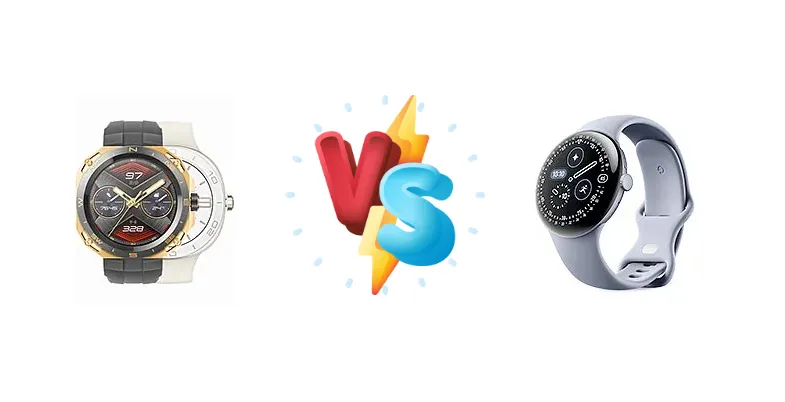
The smartwatch market is heating up, with the Huawei Watch GT Cyber offering a compelling alternative to established players like Google. While the Pixel Watch 4 leverages the latest Qualcomm silicon and Wear OS, the GT Cyber focuses on wireless convenience and potentially longer battery life. This comparison dissects the key differences to help you choose the right wearable for your lifestyle.
🏆 Quick Verdict
For the average user prioritizing performance and seamless integration with the Google ecosystem, the Google Pixel Watch 4 is the superior choice. Its Snapdragon W5 Gen 2 chipset delivers a smoother, more responsive experience, and the faster charging mitigates battery concerns. However, users valuing wireless charging simplicity may find the GT Cyber appealing.
| Network |
|---|
| 2G bands | N/A | GSM 850 / 900 / 1800 / 1900 |
| 3G bands | N/A | HSDPA 850 / 900 / 1700(AWS) / 1900 / 2100 |
| 4G bands | N/A | LTE |
| EDGE | No | - |
| GPRS | No | - |
| Speed | No | HSPA, LTE |
| Technology | No cellular connectivity | GSM / HSPA / LTE |
| Launch |
|---|
| Announced | 2022, November 02 | 2025, August 20 |
| Status | Available. Released 2022, November 12 | Available. Released 2025, October 09 |
| Body |
|---|
| Build | Nanocrystalline ceramic + 316L stainless steelReinforced composite fiber | Glass front (Gorilla Glass 5), aluminum frame |
| Dimensions | 47.4 x 44.4 x 10.2 mm45.6 x 45.6 x 10.2 mm | 45 x 45 x 12.3 mm (1.77 x 1.77 x 0.48 in) |
| SIM | No | eSIM |
| Weight | 58 / 59 / 77 g (2.05 oz) | 31 g or 37 g (1.09 oz) |
| | 50m water resistant
5 ATM
Swapable cases
Rotating bezel | - |
| Display |
|---|
| Protection | - | Corning Gorilla Glass 5 |
| Resolution | 466 x 466 pixels (~352 ppi density) | 456 x 456 pixels (~320 ppi density) |
| Size | 1.32 inches | 1.4 inches |
| Type | AMOLED | LTPO AMOLED, 3000 nits (peak) |
| Platform |
|---|
| CPU | - | Quad-core (4x1.7 GHz Cortex-A53) |
| Chipset | - | Qualcomm Snapdragon W5 Gen 2 (4 nm) |
| GPU | - | Adreno A702 |
| OS | HarmonyOS 2.0 | Android Wear OS 6 |
| Memory |
|---|
| Card slot | No | No |
| Internal | - | 32GB 2GB RAM |
| Sound |
|---|
| 3.5mm jack | No | - |
| 35mm jack | No | No |
| Loudspeaker | Yes | Yes |
| Comms |
|---|
| Bluetooth | Yes | 6.0, A2DP |
| NFC | Yes | Yes |
| Positioning | GPS, GLONASS, BDS, GALILEO, QZSS | GPS (L1+L5), GLONASS, GALILEO (E1+E5a) |
| Radio | No | No |
| USB | No | No |
| WLAN | Yes (only for Bluetooth transmission acceleration) | Wi-Fi 802.11 a/b/g/n/ac/6, dual-band |
| Features |
|---|
| Sensors | Accelerometer, gyro, heart rate, barometer, compass, SpO2 | Accelerometer, gyro, heart rate, altimeter, compass, SpO2, thermometer (skin temperature), skin conductance |
| Battery |
|---|
| Charging | Wireless | Wired, 50% in 15 min, 80% in 30 min, 100% in 60 min - 45mm model
Wired, 50% in 15 min, 80% in 25 min, 100% in 45 min - 41mm model |
| Type | Li-Po 292 mAh | Li-Ion 455 mAh |
| Misc |
|---|
| Colors | Black, Gray, White, Blue | Matte Black, Polished Silver, Champagne Gold, Satin Moonstone |
| Models | AND-B19 | - |
| Price | About 180 EUR | € 353.94 |
Huawei Watch GT Cyber
- Convenient wireless charging
- Potentially longer battery life (speculation based on brand history)
- Stylish design (subjective)
- Likely less powerful processor
- Limited app ecosystem compared to Wear OS
- Slower charging speeds
Google Pixel Watch 4
- Powerful Snapdragon W5 Gen 2 chipset
- Fast wired charging (50% in 15 minutes)
- Seamless integration with Google services
- Requires wired charging
- Battery life may be shorter than GT Cyber (depending on usage)
- Higher price point (potentially)
Display Comparison
Display specifications are absent for the Huawei Watch GT Cyber, making a direct comparison difficult. However, the Google Pixel Watch 4’s display benefits from the efficiency of the Snapdragon W5 Gen 2, potentially allowing for a higher refresh rate or always-on display functionality without significant battery drain. The Pixel Watch 4’s 41mm model charges to 100% in 45 minutes, while the 45mm model takes 60 minutes, suggesting a display power draw that is manageable with its charging capabilities. Without comparable data for the GT Cyber, we can only assume its display technology is geared towards maximizing battery life rather than visual fidelity.
Camera Comparison
Neither device is marketed for its camera capabilities, and detailed camera specifications are unavailable. Smartwatches generally feature limited camera functionality, primarily for quick scans or remote control of a phone's camera. Therefore, this is not a significant differentiating factor between these two models.
Performance
The Google Pixel Watch 4’s Qualcomm Snapdragon W5 Gen 2 (4nm) chipset is a significant advantage. The quad-core Cortex-A53 configuration, running at 1.7 GHz, provides a substantial performance uplift compared to the likely less powerful processor within the Huawei Watch GT Cyber. The 4nm process node is crucial, offering improved thermal efficiency and allowing for sustained performance during demanding tasks like app loading and fitness tracking. This translates to a smoother, more responsive user experience on the Pixel Watch 4, particularly noticeable when navigating Wear OS and utilizing its features.
Battery Life
The Huawei Watch GT Cyber’s reliance on wireless charging is a key differentiator. While convenient, wireless charging is generally less efficient than wired charging. The Google Pixel Watch 4, with its wired charging, boasts impressive speeds: 50% charge in 15 minutes, 80% in 25-30 minutes (depending on the 41mm or 45mm model), and 100% in 45-60 minutes. This faster charging mitigates concerns about battery life, allowing users to quickly top up their watch before a workout or event. Without specific battery capacity details for the GT Cyber, it’s difficult to assess its real-world endurance, but the slower charging method suggests it may need more frequent charging cycles.
Buying Guide
Buy the Huawei Watch GT Cyber if you prioritize the convenience of wireless charging and are less reliant on a robust app ecosystem. It’s ideal for users who want a stylish smartwatch with basic fitness tracking and don’t need the full suite of Wear OS features. Buy the Google Pixel Watch 4 if you demand top-tier performance, deep integration with Google services (like Google Assistant and Maps), and faster charging capabilities. This is the smartwatch for power users and those invested in the Android ecosystem.
Frequently Asked Questions
❓ How does the Snapdragon W5 Gen 2 in the Pixel Watch 4 impact app loading times compared to the GT Cyber?
The Snapdragon W5 Gen 2’s 4nm process and quad-core architecture significantly reduce app loading times on the Pixel Watch 4. The GT Cyber, likely utilizing a less powerful chipset, will experience noticeable delays when launching apps, especially those with complex graphics or data processing requirements.
❓ Is the wireless charging of the Huawei Watch GT Cyber truly more convenient than the Pixel Watch 4’s fast wired charging in daily use?
While wireless charging is undeniably convenient, the Pixel Watch 4’s fast wired charging (50% in 15 minutes) minimizes downtime. For users who frequently forget to charge overnight, the Pixel Watch 4’s quick top-up capability may be more practical than relying on slower wireless charging.
❓ Does the Google Pixel Watch 4’s Wear OS offer a wider range of apps and watch faces compared to the Huawei Watch GT Cyber’s HarmonyOS?
Yes, Wear OS boasts a significantly larger app ecosystem and a vast library of customizable watch faces compared to Huawei’s HarmonyOS. This provides Pixel Watch 4 users with greater flexibility and personalization options.