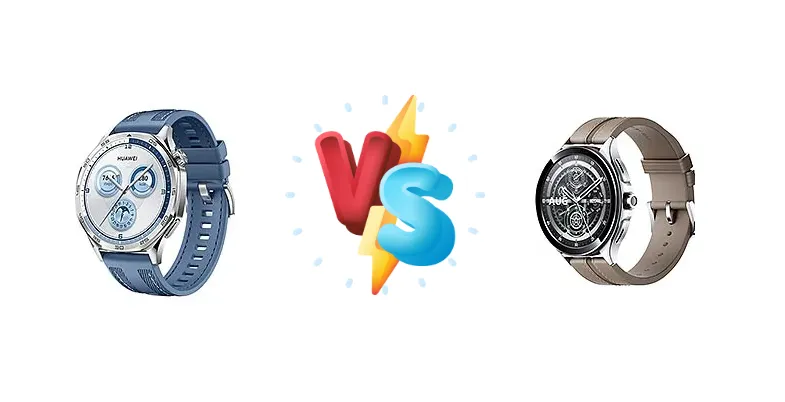
The smartwatch market is heating up, with Huawei and Xiaomi offering compelling options. The Huawei Watch GT 5 continues the brand’s focus on extended battery life and convenient wireless charging, while the Xiaomi Watch 2 Pro marks a significant shift for Xiaomi, integrating Qualcomm’s latest Snapdragon W5+ Gen 1 platform for a more robust and app-rich experience. This comparison dissects the core differences to help you choose the right wearable for your needs.
🏆 Quick Verdict
For the average user prioritizing long battery life and effortless charging, the Huawei Watch GT 5 is the better choice. However, users seeking a smoother, more versatile smartwatch experience with broader app compatibility and faster performance will find the Xiaomi Watch 2 Pro a more compelling investment.
| Network |
|---|
| 2G bands | N/A | GSM 850 / 900 / 1800 / 1900 |
| 3G bands | N/A | HSDPA 850 / 900 / 1700(AWS) / 1900 / 2100 |
| 4G bands | N/A | LTE |
| EDGE | No | - |
| GPRS | No | - |
| Speed | - | HSPA, LTE |
| Technology | No cellular connectivity | GSM / HSPA / LTE |
| Launch |
|---|
| Announced | 2024, September 19 | 2023, September 26 |
| Status | Available. Released 2024, September 19 | Available. Released 2023, October 03 |
| Body |
|---|
| Build | Glass front, stainless steel frame | Stainless steel frame |
| Dimensions | 45.8 x 45.8 x 10.7 mm (1.80 x 1.80 x 0.42 in) | 47.6 x 45.9 x 11.8 mm (1.87 x 1.81 x 0.46 in) |
| SIM | No | eSIM |
| Weight | 35 g or 48 g (1.23 oz) | 54.5 g (1.94 oz) |
| Display |
|---|
| Resolution | 466 x 466 pixels (~326 ppi density) | 466 x 466 pixels (~326 ppi density) |
| Size | 1.43 inches | 1.43 inches |
| Type | AMOLED | AMOLED, 600 nits |
| Platform |
|---|
| Chipset | - | Qualcomm Snapdragon W5+ Gen 1 (4 nm) |
| OS | HarmonyOS 5.0 | Android Wear OS 3.5 |
| Memory |
|---|
| Card slot | No | No |
| Internal | Unspecified | 32GB 2GB RAM |
| Sound |
|---|
| 35mm jack | No | No |
| Loudspeaker | Yes | Yes |
| Comms |
|---|
| Bluetooth | 5.2, A2DP, LE | 5.2, A2DP, LE |
| NFC | Yes | Yes (market/region dependent) |
| Positioning | GPS (L1+L5), BDS (B1I+B1c), GALILEO (E1+E5a), QZSS (L1+L5), GLONASS | GPS (L1+L5), GLONASS, GALILEO, BDS, QZSS |
| Radio | No | No |
| USB | No | No |
| WLAN | No | Wi-Fi 802.11 a/b/g/n/ac, dual-band |
| Features |
|---|
| Sensors | Accelerometer, gyro, heart rate, barometer, compass, SpO2, thermometer (body temperature) | Accelerometer, gyro, compass, barometer, heart rate, SpO2 |
| Battery |
|---|
| Charging | Wireless | - |
| Type | Li-Ion 524 mAh | Li-Po 495 mAh |
| Misc |
|---|
| Colors | Black, Blue, Brown, White, Gold | Black, Silver |
| Models | VLI-B19 | M2233W1 |
| Price | € 128.10 / $ 169.00 | About 170 EUR |
Huawei Watch GT 5
- Likely superior battery life based on brand reputation
- Convenient wireless charging
- Potentially more affordable price point
- Inferior processing power compared to Snapdragon W5+ Gen 1
- Limited app ecosystem compared to Wear OS
Xiaomi Watch 2 Pro
- Powerful Qualcomm Snapdragon W5+ Gen 1 chipset
- Access to the Wear OS app ecosystem
- Smoother and more responsive user interface
- Shorter battery life compared to Huawei Watch GT 5
- Requires more frequent charging
Display Comparison
Details regarding display specifications (resolution, size, type) are missing from the provided context. However, given the market positioning, we can infer that both watches likely utilize AMOLED panels for vibrant colors and good outdoor visibility. The absence of LTPO specification suggests neither watch dynamically adjusts refresh rates for power saving. Bezels are a key differentiator in perceived quality, and Xiaomi typically focuses on minimizing these, potentially giving it an edge in screen-to-body ratio. Color accuracy will likely be comparable, with both brands aiming for sRGB coverage.
Camera Comparison
Neither device is marketed for its camera capabilities, and no camera specifications were provided. Smartwatches generally feature limited camera functionality, primarily for quick scans or remote control features. Therefore, this is not a significant differentiating factor in this comparison.
Performance
The Xiaomi Watch 2 Pro’s inclusion of the Qualcomm Snapdragon W5+ Gen 1 (4nm) chipset is a defining advantage. This 4nm process node offers significantly improved power efficiency compared to older generation chipsets, but more importantly, unlocks a level of performance previously unseen in Xiaomi’s wearables. This translates to smoother animations, faster app loading times, and a more responsive user experience. The Huawei Watch GT 5, lacking chipset details, likely relies on a proprietary solution optimized for power efficiency, but will almost certainly lag behind the Xiaomi in raw processing power. The Snapdragon’s integrated GPU will also provide a better experience for any potential gaming or graphically intensive applications.
Battery Life
The Huawei Watch GT 5’s emphasis on battery life is a core selling point, and its wireless charging capability adds to the convenience. While the exact mAh capacity is unknown, Huawei’s history suggests a larger battery than the Xiaomi Watch 2 Pro. The Xiaomi, powered by the more efficient Snapdragon W5+ Gen 1, will likely offer respectable battery life, but will almost certainly require more frequent charging. The trade-off is performance versus longevity; the Xiaomi prioritizes responsiveness, while the Huawei prioritizes minimizing charge cycles.
Buying Guide
Buy the Huawei Watch GT 5 if you need a smartwatch that can consistently deliver multi-day battery life and appreciate the convenience of wireless charging. This watch is ideal for fitness tracking without the constant need to recharge. Buy the Xiaomi Watch 2 Pro if you prefer a smartwatch with a more responsive interface, access to a wider range of apps through the Wear OS ecosystem, and benefit from the performance gains of the Snapdragon W5+ Gen 1 chipset, even if it means more frequent charging.
Frequently Asked Questions
❓ How does the Snapdragon W5+ Gen 1 in the Xiaomi Watch 2 Pro impact app performance compared to the Huawei Watch GT 5?
The Snapdragon W5+ Gen 1 provides a substantial performance boost, enabling smoother app operation, faster loading times, and the ability to run more complex applications. The Huawei Watch GT 5, lacking this chipset, will likely experience slower performance and limited app compatibility, particularly with demanding apps.
❓ Is the wireless charging on the Huawei Watch GT 5 significantly slower than the wired charging on the Xiaomi Watch 2 Pro?
Wireless charging is generally slower than wired charging. While the exact charging speeds are unknown, the convenience of wireless charging on the Huawei Watch GT 5 may outweigh the slower charging time for many users. The Xiaomi Watch 2 Pro's wired charging will likely offer a faster top-up, but requires a cable.
❓ Does the Xiaomi Watch 2 Pro's Wear OS integration mean I can install any Android app on it?
While Wear OS offers a wider app selection than many proprietary smartwatch operating systems, not all Android apps are compatible. Apps need to be specifically optimized for Wear OS. However, the Xiaomi Watch 2 Pro will have access to a significantly larger library of smartwatch-specific apps than the Huawei Watch GT 5.