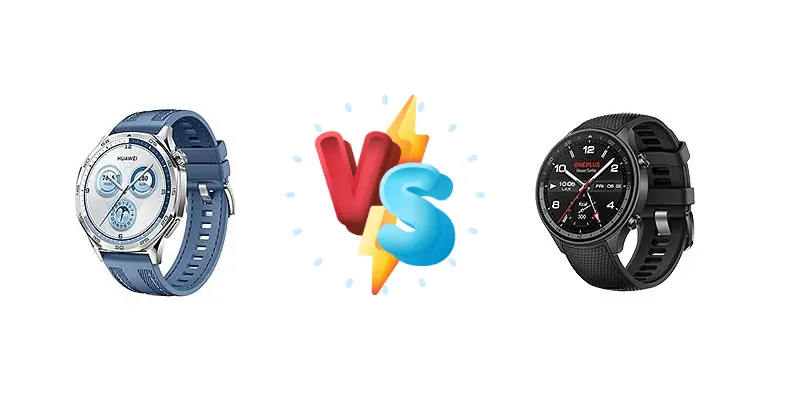
The smartwatch market is heating up, with the Huawei Watch GT 5 and OnePlus Watch 2R offering compelling features at competitive price points. This comparison focuses on the core differences: Huawei’s emphasis on convenience with wireless charging and a mature ecosystem versus OnePlus’s adoption of Qualcomm’s latest Snapdragon W5 Gen 1 platform, promising a significant leap in performance and efficiency.
🏆 Quick Verdict
For the average user prioritizing performance and app compatibility, the OnePlus Watch 2R emerges as the stronger choice. The Snapdragon W5 Gen 1 chipset delivers a smoother, more responsive experience, despite lacking wireless charging. However, users deeply embedded in the Huawei ecosystem and valuing wireless convenience may prefer the GT 5.
| Network |
|---|
| 2G bands | N/A | N/A |
| 3G bands | N/A | N/A |
| 4G bands | N/A | N/A |
| EDGE | No | No |
| GPRS | No | No |
| Technology | No cellular connectivity | No cellular connectivity |
| Launch |
|---|
| Announced | 2024, September 19 | 2024, July 16 |
| Status | Available. Released 2024, September 19 | Available. Released 2024, July 16 |
| Body |
|---|
| Build | Glass front, stainless steel frame | Glass front (Panda Glass), aluminum frame |
| Dimensions | 45.8 x 45.8 x 10.7 mm (1.80 x 1.80 x 0.42 in) | 47 x 46.6 x 12.1 mm (1.85 x 1.83 x 0.48 in) |
| SIM | No | No |
| Weight | 35 g or 48 g (1.23 oz) | 37 g (1.31 oz) |
| Display |
|---|
| Protection | - | Panda Glass |
| Resolution | 466 x 466 pixels (~326 ppi density) | 466 x 466 pixels (~326 ppi density) |
| Size | 1.43 inches | 1.43 inches |
| Type | AMOLED | AMOLED, 1000 nits (HBM) |
| Platform |
|---|
| CPU | - | Quad-core 1.7 GHz Cortex-A53 |
| Chipset | - | Qualcomm Snapdragon W5 Gen 1 (4 nm) |
| GPU | - | Adreno 702 |
| OS | HarmonyOS 5.0 | Android Wear OS, ColorOS Watch 6.0 |
| Memory |
|---|
| Card slot | No | No |
| Internal | Unspecified | 32GB 2GB RAM |
| Sound |
|---|
| 35mm jack | No | No |
| Loudspeaker | Yes | Yes |
| Comms |
|---|
| Bluetooth | 5.2, A2DP, LE | 5.0, A2DP, LE |
| NFC | Yes | Yes |
| Positioning | GPS (L1+L5), BDS (B1I+B1c), GALILEO (E1+E5a), QZSS (L1+L5), GLONASS | GPS (L1+L5), GLONASS, GALILEO, BDS, QZSS |
| Radio | No | No |
| USB | No | No |
| WLAN | No | Wi-Fi 802.11 a/b/g/n, dual-band |
| Features |
|---|
| Sensors | Accelerometer, gyro, heart rate, barometer, compass, SpO2, thermometer (body temperature) | Accelerometer, gyro, barometer, compass, heart rate, SpO2 |
| Battery |
|---|
| Charging | Wireless | 7.5W wired |
| Type | Li-Ion 524 mAh | 500 mAh |
| Misc |
|---|
| Colors | Black, Blue, Brown, White, Gold | Forest Green, Gunmetal Gray |
| Models | VLI-B19 | - |
| Price | € 128.10 / $ 169.00 | About 150 EUR |
Huawei Watch GT 5
- Wireless charging offers convenient top-ups.
- Potential integration with Huawei’s health ecosystem.
- Likely a more refined software experience due to Huawei’s maturity in the smartwatch space.
- Likely less powerful processor compared to the Snapdragon W5 Gen 1.
- Potentially limited app ecosystem compared to Wear OS or other open platforms.
OnePlus Watch 2R
- Qualcomm Snapdragon W5 Gen 1 provides superior performance and efficiency.
- More open platform with potentially wider app compatibility.
- Modern chipset ensures future software updates and feature support.
- Lacks wireless charging convenience.
- 7.5W charging is relatively slow.
Display Comparison
Neither device's display specifications are provided, so a direct comparison is limited. However, given the market positioning, we can infer the OnePlus Watch 2R likely utilizes an AMOLED panel to complement the performance focus, potentially with a higher refresh rate for smoother animations. The Huawei Watch GT 5, while potentially also AMOLED, may prioritize battery life over peak brightness or refresh rate. Bezels are likely comparable, targeting a modern aesthetic. Color accuracy will depend on calibration, a detail not currently available.
Camera Comparison
Neither device is marketed for its camera capabilities, and no camera specifications are provided. Smartwatches generally have limited camera functionality, and this comparison will not focus on this aspect.
Performance
The OnePlus Watch 2R’s Qualcomm Snapdragon W5 Gen 1 (4nm) chipset is the clear performance leader. This 4nm process node offers significantly improved power efficiency compared to older wearable chipsets, translating to longer battery life *while* delivering more processing power. The quad-core 1.7 GHz Cortex-A53 CPU will handle apps and system tasks with greater fluidity than the likely proprietary chipset within the Huawei Watch GT 5. This benefits users who frequently use apps, receive numerous notifications, or engage in more complex smartwatch functions. The Snapdragon W5 Gen 1 also supports advanced features like Bluetooth 5.2 for more stable connections.
Battery Life
While the mAh capacity of both watches is unknown, the charging methods represent a key difference. The OnePlus Watch 2R’s 7.5W wired charging is relatively slow compared to modern smartphone standards, but the Snapdragon W5 Gen 1’s efficiency should mitigate the impact. The Huawei Watch GT 5’s wireless charging offers convenience, but typically charges at a slower rate than wired solutions. The overall battery life will depend on usage patterns, but the Snapdragon W5 Gen 1’s efficiency gives the OnePlus Watch 2R a potential advantage in longevity.
Buying Guide
Buy the Huawei Watch GT 5 if you prioritize wireless charging convenience, are heavily invested in the Huawei ecosystem (phones, earbuds), and prefer a more established brand with a focus on health tracking. Buy the OnePlus Watch 2R if you value performance, a modern chipset like the Snapdragon W5 Gen 1, and a more open platform with broader app support, even if it means sacrificing wireless charging.
Frequently Asked Questions
❓ Will the OnePlus Watch 2R receive regular software updates, given OnePlus's track record with wearables?
OnePlus has historically been less consistent with software updates for its wearables compared to its smartphone lineup. However, the adoption of the Snapdragon W5 Gen 1 platform suggests a commitment to long-term support, as Qualcomm provides ongoing software development kits and updates for its chipsets. Users should expect at least security patches and bug fixes, with feature updates being less guaranteed.
❓ How does the Huawei Watch GT 5’s HarmonyOS compare to Wear OS in terms of app availability?
Huawei’s HarmonyOS has a significantly smaller app ecosystem compared to Wear OS. While Huawei is actively developing its app store, the selection remains limited. Users reliant on specific third-party apps may find them unavailable on the GT 5. HarmonyOS focuses on optimizing performance and battery life within its limited app selection.
❓ Is the 7.5W charging speed on the OnePlus Watch 2R a significant drawback in daily use?
While 7.5W is slower than many modern smartphone charging standards, the Snapdragon W5 Gen 1’s efficiency means you won’t need to charge the OnePlus Watch 2R as frequently. Overnight charging should be sufficient for most users. However, if you frequently need quick top-ups throughout the day, the slower charging speed may be noticeable.