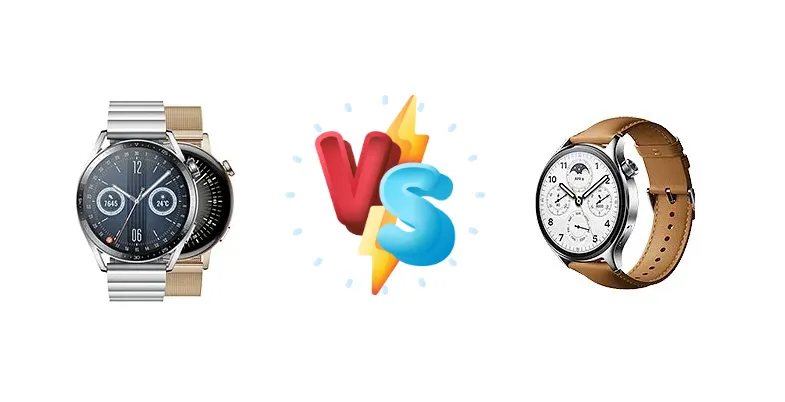
The smartwatch market is increasingly competitive, with both Huawei and Xiaomi offering compelling options. This comparison focuses on the Huawei Watch GT 3, known for its robust fitness tracking, and the Xiaomi Watch S1 Pro, which emphasizes a more premium design and faster charging. Both utilize wireless charging, but the implementation and overall experience differ significantly.
🏆 Quick Verdict
For the average user prioritizing consistent fitness tracking and potentially longer battery life, the Huawei Watch GT 3 emerges as the better choice. However, the Xiaomi Watch S1 Pro’s significantly faster 85-minute wireless charging is a compelling advantage for those who dislike waiting for their smartwatch to power up.
| Network |
|---|
| 2G bands | N/A | N/A |
| 3G bands | N/A | N/A |
| 4G bands | N/A | N/A |
| EDGE | No | No |
| GPRS | No | No |
| Speed | No | No |
| Technology | No cellular connectivity | No cellular connectivity |
| Launch |
|---|
| Announced | 2021, October 21 | 2022, August 12 |
| Status | Available. Released 2021, November 11 | Available. Released 2022, August 12 |
| Body |
|---|
| Build | Glass front, plastic back, stainless steel frame | Sapphire crystal front, stainless steel frame, sapphire crystal (heart rate zone), plastic back |
| Dimensions | 45.9 x 45.9 x 11 mm (1.81 x 1.81 x 0.43 in) | 46 x 46 x 11.3 mm (1.81 x 1.81 x 0.44 in) |
| SIM | No | No |
| Weight | 35 g (42mm) / 42.6 g (46mm) (1.23 oz) | 48.5 g (1.73 oz) |
| | 50m water resistant
5 ATM
Compatible with standard 22mm straps (46mm model), 20mm straps (42mm model) | Waterproof (5ATM) |
| Display |
|---|
| Resolution | 466 x 466 pixels (~326 ppi density) | 480 x 480 pixels (~462 ppi density) |
| Size | 1.43 inches | 1.47 inches |
| Type | AMOLED | AMOLED, 600 nits (typ) |
| Platform |
|---|
| OS | HarmonyOS 2.0, upgradable to 4.0 | MIUI Watch OS |
| Memory |
|---|
| Card slot | No | No |
| Internal | 4GB 32MB RAM | Unspecified storage |
| Sound |
|---|
| 3.5mm jack | No | No |
| 35mm jack | No | No |
| Loudspeaker | Yes | Yes |
| Comms |
|---|
| Bluetooth | 5.1, LE, EDR | 5.2, A2DP, LE |
| NFC | No | Yes |
| Positioning | GPS (L1+L5), GLONASS, BDS, GALILEO, QZSS | GPS (L1+L5), GLONASS, GALILEO, BDS, QZSS |
| Radio | No | No |
| USB | No | No |
| WLAN | No | Wi-Fi 802.11 b/g/n (China only) |
| Features |
|---|
| Sensors | Accelerometer, gyro, heart rate, barometer, compass, SpO2, thermometer (body temperature) | Accelerometer, gyro, compass, barometer, heart rate, SpO2, thermometer (body temperature) |
| Battery |
|---|
| Charging | Wireless | Wireless, 100% in 85 min |
| Type | Li-Po 455 mAh | Li-Po 500 mAh |
| Misc |
|---|
| Colors | Black, Steel, Gold | Black, Silver |
| Models | MIL-B19 | M2135W1, M2134W1 |
| Price | About 120 EUR | About 220 EUR |
Huawei Watch GT 3
- Potentially longer battery life due to power efficiency focus.
- Comprehensive fitness tracking features.
- Established ecosystem of health data analysis.
- Wireless charging time is unspecified and potentially slower.
- Design may be less premium than the Xiaomi offering.
Xiaomi Watch S1 Pro
- Fast 85-minute wireless charging.
- Premium stainless steel design.
- Potentially brighter and more visually appealing display.
- Battery life may be shorter than the Huawei Watch GT 3.
- Fitness tracking features may be less comprehensive.
Display Comparison
While specific display details like brightness and panel type are unavailable, the market positioning suggests the Xiaomi Watch S1 Pro likely targets a more visually appealing experience with potentially higher peak brightness to complement its premium design. The Huawei Watch GT 3, geared towards outdoor activity, may prioritize power efficiency over absolute brightness. Bezels are a key differentiator, and the S1 Pro’s design language suggests a focus on minimizing them for a more immersive view. Color accuracy is likely comparable, given both brands’ emphasis on quality.
Camera Comparison
Neither device is marketed for camera capabilities, and smartwatches generally lack high-quality cameras. This section is therefore not applicable to this comparison.
Performance
Without chipset specifics, we can infer that both smartwatches utilize low-power processors optimized for wearable applications. The Xiaomi Watch S1 Pro, being a newer model, *may* benefit from slight architectural improvements in its processor, but the impact on real-world performance will likely be minimal. RAM capacity is crucial for smooth operation, and any difference here would affect multitasking and app responsiveness. Thermal management is less of a concern for smartwatches than for smartphones, but efficient power usage is paramount for maximizing battery life.
Battery Life
The Huawei Watch GT 3’s battery life is a key selling point, often exceeding competitors due to its focus on power efficiency. While the exact mAh capacity is unknown, it’s designed for multi-day use. The Xiaomi Watch S1 Pro, while offering wireless charging in 85 minutes, may trade some battery endurance for this convenience. The 85-minute full charge time is a significant advantage, reducing downtime compared to potentially longer charging times for the GT 3, which only specifies 'wireless' charging without a time estimate. This difference caters to different user habits – those who prioritize longevity versus those who want quick top-ups.
Buying Guide
Buy the Huawei Watch GT 3 if you need a smartwatch primarily focused on comprehensive health and fitness monitoring, including advanced metrics and potentially longer battery endurance. Buy the Xiaomi Watch S1 Pro if you prefer a more stylish design with a stainless steel build and value the convenience of a rapid 85-minute wireless charging cycle, even if it means potentially slightly less battery life.
Frequently Asked Questions
❓ How does the wireless charging speed of the Xiaomi Watch S1 Pro compare to other smartwatches?
The Xiaomi Watch S1 Pro’s 85-minute full charge is notably faster than many competitors, which often take 2+ hours for a complete wireless charge. This speed is a key differentiator, appealing to users who dislike extended charging times.
❓ Is the Huawei Watch GT 3 compatible with smartphones outside of the Huawei ecosystem?
Yes, the Huawei Watch GT 3 is compatible with both Android and iOS smartphones, although some features may be limited when paired with an iPhone. Full functionality is best experienced within the Huawei ecosystem, but cross-platform compatibility is a significant benefit.
❓ Does the Xiaomi Watch S1 Pro offer the same level of detailed health tracking as the Huawei Watch GT 3?
While the Xiaomi Watch S1 Pro provides standard health tracking features like heart rate monitoring and sleep tracking, the Huawei Watch GT 3 is generally regarded as having more advanced and comprehensive fitness metrics, including SpO2 monitoring, stress tracking, and detailed workout analysis.