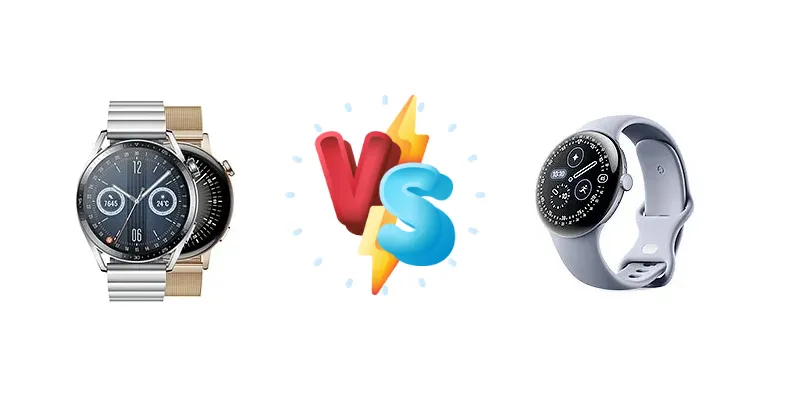
The smartwatch landscape is increasingly competitive, with Google’s latest Pixel Watch 4 aiming to disrupt the established order. We pit it against the well-regarded Huawei Watch GT 3, a device known for its battery life and refined design, to determine which offers the best overall experience for today’s user.
🏆 Quick Verdict
For users prioritizing raw performance and a modern smartwatch OS, the Google Pixel Watch 4 is the clear winner. Its Snapdragon W5 Gen 2 chipset and faster charging capabilities provide a smoother, more responsive experience. However, those seeking extended battery life and a more established ecosystem may still find the Huawei Watch GT 3 compelling.
| Network |
|---|
| 2G bands | N/A | GSM 850 / 900 / 1800 / 1900 |
| 3G bands | N/A | HSDPA 850 / 900 / 1700(AWS) / 1900 / 2100 |
| 4G bands | N/A | LTE |
| EDGE | No | - |
| GPRS | No | - |
| Speed | No | HSPA, LTE |
| Technology | No cellular connectivity | GSM / HSPA / LTE |
| Launch |
|---|
| Announced | 2021, October 21 | 2025, August 20 |
| Status | Available. Released 2021, November 11 | Available. Released 2025, October 09 |
| Body |
|---|
| Build | Glass front, plastic back, stainless steel frame | Glass front (Gorilla Glass 5), aluminum frame |
| Dimensions | 45.9 x 45.9 x 11 mm (1.81 x 1.81 x 0.43 in) | 45 x 45 x 12.3 mm (1.77 x 1.77 x 0.48 in) |
| SIM | No | eSIM |
| Weight | 35 g (42mm) / 42.6 g (46mm) (1.23 oz) | 31 g or 37 g (1.09 oz) |
| | 50m water resistant
5 ATM
Compatible with standard 22mm straps (46mm model), 20mm straps (42mm model) | - |
| Display |
|---|
| Protection | - | Corning Gorilla Glass 5 |
| Resolution | 466 x 466 pixels (~326 ppi density) | 456 x 456 pixels (~320 ppi density) |
| Size | 1.43 inches | 1.4 inches |
| Type | AMOLED | LTPO AMOLED, 3000 nits (peak) |
| Platform |
|---|
| CPU | - | Quad-core (4x1.7 GHz Cortex-A53) |
| Chipset | - | Qualcomm Snapdragon W5 Gen 2 (4 nm) |
| GPU | - | Adreno A702 |
| OS | HarmonyOS 2.0, upgradable to 4.0 | Android Wear OS 6 |
| Memory |
|---|
| Card slot | No | No |
| Internal | 4GB 32MB RAM | 32GB 2GB RAM |
| Sound |
|---|
| 3.5mm jack | No | - |
| 35mm jack | No | No |
| Loudspeaker | Yes | Yes |
| Comms |
|---|
| Bluetooth | 5.1, LE, EDR | 6.0, A2DP |
| NFC | No | Yes |
| Positioning | GPS (L1+L5), GLONASS, BDS, GALILEO, QZSS | GPS (L1+L5), GLONASS, GALILEO (E1+E5a) |
| Radio | No | No |
| USB | No | No |
| WLAN | No | Wi-Fi 802.11 a/b/g/n/ac/6, dual-band |
| Features |
|---|
| Sensors | Accelerometer, gyro, heart rate, barometer, compass, SpO2, thermometer (body temperature) | Accelerometer, gyro, heart rate, altimeter, compass, SpO2, thermometer (skin temperature), skin conductance |
| Battery |
|---|
| Charging | Wireless | Wired, 50% in 15 min, 80% in 30 min, 100% in 60 min - 45mm model
Wired, 50% in 15 min, 80% in 25 min, 100% in 45 min - 41mm model |
| Type | Li-Po 455 mAh | Li-Ion 455 mAh |
| Misc |
|---|
| Colors | Black, Steel, Gold | Matte Black, Polished Silver, Champagne Gold, Satin Moonstone |
| Models | MIL-B19 | - |
| Price | About 120 EUR | € 353.94 |
Huawei Watch GT 3
- Superior performance with Snapdragon W5 Gen 2
- Faster charging speeds (50% in 15 minutes)
- Modern Wear OS ecosystem with app support
- Potentially shorter battery life compared to GT 3
- Requires daily charging for heavy users
Google Pixel Watch 4
- Excellent battery life (estimated based on brand reputation)
- Convenient wireless charging
- Established Huawei ecosystem
- Less powerful processor compared to Pixel Watch 4
- Slower app loading times and responsiveness
Display Comparison
Display specifications are absent from the provided data, but considering the market positioning, we can infer differences. The Pixel Watch 4 likely utilizes an LTPO AMOLED panel for variable refresh rates, maximizing battery efficiency. The GT 3 likely employs a standard AMOLED. The Pixel Watch 4’s smaller size (41mm/45mm options) suggests a higher pixel density, potentially offering sharper visuals. Bezels are a key differentiator, and the Pixel Watch 4’s design language leans towards minimal bezels, enhancing immersion.
Camera Comparison
Neither device is known for its camera prowess, and the provided data doesn’t offer specifics. Smartwatch cameras are generally limited in quality, serving primarily for quick scans or remote control functionality. We can assume both devices feature basic camera sensors, but the Pixel Watch 4’s image processing algorithms, leveraging Google’s computational photography expertise, may yield slightly better results.
Performance
The Google Pixel Watch 4’s Qualcomm Snapdragon W5 Gen 2 (4nm) chipset is a significant advantage. The 4nm process node delivers superior power efficiency compared to the likely older process node used in the GT 3’s chipset. The quad-core Cortex-A53 configuration, clocked at 1.7 GHz, promises a fluid user experience, especially when running multiple apps or utilizing Google Assistant. The GT 3, while capable, will likely exhibit slower app loading times and less responsiveness due to its less powerful processor. The Pixel Watch 4’s LPDDR5x RAM (speculation based on market trends) further enhances multitasking capabilities.
Battery Life
The Huawei Watch GT 3 traditionally excels in battery life, but the Pixel Watch 4’s charging speed is a compelling counterpoint. While the GT 3’s battery capacity is unknown, the Pixel Watch 4 offers a substantial charging advantage: 50% charge in 15 minutes, 80% in 25/30 minutes (depending on the 41mm or 45mm model), and a full charge in 45/60 minutes. This rapid charging mitigates the impact of potentially lower battery capacity. The GT 3 relies on wireless charging, which is convenient but generally slower than the Pixel Watch 4’s wired charging.
Buying Guide
Buy the Huawei Watch GT 3 if you prioritize long battery life, wireless charging convenience, and a mature, albeit less feature-rich, smartwatch experience. Buy the Google Pixel Watch 4 if you demand the latest Wear OS features, a powerful processor for app responsiveness, and the convenience of rapid wired charging – even if it means more frequent charging cycles.
Frequently Asked Questions
❓ How does the Snapdragon W5 Gen 2 in the Pixel Watch 4 impact real-world app performance compared to the GT 3?
The Snapdragon W5 Gen 2’s 4nm process and quad-core architecture deliver significantly faster app loading times and smoother multitasking on the Pixel Watch 4. Expect a noticeable difference when using apps like Google Maps, Spotify, or third-party fitness trackers, which will feel more responsive and less prone to lag compared to the Huawei Watch GT 3.
❓ Is the Pixel Watch 4’s fast charging truly useful, or is it just a marketing gimmick?
The Pixel Watch 4’s charging speed is genuinely useful. Reaching 50% charge in just 15 minutes can provide enough power for a full day of moderate use, minimizing downtime. This is particularly beneficial for users who forget to charge overnight or need a quick boost before a workout.
❓ Does the Huawei Watch GT 3’s wireless charging offer any advantages over the Pixel Watch 4’s wired charging?
Wireless charging offers convenience – simply placing the GT 3 on a charging pad eliminates the need for cables. However, it’s slower than the Pixel Watch 4’s wired charging. The trade-off is convenience versus speed; choose wireless if you prioritize ease of use, and wired if you need a quick power-up.