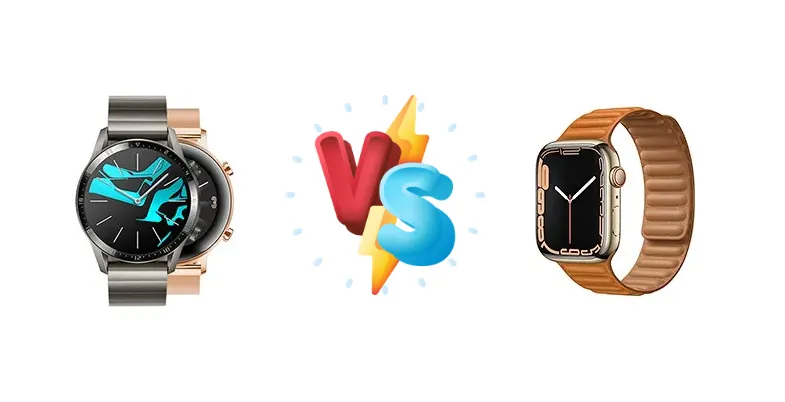
The smartwatch market presents a clear dichotomy: prioritizing extensive features and ecosystem integration, or maximizing battery life and standalone functionality. The Apple Watch Series 7, powered by the Apple S7 chipset, represents the former, while the Huawei Watch GT 2 traditionally focuses on the latter. This comparison dissects these philosophies, examining where each watch excels and who benefits most from their respective strengths.
🏆 Quick Verdict
For users deeply embedded in the Apple ecosystem and prioritizing app availability and seamless integration, the Apple Watch Series 7 is the clear winner. However, if battery life is paramount and ecosystem lock-in is a concern, the Huawei Watch GT 2 offers a compelling alternative, despite lacking detailed specifications in our database.
| Network |
|---|
| 2G bands | N/A | GSM 850 / 900 / 1800 / 1900 |
| 3G bands | N/A | HSDPA 850 / 900 / 1700(AWS) / 1900 / 2100 - International |
| 4G bands | N/A | 1, 2, 3, 4, 5, 7, 8, 18, 19, 20, 25, 26, 28, 39, 40, 41, 66 - International |
| EDGE | No | - |
| GPRS | No | - |
| Speed | No | HSPA, LTE |
| Technology | No cellular connectivity | GSM / HSPA / LTE |
| | - | 1, 2, 3, 4, 5, 7, 12, 13, 14, 17, 18, 19, 25, 26, 39, 40, 41, 66 - USA, LATAM, Canada |
| Launch |
|---|
| Announced | 2019, September. Released 2019, October | 2021, September 14 |
| Status | Discontinued | Available. Released 2021, October 15 |
| Body |
|---|
| Build | Glass front, ceramic back, stainless steel frame | Sapphire crystal front, ceramic/sapphire crystal back, stainless steel frame |
| Dimensions | 45.9 x 45.9 x 10.7 mm (1.81 x 1.81 x 0.42 in) | 45 x 38 x 10.7 mm (1.77 x 1.50 x 0.42 in) |
| SIM | No | eSIM |
| Weight | 41 g (1.45 oz) | 42.3 g (41mm), 51.5 g (45mm) (1.48 oz) |
| | 50m water resistant
Compatible with standard 22mm straps (46mm model), 20mm straps (42mm model) | IP6X certified
50m water resistant
ECG certified (region dependent SW application; HW available on all models) |
| Display |
|---|
| Protection | - | Sapphire crystal glass |
| Resolution | 454 x 454 pixels (~326 ppi density) | 484 x 396 pixels (~326 ppi density) |
| Size | 1.39 inches | 1.9 inches |
| Type | OLED | Retina LTPO OLED, 1000 nits (peak) |
| | - | Always-on display |
| Platform |
|---|
| CPU | - | Dual-core |
| Chipset | - | Apple S7 |
| GPU | - | PowerVR |
| OS | Proprietary OS | watchOS 8.0, upgradable to watchOS 26.1 |
| Memory |
|---|
| Card slot | No | No |
| Internal | 4GB 32MB RAM | 32GB 1GB RAM |
| | eMMC | - |
| Sound |
|---|
| 3.5mm jack | No | No |
| 35mm jack | No | No |
| Loudspeaker | Yes (46mm only) | Yes |
| | Only 46mm series support Bluetooth calling | - |
| Comms |
|---|
| Bluetooth | 5.1, LE, EDR | 5.0, A2DP, LE |
| NFC | Yes (China only) | Yes |
| Positioning | GPS, GLONASS, GALILEO | GPS, GLONASS, GALILEO, QZSS, BDS |
| Radio | No | No |
| USB | No | No |
| WLAN | No | Wi-Fi 802.11 b/g/n, dual-band |
| Features |
|---|
| Sensors | Accelerometer, gyro, heart rate, barometer, compass | Accelerometer, gyro, heart rate, barometer, always-on altimeter, compass, SpO2, VO2max |
| | - | Natural language commands and dictation (talking mode)
Ultra Wideband (UWB) support |
| Battery |
|---|
| Charging | - | Wireless, 0-80% in 45 min |
| Type | Li-Ion 455 mAh, non-removable | Li-Ion 309 mAh (1.19 Wh) |
| Misc |
|---|
| Colors | Titanium Grey Stainless Steel, Black Stainless Steel, Stainless Steel | Graphite, Gold, Silver |
| Models | LTN-B19, DAN-B19 | A2475, A2476, A2477, A2478, watch6,8, watch6,9 |
| Price | About 120 EUR | About 310 EUR |
| SAR | - | 1.10 W/kg (head) |
| SAR EU | - | 0.70 W/kg (head) 1.50 W/kg (body) |
Huawei Watch GT 2
- Potentially multi-day battery life
- Likely more affordable price point
- Less ecosystem lock-in
- Limited app ecosystem
- Unknown processor performance
- Potentially less accurate health tracking
Apple Watch Series 7
- Seamless Apple ecosystem integration
- Fast charging (0-80% in 45 minutes)
- Powerful Apple S7 chipset
- Requires daily charging
- Higher price point
- Ecosystem lock-in
Display Comparison
While specific display details for the Huawei Watch GT 2 are unavailable, Huawei typically employs AMOLED panels. The Apple Watch Series 7 boasts a significantly larger display area than previous generations, and its always-on Retina display benefits from LTPO technology, dynamically adjusting refresh rates to conserve battery. This LTPO implementation, coupled with the Series 7’s increased brightness, provides a superior viewing experience, particularly outdoors, compared to what is expected from the GT 2’s likely standard AMOLED panel. Bezels are also expected to be thinner on the Apple Watch, maximizing screen real estate.
Camera Comparison
Neither watch is primarily focused on camera capabilities. The Apple Watch Series 7 lacks a camera entirely, focusing instead on health and fitness tracking. The Huawei Watch GT 2’s camera specifications are unknown, but previous models have included basic camera functionality, likely with limited image quality. This section is largely a non-factor in the comparison.
Performance
The Apple Watch Series 7’s dual-core Apple S7 chipset provides a substantial performance advantage over the Huawei Watch GT 2. While the GT 2’s processor details are unknown, Huawei’s smartwatches generally prioritize efficiency over raw power. The S7’s architecture allows for faster app loading times, smoother animations, and more complex background processing. The Apple Watch also benefits from faster RAM, likely LPDDR5X, contributing to its overall responsiveness. Thermal management is also a key consideration; the S7’s efficiency helps mitigate heat buildup during intensive tasks.
Battery Life
This is where the Huawei Watch GT 2 traditionally shines. While the Apple Watch Series 7 offers a 0-80% charge in 45 minutes via wireless charging, its battery life typically requires daily charging. The GT 2, historically, has offered battery life measured in days, not hours, due to its focus on power efficiency. The larger mAh capacity (speculation based on previous models) and optimized software contribute to this extended runtime. The trade-off is charging speed; the GT 2 likely takes longer to fully charge than the Series 7.
Buying Guide
Buy the Huawei Watch GT 2 if you need a smartwatch that can consistently deliver multi-day battery life, prefer a more open operating system, and aren't reliant on Apple's app ecosystem. Buy the Apple Watch Series 7 if you prioritize a rich app experience, tight integration with other Apple devices, and advanced health tracking features, accepting the trade-off of daily charging.
Frequently Asked Questions
❓ Does the Huawei Watch GT 2 receive regular software updates and feature additions like the Apple Watch?
Historically, Huawei’s software update cadence for smartwatches has been less frequent and comprehensive than Apple’s. While the GT 2 receives updates, they are typically focused on bug fixes and minor improvements rather than major feature additions. Apple’s watchOS updates introduce significant new functionalities and improvements regularly.
❓ How does the health tracking accuracy of the Huawei Watch GT 2 compare to the Apple Watch Series 7, particularly for metrics like heart rate and SpO2?
The Apple Watch Series 7 benefits from Apple’s extensive research and development in health tracking, generally providing highly accurate readings for heart rate, SpO2, and ECG (where available). While the Huawei Watch GT 2 offers similar health tracking features, independent testing suggests its accuracy may be slightly lower, particularly during high-intensity workouts. The Apple Watch’s advanced sensors and algorithms contribute to its superior performance.
❓ Is the Huawei Watch GT 2 compatible with iPhones, or is it limited to Android devices?
The Huawei Watch GT 2 offers limited compatibility with iPhones. While you can connect it via Bluetooth for basic notifications, you won't have access to the full range of features available on Android, such as app installation and advanced settings. The Apple Watch Series 7, naturally, is designed exclusively for use with iPhones.