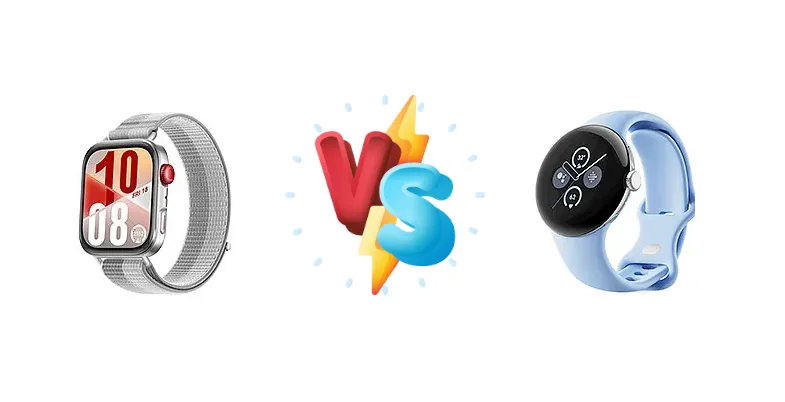
The smartwatch market offers a spectrum of choices, from feature-rich powerhouses to streamlined fitness trackers. The Huawei Watch Fit 4 and Google Pixel Watch 2 represent distinct approaches: the Fit 4 prioritizing affordability and extended battery life, while the Pixel Watch 2 aims for a premium experience with deeper OS integration and advanced health tracking. This comparison dissects their key differences to determine which device delivers the best value.
🏆 Quick Verdict
For the average user prioritizing fitness tracking and long battery life, the Huawei Watch Fit 4 offers compelling value. However, the Google Pixel Watch 2 wins for those deeply embedded in the Google ecosystem and demanding a more comprehensive smartwatch experience with faster charging and a more powerful chipset.
| Network |
|---|
| 2G bands | N/A | GSM 850 / 900 / 1800 / 1900 |
| 3G bands | N/A | HSDPA 850 / 900 / 1700(AWS) / 1900 / 2100 |
| 4G bands | N/A | LTE |
| EDGE | No | - |
| GPRS | No | - |
| Speed | No | HSPA, LTE |
| Technology | No cellular connectivity | GSM / HSPA / LTE |
| Launch |
|---|
| Announced | 2025, May 15 | 2023, October 04 |
| Status | Available. Released 2025, May 26 | Available. Released 2023, October 12 |
| Body |
|---|
| Build | Glass front, aluminum alloy frame, plastic back | Glass front (Gorilla Glass 5), aluminum frame |
| Dimensions | 43 x 38 x 9.5 mm (1.69 x 1.50 x 0.37 in) | 41 x 41 x 12.3 mm (1.61 x 1.61 x 0.48 in) |
| SIM | No | eSIM |
| Weight | 27 g (0.95 oz) | 31 g (1.09 oz) |
| Display |
|---|
| Protection | - | Corning Gorilla Glass 5 |
| Resolution | 480 x 408 pixels (~347 ppi density) | 450 x 450 pixels (~320 ppi density) |
| Size | 1.82 inches | 1.2 inches |
| Type | AMOLED, 2000 nits (peak) | AMOLED, 1000 nits (peak) |
| Platform |
|---|
| Chipset | - | Qualcomm 5100 |
| OS | - | Android Wear OS 4 |
| Memory |
|---|
| Call records | No | - |
| Card slot | No | No |
| Internal | Unspecified | 32GB 2GB RAM |
| Phonebook | No | - |
| Sound |
|---|
| 35mm jack | No | No |
| Loudspeaker | Yes | Yes |
| Comms |
|---|
| Bluetooth | 5.2, LE | 5.0, A2DP, LE |
| NFC | Yes (gray model only) | Yes |
| Positioning | GPS (L1+L5), GALILEO (E1+E5a), QZSS (L1+L5), BDS (B1l+B1C), GLONASS | GPS, GLONASS, GALILEO, BDS, QZSS |
| Radio | No | No |
| USB | No | No |
| WLAN | No | Wi-Fi 802.11 b/g/n |
| Features |
|---|
| Games | No | - |
| Java | No | - |
| Messaging | Email, IM | - |
| Sensors | Accelerometer, gyro, heart rate, SpO2, compass, barometer | Accelerometer, gyro, heart rate, altimeter, compass, SpO2, thermometer (skin temperature), skin conductance |
| Battery |
|---|
| Charging | 5W wireless | Wired, 80% in 45 min |
| Type | Li-Ion 400 mAh | Li-Ion 306 mAh |
| Misc |
|---|
| Colors | Black, Silver | Polished Silver, Matte Black, Champagne Gold |
| Models | SYA-B19 | G4TSL, GC3G8, GD2WG |
| Price | € 109.00 / $ 140.75 | About 160 EUR |
Huawei Watch Fit 4
- Likely longer battery life due to lower power chipset.
- More affordable price point.
- Convenient wireless charging.
- Less powerful processor limits app performance.
- Display technology likely inferior to AMOLED.
Google Pixel Watch 2
- Faster charging with wired connection.
- More powerful Qualcomm 5100 chipset.
- Seamless integration with Google services.
- Higher price point.
- Potentially shorter battery life compared to Fit 4.
Display Comparison
While specific display details for the Huawei Watch Fit 4 are not provided, its market positioning suggests an LCD panel optimized for efficiency. The Google Pixel Watch 2 features a circular AMOLED display, known for vibrant colors and deep blacks. The Pixel Watch 2’s AMOLED benefits from individual pixel control, potentially offering better contrast and viewing angles. The lack of LTPO on the Fit 4 likely means a less dynamic refresh rate, impacting battery life during always-on display usage compared to the Pixel Watch 2, which is expected to have LTPO. Bezels are likely thinner on the Pixel Watch 2, contributing to a more modern aesthetic.
Camera Comparison
Neither device is designed with camera functionality, focusing instead on fitness and smartwatch features. Therefore, a camera comparison is not applicable.
Performance
The Google Pixel Watch 2’s Qualcomm 5100 chipset represents a significant performance advantage over the Huawei Watch Fit 4, which likely utilizes a less powerful, proprietary processor. The 5100, built on a power-efficient node, enables smoother animations, faster app loading times, and more responsive interactions. While RAM specifications are unavailable for either device, the Pixel Watch 2’s chipset suggests a greater capacity for multitasking. The Fit 4 will likely prioritize efficiency over raw processing power, focusing on core fitness tracking functions. The Pixel Watch 2’s architecture allows for more complex health metric calculations and potentially more accurate data analysis.
Battery Life
The Huawei Watch Fit 4’s 5W wireless charging suggests a focus on convenience and potentially longer overall battery life due to the lower power draw. However, the Google Pixel Watch 2’s wired charging, achieving 80% charge in 45 minutes, offers a significantly faster top-up time. While the Pixel Watch 2’s battery capacity is unknown, the faster charging mitigates concerns about daily charging. Users prioritizing minimal downtime will favor the Pixel Watch 2, while those seeking multi-day battery life may prefer the Fit 4, assuming its power efficiency is optimized.
Buying Guide
Buy the Huawei Watch Fit 4 if you need a lightweight, long-lasting fitness tracker with essential smartwatch features and prefer a more affordable price point. It’s ideal for users focused on activity tracking and basic notifications. Buy the Google Pixel Watch 2 if you prefer a premium design, seamless integration with Google services like Google Assistant and Maps, and benefit from faster charging and a more robust app ecosystem, even at a higher cost.
Frequently Asked Questions
❓ How does the Qualcomm 5100 chipset in the Pixel Watch 2 impact app responsiveness compared to the Huawei Watch Fit 4?
The Qualcomm 5100 provides a significant performance boost, resulting in noticeably faster app loading times and smoother animations on the Pixel Watch 2. The Fit 4, likely using a less powerful processor, will experience slower performance, particularly with more demanding applications.
❓ Is the 45-minute charging time of the Pixel Watch 2 a significant advantage over the Huawei Watch Fit 4's wireless charging?
Yes, the Pixel Watch 2’s wired charging offers a substantial convenience advantage. While the Fit 4’s wireless charging is convenient, the 45-minute top-up time of the Pixel Watch 2 minimizes downtime and ensures you can quickly get back to using your smartwatch.
❓ Given the lack of specific battery capacity details, how can I estimate real-world battery life differences between the two devices?
Consider your usage patterns. If you primarily track fitness and receive basic notifications, the Huawei Watch Fit 4’s focus on efficiency may yield longer battery life. However, if you heavily utilize apps, Google Assistant, and always-on display, the Pixel Watch 2’s faster charging will offset its potentially shorter battery life.