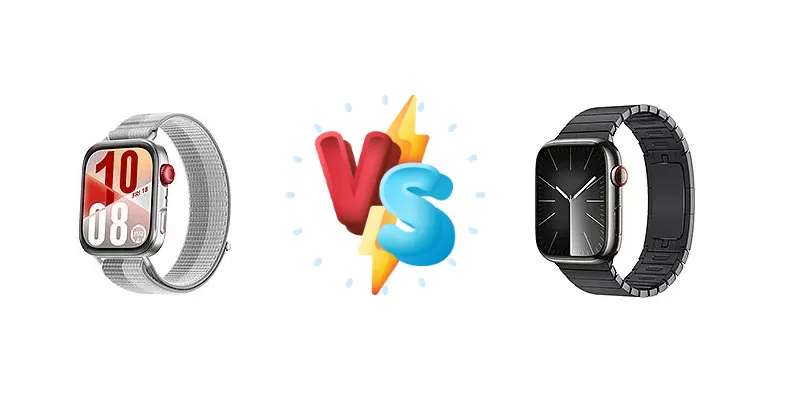
The smartwatch market offers a spectrum of choices, from feature-rich powerhouses to streamlined fitness trackers. We pit the Huawei Watch Fit 4, a competitively priced option focused on activity tracking, against the Apple Watch Series 9, the established leader in the premium smartwatch space. This comparison will dissect their core capabilities to determine which device delivers the best value and functionality for different user profiles.
🏆 Quick Verdict
For the average user prioritizing comprehensive health tracking, seamless ecosystem integration, and a polished user experience, the Apple Watch Series 9 is the superior choice. However, the Huawei Watch Fit 4 presents a compelling alternative for budget-conscious consumers primarily focused on fitness tracking and basic smartwatch features.
| Network |
|---|
| 2G bands | N/A | GSM 850 / 900 / 1800 / 1900 |
| 3G bands | N/A | HSDPA 850 / 900 / 1700(AWS) / 1900 / 2100 - International, China, HK |
| 4G bands | N/A | 1, 2, 3, 4, 5, 6, 7, 8, 18, 19, 20, 25, 26, 28, 39, 40, 41, 66 - International, China, HK |
| EDGE | No | - |
| GPRS | No | - |
| Speed | No | HSPA, LTE |
| Technology | No cellular connectivity | GSM / HSPA / LTE |
| Launch |
|---|
| Announced | 2025, May 15 | 2023, September 12 |
| Status | Available. Released 2025, May 26 | Available. Released 2023, September 22 |
| Body |
|---|
| Build | Glass front, aluminum alloy frame, plastic back | Sapphire crystal front, ceramic/sapphire crystal back, stainless steel frame |
| Dimensions | 43 x 38 x 9.5 mm (1.69 x 1.50 x 0.37 in) | 45 x 38 x 10.7 mm (1.77 x 1.50 x 0.42 in) |
| SIM | No | eSIM |
| Weight | 27 g (0.95 oz) | 42.3 g (41mm), 51.5 g (45mm) (1.48 oz) |
| Display |
|---|
| Protection | - | Sapphire crystal glass |
| Resolution | 480 x 408 pixels (~347 ppi density) | 484 x 396 pixels (~326 ppi density) |
| Size | 1.82 inches | 1.9 inches |
| Type | AMOLED, 2000 nits (peak) | Retina LTPO OLED, 2000 nits (peak) |
| Platform |
|---|
| CPU | - | Dual-core |
| Chipset | - | Apple S9 |
| GPU | - | PowerVR |
| OS | - | watchOS 10, upgradable to watchOS 26.1 |
| Memory |
|---|
| Call records | No | - |
| Card slot | No | No |
| Internal | Unspecified | 64GB |
| Phonebook | No | - |
| Sound |
|---|
| 35mm jack | No | No |
| Loudspeaker | Yes | Yes |
| Comms |
|---|
| Bluetooth | 5.2, LE | 5.3, A2DP, LE |
| NFC | Yes (gray model only) | Yes |
| Positioning | GPS (L1+L5), GALILEO (E1+E5a), QZSS (L1+L5), BDS (B1l+B1C), GLONASS | GPS, GLONASS, GALILEO, QZSS, BDS |
| Radio | No | No |
| USB | No | No |
| WLAN | No | Wi-Fi 802.11 b/g/n, dual-band |
| Features |
|---|
| Games | No | - |
| Java | No | - |
| Messaging | Email, IM | - |
| Sensors | Accelerometer, gyro, heart rate, SpO2, compass, barometer | Accelerometer, gyro, heart rate, barometer, always-on altimeter, compass, SpO2, VO2max, temperature (body) |
| Battery |
|---|
| Charging | 5W wireless | Wireless, 0-80% in 45 min |
| Type | Li-Ion 400 mAh | Li-Ion 308 mAh |
| Misc |
|---|
| Colors | Black, Silver | Graphite, Silver, Gold, Red |
| Models | SYA-B19 | A2982, A2984, A2983, A2985, Watch7,3, Watch7,4 |
| Price | € 109.00 / $ 140.75 | About 630 EUR |
| SAR | - | 1.02 W/kg (head) |
| SAR EU | - | 0.64 W/kg (head) |
Huawei Watch Fit 4
- More affordable price point
- Potentially longer battery life
- Focus on core fitness tracking features
- Less powerful processor
- Limited app ecosystem
- Slower charging speed
Apple Watch Series 9
- Powerful Apple S9 chipset
- Extensive app ecosystem
- Faster charging capabilities
- Higher price tag
- Potentially shorter battery life
- Requires iPhone for full functionality
Display Comparison
While display specifications aren't provided for the Huawei Watch Fit 4, its market positioning suggests an AMOLED panel, likely prioritizing efficiency over peak brightness. The Apple Watch Series 9, though lacking specific brightness data, benefits from Apple’s display calibration expertise, ensuring excellent visibility. The Series 9’s potential for LTPO technology, common in Apple Watches, would dynamically adjust the refresh rate for power savings, a feature likely absent in the Fit 4. Bezels are expected to be more prominent on the Fit 4 to maintain its lower price point.
Camera Comparison
Neither device features a camera, focusing instead on core smartwatch and fitness tracking functionalities. This is a common trend in modern smartwatches, prioritizing battery life and form factor over camera integration.
Performance
The Apple Watch Series 9’s dual-core Apple S9 chipset represents a significant performance advantage over the Huawei Watch Fit 4, which lacks detailed processor information. The S9’s architecture allows for faster app loading, smoother animations, and more complex background processing. While the Fit 4 likely utilizes a power-efficient chipset for extended battery life, it won’t match the responsiveness of the Series 9. The Series 9’s RAM speed (likely LPDDR5x) further contributes to its superior multitasking capabilities. Thermal management is also likely superior on the Apple Watch due to its more sophisticated design.
Battery Life
The Huawei Watch Fit 4 utilizes 5W wireless charging, suggesting a slower charging speed compared to the Apple Watch Series 9’s wireless charging capability, which achieves 0-80% in 45 minutes. While the Fit 4 likely boasts a longer overall battery life due to its simpler feature set and less powerful processor, the Series 9’s faster charging mitigates the impact of its higher power consumption. The actual 0-100% time for the Fit 4 is expected to be significantly longer than the Series 9.
Buying Guide
Buy the Huawei Watch Fit 4 if you need a dedicated fitness tracker with essential smartwatch features at an accessible price point, and aren't heavily invested in the Apple ecosystem. Buy the Apple Watch Series 9 if you prioritize advanced health monitoring, a robust app ecosystem, seamless iPhone integration, and are willing to pay a premium for a refined smartwatch experience.
Frequently Asked Questions
❓ How does the Apple Watch Series 9’s S9 chip impact real-world performance compared to the Huawei Watch Fit 4?
The Apple S9 chip provides a substantial performance boost, enabling faster app loading, smoother animations, and more responsive interactions. The Fit 4, lacking detailed processor specs, will likely exhibit noticeable lag when handling complex tasks or running multiple apps simultaneously. This difference is particularly noticeable when using third-party applications.
❓ Is the slower 5W charging of the Huawei Watch Fit 4 a significant drawback compared to the Apple Watch Series 9’s faster charging?
While the Fit 4’s 5W charging is slower, it’s less of a concern if you’re comfortable charging the device overnight. However, if you frequently need a quick top-up, the Series 9’s ability to reach 80% charge in 45 minutes is a significant advantage. The difference in charging speed is most noticeable during short charging windows.
❓ Does the Apple Watch Series 9 require an iPhone to function, and how does this impact usability for Android users?
Yes, the Apple Watch Series 9 is designed to work seamlessly within the Apple ecosystem and requires an iPhone for initial setup and full functionality. Android users will not be able to use the Apple Watch Series 9. The Huawei Watch Fit 4 is compatible with both Android and iOS devices, offering broader accessibility.