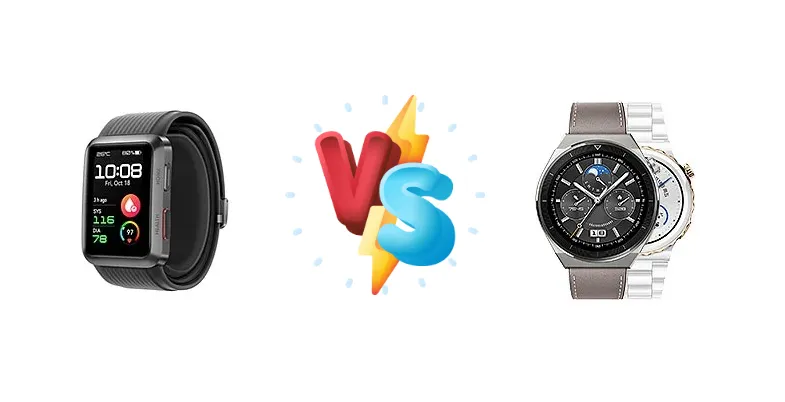
Huawei continues to push boundaries in the wearable tech space. The Watch D introduces groundbreaking health monitoring, while the GT 3 Pro refines the premium smartwatch experience. But which one deserves a spot on your wrist? This comprehensive comparison breaks down the key differences.
🏆 Quick Verdict
The Watch D excels in health tracking, particularly blood glucose monitoring, making it ideal for those needing proactive health management. The GT 3 Pro offers a more refined design, longer battery life, and broader smartwatch features. Ultimately, the choice depends on your priorities: health or premium features.
| Network |
|---|
| 2G bands | N/A | N/A |
| 3G bands | N/A | N/A |
| 4G bands | N/A | N/A |
| EDGE | No | No |
| GPRS | No | No |
| Speed | No | No |
| Technology | No cellular connectivity | No cellular connectivity |
| Launch |
|---|
| Announced | 2022, May 18 | 2022, April 28 |
| Status | Available. Released 2022, October 12 | Available. Released 2022, May 05 |
| Body |
|---|
| Build | Glass front, aluminum frame | Sapphire crystal front, titanium frame or ceramic frame, ceramic back |
| Dimensions | 51 x 38 x 13.6 mm (2.01 x 1.50 x 0.54 in) | 46.6 x 46.6 x 10.9 mm (1.83 x 1.83 x 0.43 in) |
| SIM | No | No |
| Weight | 40.9 g (1.45 oz) | 50 g (43mm) / 54 g (46mm) (1.76 oz) |
| | IP68
Blood Pressure Measurement & ECG with built-in pump & inflatable strap | 30m water resistant
5 ATM
IP68
Compatible with standard 22mm straps (46mm model), 20mm straps (43mm model)
ECG certified |
| Display |
|---|
| Resolution | 456 x 280 pixels (~326 ppi density) | 466 x 466 pixels (~326 ppi density) |
| Size | 1.64 inches | 1.43 inches |
| Type | AMOLED | AMOLED |
| Platform |
|---|
| OS | HarmonyOS 2.1 | HarmonyOS 2.0, upgradable to 3.0 |
| Memory |
|---|
| Card slot | No | No |
| Internal | 4GB | 32GB |
| Sound |
|---|
| 3.5mm jack | No | No |
| 35mm jack | No | No |
| Loudspeaker | No | Yes |
| Comms |
|---|
| Bluetooth | 5.1, LE | 5.2, A2DP, LE |
| NFC | Yes (market/region dependent) | Yes |
| Positioning | GPS | GPS (L1+L5), GLONASS, BDS, GALILEO, QZSS |
| Radio | No | No |
| USB | No | No |
| WLAN | No | No |
| Features |
|---|
| Sensors | Accelerometer, gyro, heart rate, SpO2, thermometer (skin temperature), differential pressure sensor | Accelerometer, gyro, heart rate, barometer, compass, SpO2, thermometer (body temperature) |
| Battery |
|---|
| Charging | 3.5W wireless | Wireless |
| Type | Li-Ion 451 mAh | Li-Po 530 mAh |
| Misc |
|---|
| Colors | Graphite Black | Silver |
| Models | MLY-B10, MLY-B11, MLY-B19 | ODN-B19, FRG-B19 |
| Price | About 350 EUR | About 200 EUR |
Huawei Watch D
- Revolutionary blood glucose monitoring
- Advanced health tracking features
- Clear and functional display
- Stylish design
- Shorter battery life compared to GT 3 Pro
- Limited app ecosystem compared to Wear OS
- Charging speed is slower (3.5W)
Huawei Watch GT 3 Pro
- Premium design and build quality (sapphire glass)
- Longer battery life
- Comprehensive fitness tracking
- Elegant watch faces
- Wireless charging
- Lacks the groundbreaking health features of the Watch D
- App ecosystem still limited
- Can be pricier than the Watch D
Display Comparison
The GT 3 Pro boasts a more premium display, often featuring sapphire glass and a brighter AMOLED panel. The Watch D's display is functional and clear, but may not offer the same level of vibrancy or scratch resistance. Expect sharper visuals and more customizable watch faces on the GT 3 Pro.
Camera Comparison
Neither watch features a dedicated camera. This is a common omission in smartwatches, and users will rely on their smartphones for photography.
Performance
Both watches utilize Huawei's HarmonyOS, offering smooth navigation and app access. The GT 3 Pro might have a slight edge in responsiveness due to potentially more optimized hardware, but both provide a generally fluid user experience. App availability remains a consideration for both.
Battery Life
The GT 3 Pro generally offers significantly longer battery life, often lasting 7-14 days depending on usage. The Watch D's battery life is shorter, typically around 3-7 days, impacted by its more intensive health monitoring features.
Buying Guide
The Huawei Watch D is perfect for individuals prioritizing advanced health monitoring, especially those managing diabetes or seeking proactive health insights. The Huawei Watch GT 3 Pro is best suited for users who value premium design, longer battery life, comprehensive fitness tracking, and a more traditional smartwatch experience.
Frequently Asked Questions
❓ Does the Huawei Watch D require finger pricks for blood glucose monitoring?
No, the Watch D utilizes non-invasive optical technology to estimate blood glucose levels. However, it's crucial to note that it's an estimation and should not replace traditional blood glucose monitoring methods recommended by a healthcare professional.
❓ Are the Huawei Watch D and GT 3 Pro compatible with iOS devices?
While both watches offer Bluetooth connectivity, full functionality and app support are primarily optimized for Android devices. iOS compatibility is limited.