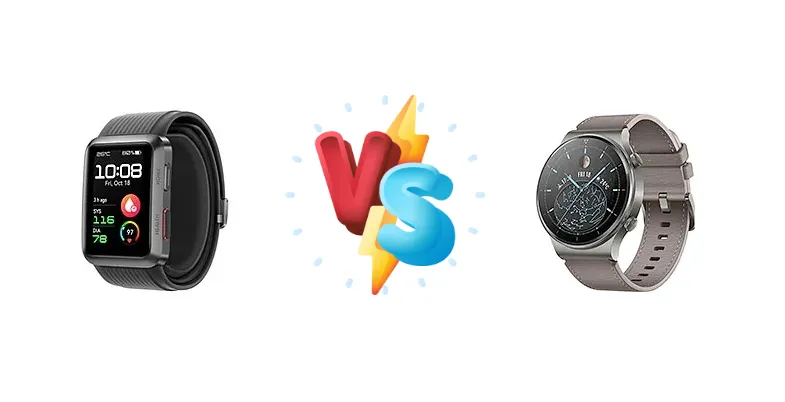
Huawei has established itself as a strong contender in the smartwatch market. The Watch D focuses on advanced health monitoring, particularly blood glucose tracking, while the GT 2 Pro offers a more premium design and broader feature set. Let's dive into a comprehensive comparison to help you decide which one is right for you.
🏆 Quick Verdict
The Huawei Watch D excels in health tracking, especially with its non-invasive blood glucose monitoring. However, the GT 2 Pro boasts a more refined design, a faster Kirin A1 chipset, and a wider range of sports modes. For health-focused users, the D wins; for style and performance, the GT 2 Pro takes the lead.
| Network |
|---|
| 2G bands | N/A | N/A |
| 3G bands | N/A | N/A |
| 4G bands | N/A | N/A |
| EDGE | No | No |
| GPRS | No | No |
| Speed | No | No |
| Technology | No cellular connectivity | No cellular connectivity |
| Launch |
|---|
| Announced | 2022, May 18 | 2020, September 10. Released 2020, October 05 |
| Status | Available. Released 2022, October 12 | Discontinued |
| Body |
|---|
| Build | Glass front, aluminum frame | Glass front (Sapphire crystal), ceramic back, titanium frame |
| Dimensions | 51 x 38 x 13.6 mm (2.01 x 1.50 x 0.54 in) | 46.7 x 46.7 x 11.4 mm (1.84 x 1.84 x 0.45 in) |
| SIM | No | No |
| Weight | 40.9 g (1.45 oz) | 52 g (1.83 oz) |
| | IP68
Blood Pressure Measurement & ECG with built-in pump & inflatable strap | 50m water resistant
Compatible with standard 22mm straps |
| Display |
|---|
| Resolution | 456 x 280 pixels (~326 ppi density) | 454 x 454 pixels (~326 ppi density) |
| Size | 1.64 inches | 1.39 inches |
| Type | AMOLED | AMOLED |
| Platform |
|---|
| Chipset | - | Kirin A1 |
| OS | HarmonyOS 2.1 | Huawei Lite OS |
| Memory |
|---|
| Card slot | No | No |
| Internal | 4GB | 4GB 32MB RAM |
| | - | eMMC |
| Sound |
|---|
| 3.5mm jack | No | No |
| 35mm jack | No | No |
| Loudspeaker | No | Yes |
| Comms |
|---|
| Bluetooth | 5.1, LE | 5.1, LE, EDR |
| NFC | Yes (market/region dependent) | Yes (China only) |
| Positioning | GPS | GPS, GLONASS, GALILEO |
| Radio | No | No |
| USB | No | No |
| WLAN | No | No |
| Features |
|---|
| Sensors | Accelerometer, gyro, heart rate, SpO2, thermometer (skin temperature), differential pressure sensor | Accelerometer, gyro, heart rate, barometer, compass, SpO2, VO2max |
| Battery |
|---|
| Charging | 3.5W wireless | Wireless |
| Type | Li-Ion 451 mAh | Li-Ion 455 mAh |
| Misc |
|---|
| Colors | Graphite Black | Night Black, Nebula Gray |
| Models | MLY-B10, MLY-B11, MLY-B19 | VID-B19 |
| Price | About 350 EUR | About 140 EUR |
Huawei Watch D
- Non-invasive blood glucose monitoring
- Excellent health tracking features
- Clear and functional display
- Good value for health-focused users
- Slightly less premium design
- Performance can be sluggish at times
- Battery life impacted by continuous glucose monitoring
- Limited third-party app support
Huawei Watch GT 2 Pro
- Premium design and build quality
- Faster Kirin A1 chipset
- Longer battery life
- Wide range of sports modes
- Elegant and customizable watch faces
- Lacks non-invasive blood glucose monitoring
- Can be more expensive
- Limited third-party app support
- Health tracking features not as specialized as Watch D
Display Comparison
Both watches feature AMOLED displays, offering vibrant colors and excellent clarity. The GT 2 Pro might have a slightly more premium feel due to its ceramic or titanium case options, while the Watch D prioritizes functionality and ease of use for health data visualization.
Camera Comparison
Neither watch has a built-in camera. This is a common omission in smartwatches, and users will need to rely on their smartphones for capturing photos and videos.
Performance
The GT 2 Pro's Kirin A1 chipset provides noticeably smoother performance and faster app loading times compared to the Watch D. This translates to a more responsive user experience, especially when navigating menus and using third-party apps. The Watch D's performance is adequate for its core health tracking functions.
Battery Life
Battery life is a key consideration. The GT 2 Pro generally offers longer battery life (around 14 days with typical use) compared to the Watch D (around 7-10 days). However, the Watch D's continuous blood glucose monitoring can significantly impact battery performance.
Buying Guide
The Huawei Watch D is ideal for individuals prioritizing health monitoring, particularly those managing diabetes or seeking proactive health insights. The Huawei Watch GT 2 Pro is a better choice for users who value premium design, performance, and a broader range of fitness tracking features, and don't require the unique blood glucose monitoring.
Frequently Asked Questions
❓ Does the Huawei Watch D require finger pricks for blood glucose monitoring?
No, the Watch D uses non-invasive optical technology to estimate blood glucose levels. However, it's crucial to note that it's an estimation and should not replace traditional blood glucose monitoring methods recommended by your doctor.
❓ Can I use the Huawei Watch GT 2 Pro for contactless payments?
Yes, the GT 2 Pro supports Huawei Pay in regions where it's available. However, compatibility may vary depending on your bank and location.