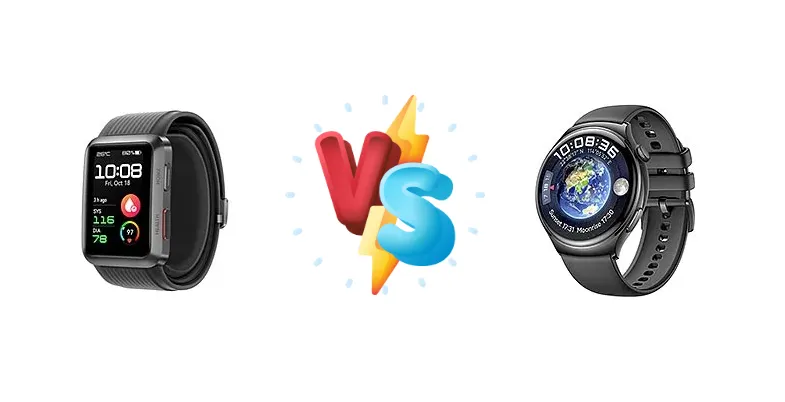
Huawei continues to push boundaries in the wearable tech space. The Watch D, with its unique health monitoring capabilities, faces off against the newer Watch 4, boasting a powerful processor and refined design. Let's dive into a comprehensive comparison to help you choose the perfect smartwatch for your needs.
🏆 Quick Verdict
The Huawei Watch 4 takes the crown for overall performance and a more modern experience thanks to its Snapdragon W5 Gen 1 chipset. However, the Watch D's standout health features, particularly its blood glucose monitoring, make it a compelling choice for those prioritizing health tracking above all else.
| Network |
|---|
| 2G bands | N/A | N/A |
| 3G bands | N/A | HSDPA 850 / 900 / 1800 / 1900 / 2100 / 800 |
| 4G bands | N/A | LTE |
| EDGE | No | - |
| GPRS | No | - |
| Speed | No | HSPA, LTE |
| Technology | No cellular connectivity | HSPA / LTE |
| Launch |
|---|
| Announced | 2022, May 18 | 2023, May 10 |
| Status | Available. Released 2022, October 12 | Available. Released 2023, June 22 |
| Body |
|---|
| Build | Glass front, aluminum frame | Glass front, ceramic back, stainless steel frame |
| Dimensions | 51 x 38 x 13.6 mm (2.01 x 1.50 x 0.54 in) | 46.2 x 46.2 x 10.9 mm (1.82 x 1.82 x 0.43 in) |
| SIM | No | eSIM |
| Weight | 40.9 g (1.45 oz) | 48 g (1.69 oz) |
| | IP68
Blood Pressure Measurement & ECG with built-in pump & inflatable strap | 50m water resistant
5 ATM
Compatible with standard 22mm straps |
| Display |
|---|
| Resolution | 456 x 280 pixels (~326 ppi density) | 466 x 466 pixels (~310 ppi density) |
| Size | 1.64 inches | 1.5 inches |
| Type | AMOLED | AMOLED |
| | - | * the display resolution is unconfirmed
Always-on display |
| Platform |
|---|
| CPU | - | Quad-core 1.7 GHz Cortex-A53 |
| Chipset | - | Qualcomm Snapdragon W5 Gen 1 (4 nm) |
| GPU | - | Adreno 702 |
| OS | HarmonyOS 2.1 | HarmonyOS 3.0 |
| Memory |
|---|
| Card slot | No | No |
| Internal | 4GB | 32GB 2GB RAM |
| Sound |
|---|
| 3.5mm jack | No | No |
| 35mm jack | No | No |
| Loudspeaker | No | Yes |
| Comms |
|---|
| Bluetooth | 5.1, LE | 5.2, A2DP, LE |
| NFC | Yes (market/region dependent) | Yes |
| Positioning | GPS | GPS, GLONASS, BDS, GALILEO, QZSS |
| Radio | No | No |
| USB | No | No |
| WLAN | No | Wi-Fi 802.11 b/g/n (market/region dependent) |
| Features |
|---|
| Sensors | Accelerometer, gyro, heart rate, SpO2, thermometer (skin temperature), differential pressure sensor | Accelerometer, gyro, heart rate, barometer, compass, SpO2, thermometer (body temperature) |
| Battery |
|---|
| Charging | 3.5W wireless | Wireless |
| Type | Li-Ion 451 mAh | Li-Ion 530 mAh |
| Misc |
|---|
| Colors | Graphite Black | Black |
| Models | MLY-B10, MLY-B11, MLY-B19 | ARC-AL00 |
| Price | About 350 EUR | About 450 EUR |
Huawei Watch D
- Unique blood glucose monitoring
- Comprehensive health tracking
- Durable design
- Good battery life (without constant glucose monitoring)
- Slower performance
- Less refined user interface
- Charging speed is slow (3.5W)
- Design may not appeal to everyone
Huawei Watch 4
- Fast and responsive performance (Snapdragon W5 Gen 1)
- Sleek and modern design
- Excellent fitness tracking features
- Bright and vibrant display
- Blood glucose monitoring absent
- Battery life slightly shorter than Watch D (with heavy use)
- Wireless charging only (no fast charging)
Display Comparison
Both watches feature AMOLED displays, offering vibrant colors and excellent clarity. The Watch 4 likely has a slightly higher resolution and potentially a brighter display, contributing to a more immersive viewing experience. The Watch D's display is functional and clear, but may not be as visually stunning.
Camera Comparison
Neither watch has a built-in camera. This is a common omission in smartwatches, and users will need to rely on their smartphones for capturing photos and videos.
Performance
The Watch 4's Qualcomm Snapdragon W5 Gen 1 chipset provides a significant performance advantage over the Watch D. Expect faster app loading times, smoother animations, and a more responsive user interface on the Watch 4. The Watch D's performance is adequate for basic smartwatch functions, but can feel sluggish at times.
Battery Life
Battery life is a key consideration. While both offer decent battery life, the Watch 4's more efficient chipset likely translates to slightly longer usage between charges. The Watch D's health monitoring features, particularly continuous glucose monitoring, can impact battery life more significantly.
Buying Guide
The Huawei Watch D is ideal for users heavily invested in health monitoring, especially those interested in non-invasive blood glucose tracking. The Huawei Watch 4 is better suited for those seeking a faster, smoother smartwatch experience with a focus on fitness tracking and a more contemporary design.
Frequently Asked Questions
❓ Does the Huawei Watch D require calibration for blood glucose monitoring?
Yes, the Watch D requires occasional calibration using a traditional blood glucose meter to ensure accuracy. Follow the manufacturer's instructions for proper calibration procedures.
❓ Is the Huawei Watch 4 compatible with iOS devices?
While the Huawei Watch 4 offers improved iOS compatibility compared to previous models, functionality may be limited compared to Android devices. Some features may not be available on iOS.