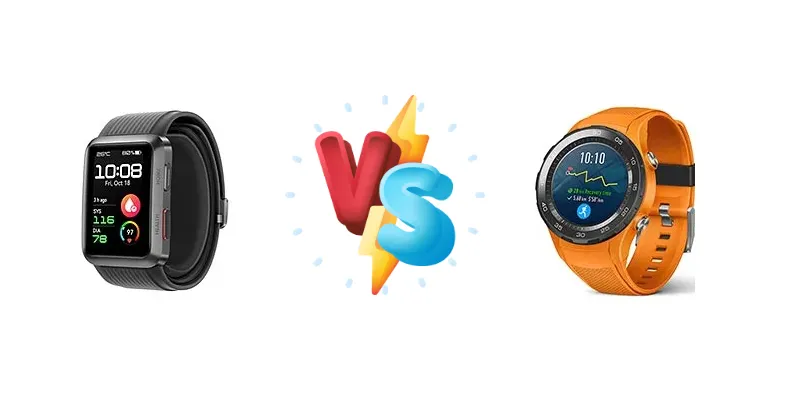
Huawei's smartwatch lineup offers compelling options, but choosing between the Watch D and Watch 2 can be tricky. Both devices boast unique features and cater to different user preferences. This comprehensive comparison will dissect their strengths and weaknesses to help you make an informed decision.
🏆 Quick Verdict
The Huawei Watch 2 takes the crown for overall performance thanks to its Snapdragon Wear 2100 chipset and faster charging. However, the Watch D's focus on health monitoring, particularly blood glucose tracking, makes it a strong contender for health-conscious users. It depends on your priorities!
| Network |
|---|
| 2G bands | N/A | GSM 900 / 1800 |
| 3G bands | N/A | HSDPA 900 / 1900 / 2100 |
| 4G bands | N/A | 1, 3, 7, 8, 39, 41 |
| EDGE | No | - |
| GPRS | No | - |
| Speed | No | HSPA, LTE |
| Technology | No cellular connectivity | GSM / HSPA / LTE |
| Launch |
|---|
| Announced | 2022, May 18 | 2017, February. Released 2017, April |
| Status | Available. Released 2022, October 12 | Discontinued |
| Body |
|---|
| Build | Glass front, aluminum frame | - |
| Dimensions | 51 x 38 x 13.6 mm (2.01 x 1.50 x 0.54 in) | 48.9 x 45 x 12.6 mm (1.93 x 1.77 x 0.50 in) |
| SIM | No | Nano-SIM |
| Weight | 40.9 g (1.45 oz) | 57 g (2.01 oz) |
| | IP68
Blood Pressure Measurement & ECG with built-in pump & inflatable strap | IP68 dust/water resistant (up to 1.5m for 30 mins)
Compatible with standard 20mm straps |
| Display |
|---|
| Protection | - | Corning Gorilla Glass (unspecified version) |
| Resolution | 456 x 280 pixels (~326 ppi density) | 390 x 390 pixels (~326 ppi density) |
| Size | 1.64 inches | 1.2 inches |
| Type | AMOLED | OLED |
| Platform |
|---|
| CPU | - | Quad-core 1.1 GHz Cortex-A7 |
| Chipset | - | Qualcomm MSM8909W Snapdragon Wear 2100 |
| GPU | - | Adreno 304 |
| OS | HarmonyOS 2.1 | Android Wear OS 2.1 |
| Memory |
|---|
| Card slot | No | No |
| Internal | 4GB | 4GB 768MB RAM |
| | - | eMMC 4.5 |
| Sound |
|---|
| 3.5mm jack | No | No |
| 35mm jack | No | No |
| Loudspeaker | No | Yes |
| Comms |
|---|
| Bluetooth | 5.1, LE | 4.1, LE, EDR |
| NFC | Yes (market/region dependent) | Yes |
| Positioning | GPS | GPS, GLONASS |
| Radio | No | No |
| USB | No | No |
| WLAN | No | Wi-Fi 802.11 b/g/n (market/region dependent) |
| Features |
|---|
| Sensors | Accelerometer, gyro, heart rate, SpO2, thermometer (skin temperature), differential pressure sensor | Accelerometer, gyro, heart rate, barometer, compass |
| Battery |
|---|
| Charging | 3.5W wireless | 10W wired |
| Type | Li-Ion 451 mAh | Li-Ion 420 mAh, non-removable |
| Misc |
|---|
| Colors | Graphite Black | Dynamic Orange, Carbon Black, Concrete Grey |
| Models | MLY-B10, MLY-B11, MLY-B19 | - |
| Price | About 350 EUR | About 180 EUR |
Huawei Watch D
- Advanced health tracking (blood glucose)
- Vibrant AMOLED display
- Sleek design
- Potentially longer battery life (depending on usage)
- Slower charging (3.5W wireless)
- Likely less powerful processor
- May lack camera
- Potentially limited app ecosystem
Huawei Watch 2
- Powerful Snapdragon Wear 2100 chipset
- Faster 10W wired charging
- Built-in camera
- Smoother user experience
- More versatile app ecosystem
- Potentially shorter battery life
- Health tracking may be less advanced than Watch D
- Design might be less unique
Display Comparison
The Watch D features a vibrant AMOLED display, likely with a focus on clarity for health data visualization. The Watch 2 also uses AMOLED, but its display might be slightly larger and more versatile for app interactions. We'll assess brightness, color accuracy, and readability in various lighting conditions.
Camera Comparison
The Watch 2 is expected to have a built-in camera, offering convenient photo and video capture on the go. The Watch D likely omits a camera to prioritize health sensors and battery life. We'll evaluate the Watch 2's camera quality and usability.
Performance
Here's where the Watch 2 shines. Its Snapdragon Wear 2100 chipset provides significantly better performance than the Watch D's likely less powerful processor. Expect smoother animations, faster app loading times, and a more responsive user interface on the Watch 2. The Watch D might feel slightly sluggish in comparison.
Battery Life
The Watch 2's 10W wired charging is a major advantage, offering significantly faster charging times compared to the Watch D's 3.5W wireless charging. Battery life will also be compared, considering typical usage scenarios and power consumption of each device.
Buying Guide
The Huawei Watch D is ideal for individuals prioritizing advanced health tracking, especially those interested in non-invasive blood glucose monitoring. The Huawei Watch 2 is better suited for users who value performance, a smoother user experience, and faster charging speeds, and appreciate a more traditional smartwatch design.
Frequently Asked Questions
❓ Does the Huawei Watch D require calibration for blood glucose monitoring?
Yes, the Huawei Watch D requires calibration using a traditional blood glucose meter for accurate readings. It's not a replacement for medical devices.
❓ Is the Huawei Watch 2 compatible with iOS devices?
While Huawei smartwatches generally offer some iOS compatibility, full functionality might be limited compared to Android devices. Check Huawei's official website for the latest compatibility information.